
In the world of survival tools, rescue knives have positioned themselves as an indispensable element, especially for drivers, emergency professionals, and anyone who wants to be prepared. But what exactly do they offer and are they as effective as they promise?
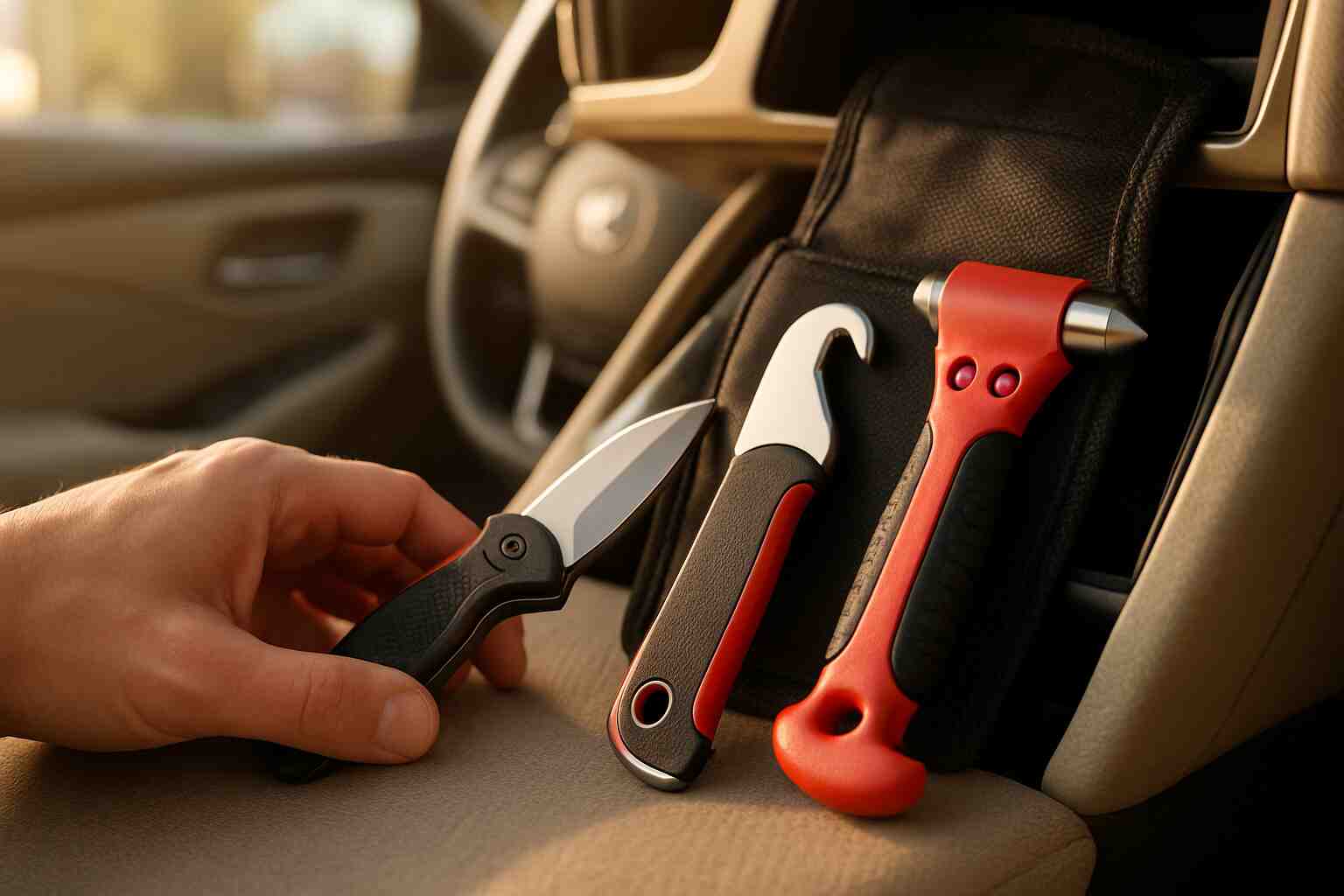
We all wish to avoid traffic accidents, but the reality is that any driver can be involved in one. In those critical moments, having the right tools can make the difference between a desperate situation and a successful self-rescue, or even the possibility of helping others. Therefore, carrying a glass breaker and a seatbelt cutter in your vehicle is not a fantasy, but a measure of essential preparation.
Think of a situation like a friend’s: one rainy night, his car skidded and ended up in a ditch with water. Fortunately, it didn’t overturn. But in the darkness and solitude of the road, the vital need for an emergency kit in the car became evident, including, of course, a rescue tool. Without a glass breaker, getting out of that situation would have been extremely difficult.
These tools, often compact and designed for extreme situations, integrate two key elements: a seatbelt cutter and a glass breaker. Their objective is clear: to facilitate a quick and safe exit from a vehicle in case of an accident.
The main question many people ask is: do they really work? To answer this question, it is essential to understand the engineering behind their components, the materials used, and, above all, the use scenarios in which they demonstrate their value. Throughout this article, we will break down each of their parts, analyze their effectiveness in real situations, and offer you a complete guide so you can decide if one of these knives is the right tool for you.
Why are these rescue tools so crucial?
Contents
- Why are these rescue tools so crucial?
- What is a rescue knife?
- Types of Rescue Tools for Your Car
- Effectiveness of the glass breaker: How does it work?
- Analysis of the seatbelt cutter: safety and speed
- Are they everyday knives or just for emergencies?
- Key features to look for in a rescue tool
- Types of rescue knives and buying recommendations
- A Crucial Legal Consideration
In an accident, doors can get blocked or seatbelts can get stuck, preventing a quick exit. In those critical moments, every second counts. A combined rescue tool allows you to cut the seatbelt and break a window in a matter of seconds, facilitating the evacuation of the vehicle for yourself or to help other occupants. Foresight is key to being able to act effectively when it matters most.
What is a rescue knife?
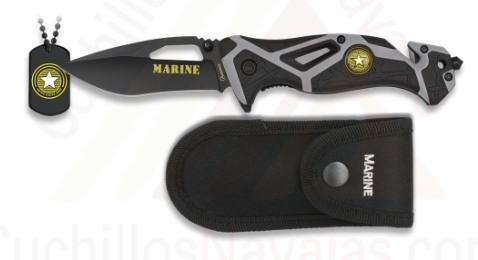
A rescue knife, also known as an emergency knife or tactical emergency knife, is a multi-purpose tool designed specifically for dangerous situations, mainly in automotive environments. Unlike a conventional knife, its purpose is not general cutting, but to offer life-saving functionalities. Its distinctive features are:
- Blade with partial or serrated edge: The main blade is usually made of high-quality stainless steel, with a design that often includes a mixed edge (smooth and serrated) for cutting different types of materials, from clothing to ropes or plastics.
- Seatbelt cutter: This is a small notch with a hidden blade inside, usually located at the bottom or back of the knife. Its design protects the user and the person being helped from accidental cuts while sectioning the seatbelt. It is one of the most crucial features, as a stuck seatbelt can be a fatal obstacle.
- Glass breaker: It is a tungsten carbide tip or a hardened steel striker, located at the end of the handle. Its function is to concentrate all the impact force on a tiny point of the glass, causing it to break into small, non-sharp fragments, minimizing the risk of cuts.
- Pocket clip or sheath: Many rescue knives include a robust clip to carry it securely in your pocket, or a sheath that allows it to be transported on a belt or in a vehicle compartment, ensuring it is always at hand.
The versatility of these tools makes them useful not only for professionals such as firefighters or paramedics, but also for any driver who wants to be prepared for the unexpected.
Types of Rescue Tools for Your Car
There are various options on the market, each with its peculiarities:
The Emergency Hammer with Seatbelt Cutter
This is the type of hammer you may have seen in public transport. When choosing one, it is essential to ensure that the hammer body is a single continuous steel bar, from tip to tip, instead of separate pieces with plastic in the middle, which guarantees its strength and durability. The seatbelt cutter is usually integrated into the base of the hammer, with a protected blade to prevent accidental cuts. Its design allows only the belt to pass through the slot, guiding the cut safely and efficiently.
- A tip when using it: To prevent the belt fabric from bending, it is best to make the cut diagonally.
- An additional advantage of the hammer is that, once the glass is broken, you can use it to clear the remaining pieces from the window, making the exit safer.
The Rescue Keychain
These compact devices are a very popular option due to their small size and ease of transport. Many models are copies of famous designs and easily attach to your car keys.
Rescue Keychain Glass Breaker
They incorporate a push-button mechanism that, when pushed firmly against the glass, releases a small steel tip with a spring. This tip strikes the glass with concentrated force, breaking it into small pieces without the tip flying off. They are safe, as the tip barely protrudes, even if pressed against the skin.
Rescue Keychain Seatbelt Cutter
To access the blade, simply pull a ring or extract a clip from the device. As with the hammer, cutting the belt diagonally is the most effective way to prevent jamming.
Its main benefit is that, despite its small size, its usefulness can save lives and its discreet appearance does not identify its safety function. Furthermore, from a legal point of view, they are usually easier to carry than a hammer.
Other Tools with Integrated Functions
The market offers a variety of multi-purpose tools that incorporate rescue functions:
- Tactical Pens: These are metal pens that end in a tip designed to break glass. They are often confused with self-defense tools, but their shallow cone is designed to break glass without being a danger to your personal belongings if you carry it with you.
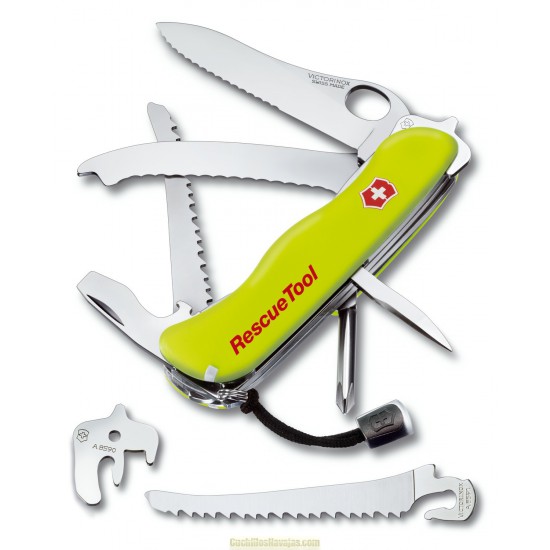
- Knives and Multi-tools: Many multi-purpose knives and other tools integrate glass breaker tips and seatbelt cutter blades. The latter can be serrated blades or “pearled” type, formed by sharp round arcs, similar to some kitchen knives.
Effectiveness of the glass breaker: How does it work?
The glass breaker is, without a doubt, the most striking feature of a rescue knife. Although its appearance may seem simple, its operation is based on very precise physics principles. Most car side windows are made of tempered glass. This type of glass is very strong on its surface, which makes it resistant to direct impacts. However, it is vulnerable to pressure at specific points.
This is where the glass breaker comes in. The tungsten carbide tip, an extremely hard material, concentrates a large amount of force on a very small area. By striking the window with this tip, a micro-fracture is created that unbalances the internal tension of the tempered glass, causing it to instantly disintegrate into hundreds of small fragments. It is important to remember that this technique is only effective on side windows. The windshield, being laminated glass, is designed not to break in this way.
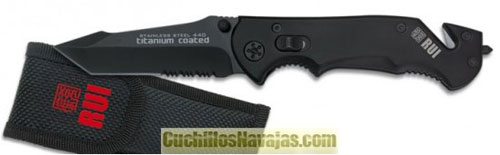
For it to work correctly, the blow must be firm and precise, generally in one of the corners of the glass, where the tension is greater. Superhuman strength is not needed, but rather the correct technique. The rescue knife provides the perfect tool to apply that force in a concentrated and effective way.
Analysis of the seatbelt cutter: safety and speed
The seatbelt cutter is the second big star of these knives. Its design is crucial for safety. Since the blade is recessed in a slot, the risk of accidentally cutting the skin or injuring the rescued person is practically nil. To use it, simply slide the seatbelt cutter part under the seatbelt strap and pull firmly. The sharp, curved blade sections the material with surprising ease.
Speed is key in an emergency situation, and a seatbelt cutter integrated into a rescue knife offers a quick and effective solution. In an overturned or submerged vehicle, a stuck seatbelt can be the difference between life and death. Having a tool dedicated to this task is an undeniable advantage over trying to cut the seatbelt with a conventional knife, which could be dangerous, slow, and ineffective due to the material’s resistance.
Are they everyday knives or just for emergencies?
This is a frequent question. Most rescue knives are designed primarily for emergencies. Although their main blade is perfectly functional for everyday cutting tasks (opening boxes, cutting ropes, etc.), their additional features, such as the glass breaker or seatbelt cutter, make them bulkier and often less ergonomic for daily use than a standard pocket knife.
However, for those looking for a multi-purpose tool with extra security, a rescue knife can be an excellent option. Their strength and durability make them suitable for outdoor activities such as camping or hiking, where cutting functions and the possibility of facing unexpected situations are always welcome. The final decision will depend on whether you prioritize emergency preparedness over the convenience of an everyday knife.
Key features to look for in a rescue tool
Regardless of the type, a good rescue tool should be:
- Robust and Durable: Especially in the case of hammers, single-piece steel construction is essential.
- Safe to use: Seatbelt cutter blades must be protected to prevent accidental cuts. The glass breaker mechanism must be effective but not dangerous to the user.
- Accessible: It is vital that the tool is always securely fastened and within reach in the car so that it can be used in an emergency.
Types of rescue knives and buying recommendations
The market offers a wide variety of rescue knives, from basic models to high-end options. When choosing one, it is important to consider the following aspects:
- Blade material: Stainless steel is the standard, but the type (440C, D2, Sandvik) will influence edge retention and corrosion resistance.
- Opening mechanism: Most are manual opening with a thumb stud, but some advanced models incorporate assisted mechanisms for faster deployment.
- Handle material: The most common materials are aluminum, G-10, or carbon fiber scales. G-10, for example, offers exceptional grip even in wet conditions.
- Portability: Look at the type of pocket clip or if it includes a sheath. Accessibility is key in an emergency.
For beginners or those who just want a safety tool in their car, a basic and reliable model with a glass breaker and seatbelt cutter will be more than enough. For emergency professionals, a high-end knife with durable materials and quick opening could be a valuable investment.
Below is a comparative table of the main features you can find on the market:
| Feature | Basic Rescue Knife | Tactical/Professional Rescue Knife |
|---|---|---|
| Blade Material | Standard stainless steel (e.g., 420) | High-quality steel (e.g., 440C, D2) |
| Glass Breaker | Simple steel tip | Reinforced tungsten carbide tip |
| Seatbelt Cutter | Functional blade, sometimes not replaceable | Sharp and safe blade, sometimes replaceable |
| Opening Mechanism | Manual opening | Manual or assisted (fast) opening |
| Handle | Aluminum or simple plastics | G-10, carbon fiber, high-quality aluminum |
| Recommended Use | Occasional driver, personal emergency kit | Firefighters, paramedics, rescue professionals |
A Crucial Legal Consideration
Although these tools are freely available and designed for safety, it is essential that you review the legislation of your country or region before carrying them in your car’s cabin. What is a common retail item in a supermarket could lead to fines if you do not comply with local regulations. Inform yourself properly to avoid unnecessary legal problems while looking for a solution for your safety.
In conclusion, rescue knives with seatbelt cutters and glass breakers are much more than a simple gadget. They are tools designed with a vital purpose in mind and, if used correctly, can make a crucial difference in an emergency situation. Their effectiveness is proven, and their simplicity makes them accessible to anyone. Ensuring you have one on hand in your vehicle is a smart precaution that could save you or someone else in a moment of need. Equipping your car with a glass breaker and a seatbelt cutter is a minimal investment with incalculable life-saving potential. Preparation is your best ally against the unexpected.
VIEW MORE RESCUE KNIVES | VIEW TACTICAL AND SURVIVAL KNIVES | VIEW MULTI-PURPOSE KNIVES