Have you ever experienced the frustration of watching a knife butcher the fibers of a perfectly roasted steak, spilling its juices onto the board as the cut turns into an uneven mess? The difference between a masterful cut and a mediocre one lies not only in the diner’s technique, but in the precise choice of tool: smooth or serrated blade. This seemingly simple decision completely transforms the experience of cutting meat, determining the quality of the cut, the preservation of its texture, and the effort required for each slice.
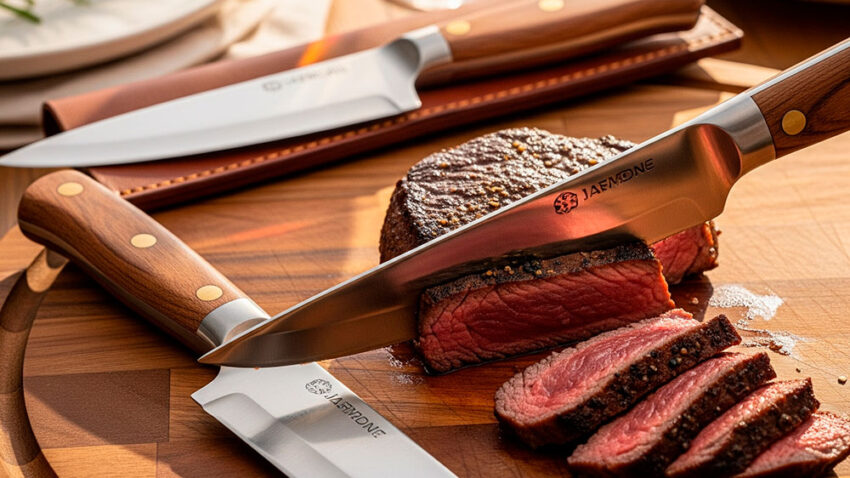
In the world of meat knives, the type of edge is neither an aesthetic whim nor a passing fashion. It is a technical decision based on the physics of cutting, the structure of meat fibers, and the interaction between steel and food. Each blade has been designed to meet specific needs: from the clean, surgical cut of a pink sirloin to the challenge of piercing a crispy crust without crushing the tender meat inside.
This article will guide you through the technical characteristics, advantages, and applications of each type of blade, providing you with the necessary knowledge to choose the right tool according to the type of meat, the cooking level, and the desired result. Because a true connoisseur of good meat knows that the experience begins long before the first bite: it starts with the correct edge in your hand.
The Art of Cutting: Why the Type of Blade Matters
Contents
- The Art of Cutting: Why the Type of Blade Matters
- Smooth Blade: Surgical Precision in Every Cut
- Serrated Blade: Grip and Efficiency for Challenging Textures
- Technical Comparison: Smooth vs. Serrated
- Combined and Scalloped Blades: The Best of Both Worlds
- High-Quality Meat Knives: What to Look For
- Maintenance and Care: Prolonging the Life of Your Tool
- Solve your doubts about meat knives: differences between smooth and serrated blades
A meat knife is not just a table utensil. It is the extension of your hand at the crucial moment that defines how you will experience each bite. The microscopic structure of muscle fibers, the arrangement of connective tissue, and the resistance of the meat’s outer surface interact differently with each type of edge.
When you cut meat, you are not simply separating matter: you are performing a precision operation that can preserve or destroy the cellular integrity of the fibers. An inadequate edge crushes the cells, prematurely releasing internal juices and altering the texture that the cook has meticulously worked to achieve. Conversely, the correct edge glides between the fibers, cutting them cleanly without compromising their structure.
The geometry of the blade, the sharpening angle, and the presence or absence of teeth determine three critical factors: the quality of the cut, the effort required to perform it, and the durability of the edge over time. Understanding these differences transforms the simple act of cutting into an informed and efficient gesture.
Smooth Blade: Surgical Precision in Every Cut
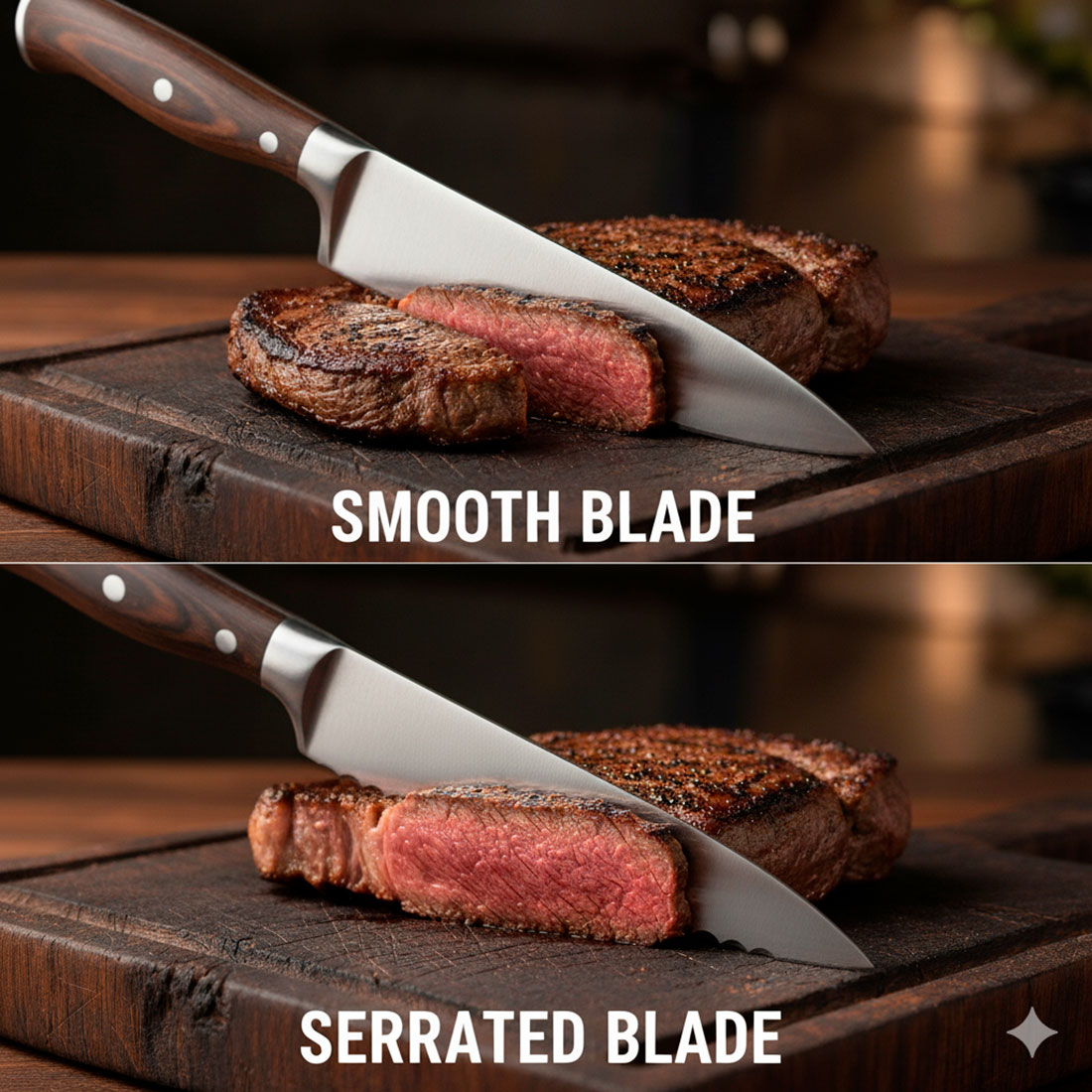
 The smooth-bladed knife represents the elegance of simplicity brought to its maximum functional expression. Its straight edge, sharpened to a precise angle, offers superior performance when the goal is cutting perfection. This type of blade is unforgiving: it is either impeccably sharp, or its performance degrades quickly.
The secret of the smooth blade lies in its ability to make clean and continuous cuts without tearing or ripping the fibers. As it glides through the meat, the straight edge separates the cells with minimal lateral resistance, preserving the internal structure of the tissue. This is especially critical for tender meats where texture and juice retention are primary concerns.
Advantages of the Smooth Edge
The first and most notable advantage is the quality of the cut. A perfectly sharp smooth blade produces uniform slices with impeccable edges, free from irregularities or tears. This type of cut is essential for presentations where aesthetics matter as much as taste.
Secondly, the smooth blade does not break the meat fibers, which allows it to retain its natural juices and texture. By not compressing or crushing the tissue during cutting, internal liquids remain within the fibers until the moment of biting, ensuring a juicier experience.
Furthermore, the smooth edge offers exceptional control during cutting. The cook or diner can feel exactly the resistance of the tissue and adjust the pressure and angle to obtain the desired thickness in each slice, from ultra-thin cuts to thicker medallions.
Limitations to Consider
The main disadvantage of the smooth edge is its need for constant maintenance. To maintain optimal performance, it requires regular sharpening, the frequency of which depends on use and the type of steel. A dull smooth edge not only cuts poorly but can be even more dangerous by requiring greater pressure and causing slips.
In addition, this type of blade requires more force and effort when facing meats with a crispy crust or tougher surfaces. The initial resistance of these textures can make starting the cut difficult, especially if the edge is not in optimal condition.
Ideal Applications of the Smooth Blade
The smooth-bladed knife particularly shines when cutting tender and soft meats: sirloins, rare steaks, carpaccios, tatakis, and any cut where tenderness is paramount. It is the professional choice for white meats such as chicken, turkey, or rabbit, whose more delicate fibers greatly benefit from a clean cut.
It is also indispensable for precision filleting, where extremely thin and uniform slices are required. Master butchers and professional chefs rely on the smooth blade when plate presentation demands visual perfection.
Serrated Blade: Grip and Efficiency for Challenging Textures
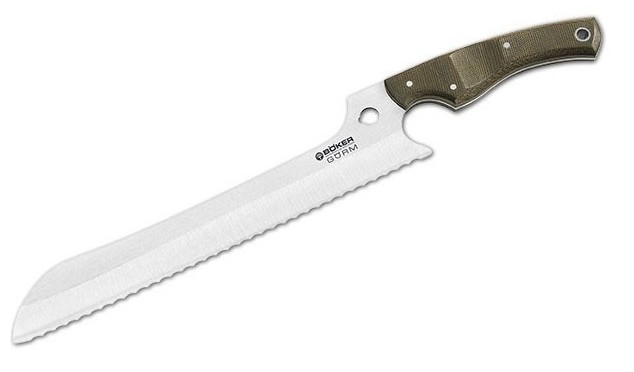
The serrated-bladed knife (also known as a saw edge or micro-serrated edge) adopts a radically different approach to the problem of cutting. Instead of penetrating with continuous pressure, its teeth act as small points of concentrated force that grip and penetrate the surface before cutting the interior.
This design is particularly effective when the meat presents variable resistances: a hard crust over a tender interior, crispy skin over juicy meat, or simply denser and tougher fibers that require a more aggressive approach.
Advantages of the Serrated Edge
The most valued characteristic of the serrated blade is its exceptional edge durability. The teeth maintain their cutting ability for years with virtually no maintenance required. This is because wear is distributed among multiple contact points rather than being concentrated on a single continuous edge.
The second major advantage is the reduction of effort required for cutting. The teeth act as anchor points that allow the cut to be initiated with less pressure, preventing the meat from slipping or being crushed. This is especially useful for diners with less hand strength or when cutting large volumes of meat.
In addition, the serrated blade is extraordinarily effective with tougher meats or those with a crust. That initial resistance that complicates the smooth blade’s work is precisely where the serrated edge demonstrates its superiority, piercing crispy surfaces without compromising the interior.
Considerations and Limitations
The serrated edge produces a less uniform cut than the smooth blade. The teeth create micro-irregularities on the edges of the cut, which can be noticeable in presentations where aesthetics are a priority or in extremely tender meats where these irregularities affect the sensory experience.
Furthermore, there is a greater risk of tearing the fibers rather than cutting them cleanly. The sawing motion, although efficient, can break the cellular structure more aggressively, prematurely releasing juices and slightly altering the perceived texture.
Finally, although its durability is an advantage, the serrated edge is practically impossible to sharpen at home. When it eventually loses effectiveness (typically after several years of intensive use), most users opt to replace the knife rather than attempting professional sharpening, the cost of which can approach that of a new piece.
Ideal Applications of the Serrated Blade
The serrated knife is the tool of choice for red or pink meats with a certain degree of firmness: well-done steaks, roasts with caramelized crust, bone-in cuts that require piercing areas of different resistance.
It is particularly effective with meats with skin or a hard crust: roasted duck, suckling pig, lamb, or any preparation where the crispy exterior contrasts with a more tender interior. The teeth penetrate the crust without crushing it, keeping its crispy structure intact.
It is also excellent for roasted meat or slightly overcooked meat, whose more compacted fibers offer greater resistance to cutting than juicier cooking points.
Technical Comparison: Smooth vs. Serrated
To facilitate your choice according to your specific needs, below we present a detailed comparison of the differential characteristics between both types of blades:
| Characteristic | Smooth Blade | Serrated Blade |
|---|---|---|
| Type of cut | Clean, precise, surgical | Aggressive, with a sawing effect |
| Finish quality | Perfect edges, no irregularities | Slightly irregular edges |
| Fiber preservation | Excellent: does not break cell structure | Moderate: can tear fibers |
| Juice retention | Maximum: clean cut seals cells | Good: can release some liquid |
| Effort required | Greater, especially on tough textures | Less: teeth facilitate grip |
| Edge durability | Requires frequent sharpening | Maintains sharpness for years |
| Maintenance | High: regular sharpening necessary | Minimal: virtually maintenance-free |
| Sharpening possibility | Yes, with sharpening steel or stone | No, requires professional equipment |
| Ideal meats | Tender, white, rare, juicy | Firm, red, with crust, well-done |
| Cut control | Exceptional: maximum tactile sensitivity | Good: less direct sensitivity |
| Aesthetic presentation | Superior: perfect slices | Correct: small irregularities |
- Type of cut
-
- Smooth Blade: Clean, precise, surgical
- Serrated Blade: Aggressive, with a sawing effect
- Finish quality
-
- Smooth Blade: Perfect edges, no irregularities
- Serrated Blade: Slightly irregular edges
- Fiber preservation
-
- Smooth Blade: Excellent: does not break cell structure
- Serrated Blade: Moderate: can tear fibers
- Juice retention
-
- Smooth Blade: Maximum: clean cut seals cells
- Serrated Blade: Good: can release some liquid
- Effort required
-
- Smooth Blade: Greater, especially on tough textures
- Serrated Blade: Less: teeth facilitate grip
- Edge durability
-
- Smooth Blade: Requires frequent sharpening
- Serrated Blade: Maintains sharpness for years
- Maintenance
-
- Smooth Blade: High: regular sharpening necessary
- Serrated Blade: Minimal: virtually maintenance-free
- Sharpening possibility
-
- Smooth Blade: Yes, with sharpening steel or stone
- Serrated Blade: No, requires professional equipment
- Ideal meats
-
- Smooth Blade: Tender, white, rare, juicy
- Serrated Blade: Firm, red, with crust, well-done
- Cut control
-
- Smooth Blade: Exceptional: maximum tactile sensitivity
- Serrated Blade: Good: less direct sensitivity
- Aesthetic presentation
-
- Smooth Blade: Superior: perfect slices
- Serrated Blade: Correct: small irregularities
This comparison reveals that there is no universally superior option, but rather two specialized tools for different contexts. The correct choice depends on the type of meat, frequency of use, and your personal priorities between cut quality and maintenance convenience.
Combined and Scalloped Blades: The Best of Both Worlds
Innovation in cutlery design has led to hybrid solutions that attempt to capture the advantages of both types of edges. Combined blades feature sections of smooth edge alternated with serrated areas, allowing the user to choose which part to use depending on the texture they encounter at any given moment of the cut.
These designs are especially useful in situations where a single piece of meat presents highly variable textures: for example, a roast with crispy crust areas and other areas of more tender meat. The user can start the cut with the serrated section to penetrate the tough surface and continue with the smooth edge for the more delicate interior.
Scalloped blades represent another interesting variant. They feature small concavities or alveoli along the edge that create air pockets between the blade and the meat. This design reduces friction and prevents the meat from sticking to the steel surface, facilitating smoother and cleaner cuts.
Scallops are particularly effective with very juicy or fatty meats, where adhesion to the metal can become a problem during cutting. They also significantly improve performance when cutting very thin slices, where prolonged contact between the blade and the meat tends to create resistance due to adhesion.
However, these hybrid designs represent compromises. A combined blade will never achieve the cutting perfection of a completely sharpened smooth blade, nor the maintenance-free durability of a full serrated one. They are versatile solutions for those seeking a single multi-purpose tool rather than specializing with multiple knives.
High-Quality Meat Knives: What to Look For
Regardless of the type of edge chosen, a superior quality meat knife must meet certain technical standards that determine its performance, durability, and user experience.
Blade Material: The Heart of the Knife
Stainless steel is the most common material in quality meat knives. Stainless steel alloys offer an optimal balance between corrosion resistance, ease of maintenance, and the ability to maintain a sharp edge. Higher grades of stainless steel, such as 440C or VG-10, provide greater hardness and better edge retention.
Carbon steel is an alternative appreciated by professionals who prioritize sharpening ability and extreme edge hardness. Although it requires more care to prevent oxidation, a properly maintained carbon steel knife achieves sharpening levels hardly matched by conventional stainless steel.
For the most demanding, Damascus steel combines multiple layers of different steels forged together, creating blades of exceptional hardness, flexibility, and aesthetic beauty. The characteristic undulations visible on its surface are not merely decorative: they represent the laminar structure that confers superior mechanical properties.
Handle Design: Ergonomics and Safety
The handle should offer a secure and non-slip grip, even when your hands are wet or greasy. Textured materials, ergonomic shapes that adapt to the anatomy of the hand, and the correct balance between blade weight and handle weight determine comfort during prolonged use.
A good balance is fundamental. The ideal balance point is located near the start of the blade, allowing the weight of the blade to do part of the cutting work without requiring excessive wrist effort. A poorly balanced knife quickly fatigues the hand and reduces cutting accuracy.
The length of the handle also matters. It should be long enough to fully accommodate your hand without your fingers dangerously protruding close to the blade, but not so long that it hinders fine control of movements.
Blade Length and Geometry
For table knives, a 10 to 12 centimeter blade offers the ideal balance between comfortable handling and cutting ability. For carving or grilling knives, longer blades (15-20 cm) allow continuous cuts on large pieces with fluid and uniform movements.
The edge geometry also determines performance. A sharper sharpening angle (15-18 degrees) provides cleaner cuts but requires harder steels and more meticulous care. Wider angles (20-25 degrees) offer greater durability and resistance to edge damage.
Maintenance and Care: Prolonging the Life of Your Tool
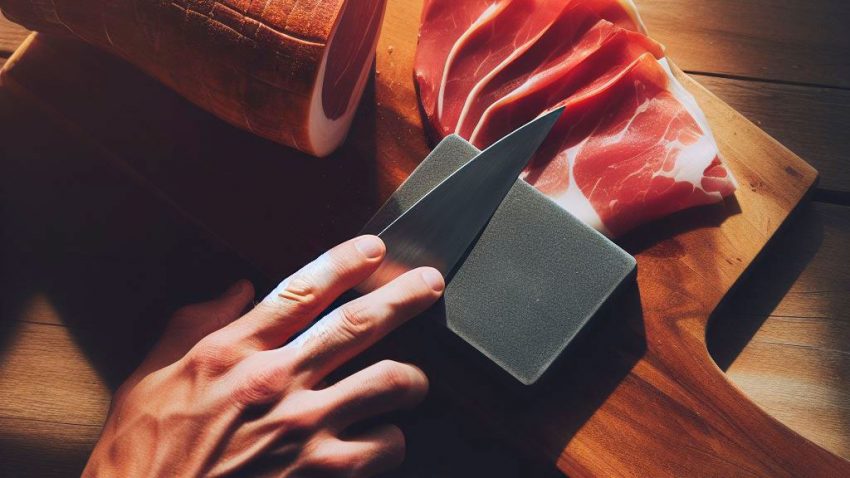 A meat knife is an investment that, with proper care, can accompany you for decades while maintaining optimal performance. Maintenance varies significantly depending on the type of blade.
Care of the Smooth Blade
Regular sharpening is key to maintaining the performance of a smooth blade. The frequency depends on use: an occasional household knife may require sharpening every 3-6 months, while intensive professional use may require weekly maintenance.
Using a honing steel or sharpening steel before each use realigns the microscopic edge without removing material, extending the time between full sharpenings. Sharpening itself, whether with water stones or guided systems, restores the original edge angle by removing small amounts of steel.
Avoid excessively hard cutting surfaces. Wood or polyethylene cutting boards are ideal; glass, ceramic, or stone surfaces quickly damage even the most carefully sharpened edge.
Care of the Serrated Blade
Although the serrated blade requires minimal maintenance, it is not completely care-free. Careful washing after each use removes grease and protein residues that can accumulate between the teeth, gradually reducing cutting effectiveness.
Avoid the dishwasher. The aggressive environment, powerful detergents, and banging with other utensils can damage the teeth and accelerate wear. Hand washing with warm water and mild soap, followed by immediate drying, optimally preserves the edge.
When the serrated blade eventually loses effectiveness (typically after several years of intensive use), most users opt to replace the knife rather than attempting professional sharpening, the cost of which can approach that of a new piece.
Correct Storage
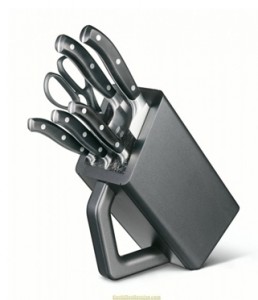 Proper storage protects both the blade and the safety of those accessing kitchen drawers. Knife blocks, magnetic wall strips, or individual sheaths are superior options to loose storage in drawers where knives collide with each other.
Store knives completely dry. Residual moisture, especially in contact with other metals, can initiate corrosion processes even in high-quality stainless steels.
After investing in a quality knife and making an informed choice between a smooth and serrated blade, the real enjoyment comes with the first cut: that moment when the blade glides effortlessly through the meat, releasing aromas, revealing textures, and preparing the perfect bite. Because the gastronomic experience begins with a tool that respects both the cook’s work and the quality of the ingredient.
Whether you choose the surgical precision of the smooth blade for your most delicate cuts or the long-lasting efficiency of the serrated blade for your most challenging roasts, you now possess the knowledge to make every cut a statement of respect for the meat that reaches your table. The next time you face a perfectly roasted steak or a tender pink sirloin, your hand will know exactly which tool to choose. And in that seemingly simple yet deeply informed gesture lies the difference between eating meat and experiencing it fully.
Solve your doubts about meat knives: differences between smooth and serrated blades
- What is the main difference between a meat knife with a smooth blade and one with a serrated blade?The main difference between a meat knife with a smooth blade and one with a serrated blade lies in the type of cut they make and their application:
- A smooth-bladed knife allows for precise and clean cuts, ideal for cutting meat without breaking the fibers, preserving its juices and natural texture. It is especially suitable for filleting and cutting pieces of roasted or raw meat with precision and without tearing.
- A serrated-bladed knife facilitates the cutting of tougher or slightly roasted meats, as its teeth grip the material better, requiring less pressure and preventing the meat from being crushed. However, its cut is less precise and can result in more irregular edges.
Therefore, the smooth blade is for clean and delicate cuts on fresh meat, while the serrated one is better for meats with crust or firmer textures that need additional grip for efficient cutting.
- What type of knife is best suited for cutting roasted meat?The most suitable type of knife for cutting roasted meat is a long, sharp knife with a smooth edge, as it allows for precise, uniform cuts without tearing the meat, maintaining its juiciness. It is important that it has an ergonomic handle for good control during cutting. Alternatively, a boning knife can be useful for separating meat from bone, and an axe-type knife or grill machete for large bone-in pieces, but for the main action of cutting roasted meat, a long, smooth, quality stainless steel blade is recommended.In summary, a long, sharp, smooth-bladed carving knife, with a good ergonomic handle, is ideal for cutting roasted meat cleanly and easily.
- How does the shape of the blade affect the meat cutting process?The shape of the blade affects the meat cutting process because it determines the type of cut and its quality: a straight blade is suitable for general cuts, providing uniform and precise cuts, while blades with different tooth sizes or shapes can influence the speed and smoothness of the cut, being ideal for specific tasks such as cutting bones or frozen meat. Additionally, blades with more teeth per inch (TPI) allow for a cleaner and smoother cut, while blades with fewer teeth facilitate faster and coarser cuts, useful for harder materials.
- What characteristics should a meat knife have to be considered high quality?A high-quality meat knife must have a robust and sharp blade made of stainless steel or carbon steel to ensure durability, good edge retention, corrosion resistance, and ease of maintenance. The edge should be smooth or serrated, depending on the type of meat to be cut, ensuring clean cuts without damaging the fibers. In addition, it must have an ergonomic and non-slip handle that allows for a secure and comfortable grip during prolonged use, favoring precision and safety. It is also important that the knife has a good balance between blade and handle to facilitate control and reduce effort when cutting. In some premium options, the blade may be made of Damascus steel, which combines hardness, durability, and superior aesthetics.
- Are there meat knives that combine smooth and serrated blades?Yes, there are meat knives that combine smooth and serrated blades, also known as combined blade knives or those that feature small teeth integrated into a section of the blade. These designs allow for leveraging the ease of cutting and sharpening of a smooth blade along with the durability and ability to cut harder surfaces that a serrated edge offers. However, most meat knives usually have either a completely smooth or completely serrated edge, and the combination is not as common but does exist in some specialized models for precise and versatile cuts. Some knives incorporate small saws or combine sections of both edges for delicate and decorative tasks, in addition to cutting meat.