Two rectangular blades, two worlds facing each other on your cutting board. Is it just a matter of appearance, or does a universe of technique, steel, and philosophy lie hidden in the choice between a Japanese cleaver and a Western cleaver? Although visually similar, these tools are born from opposing traditions: one designed for surgical precision and the other forged for brute force. This article unveils the soul of each one so you can discover which should be the extension of your hand in the kitchen.
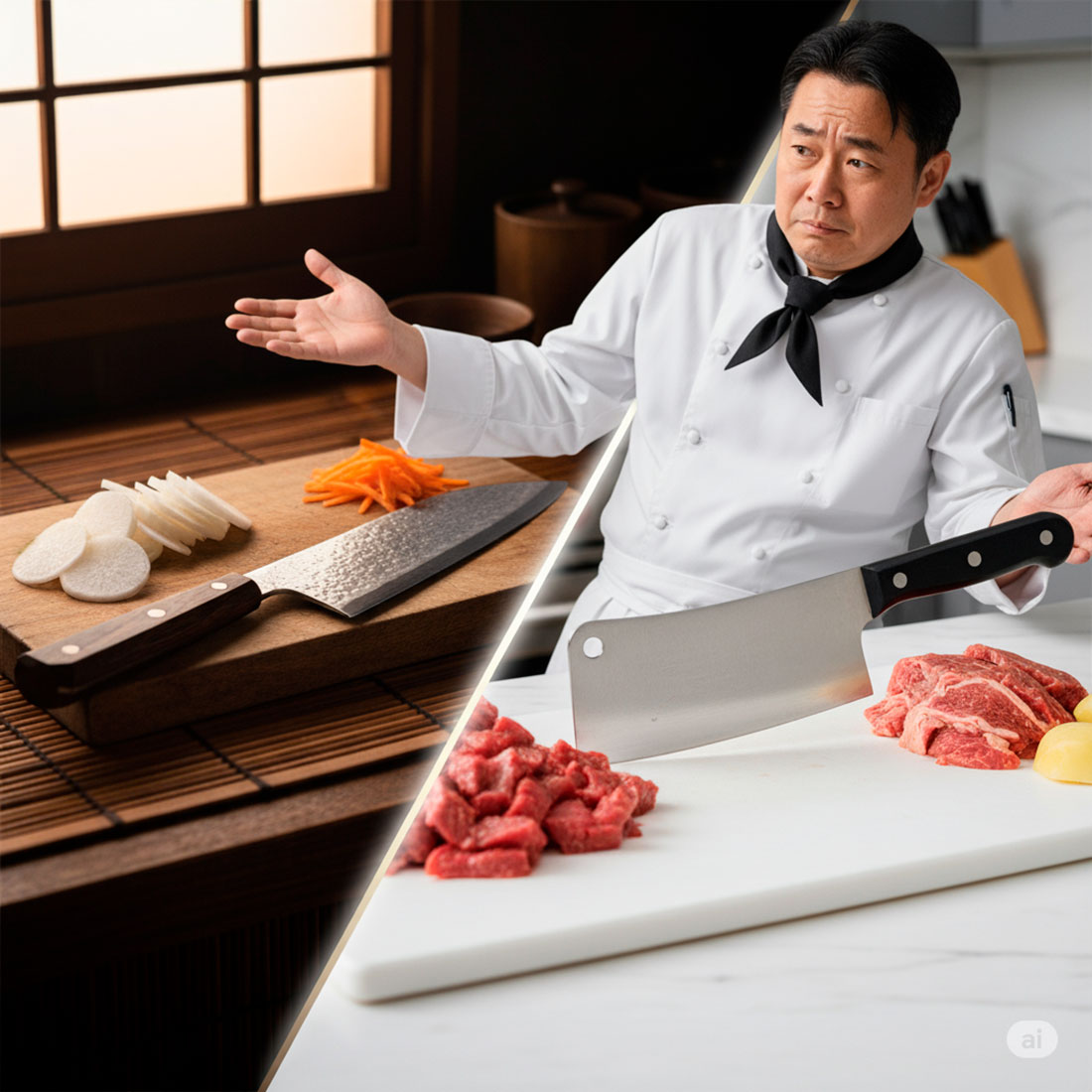
Strength vs. Precision: The Fundamental Conflict
Contents
The main distinction between these two tools boils down to their central purpose. The Western cleaver, known as a butcher’s cleaver, is the kitchen’s hammer, designed for direct impact on bones and large pieces of meat. Its weight and robustness are its greatest allies, allowing for powerful cuts that separate joints and chop with unstoppable force.
On the other hand, we find oriental-style knives, such as the Japanese Nakiri or the Chinese Tou. Despite their shape, they are not true cleavers. They are more like wide-bladed scalpels, created for a dance of precision on vegetables and boneless meats. Their design prioritizes a razor-sharp edge and total control for tasks that demand delicacy and clean cutting.
Anatomy of Two Philosophies: Technical Comparison
To understand the battle between these two blades, it is crucial to analyze their technical differences. Each characteristic, from the steel to the handle, responds to a specific function and a centuries-old tradition.
| Characteristic | Japanese Cleaver | Western Cleaver |
|---|---|---|
| Material and Hardness | Harder steel with high carbon content (58-65 HRC). Retains its edge longer. | Softer and more flexible steel (54-58 HRC). More resistant to impacts and less prone to chipping. |
| Edge and Geometry | Extremely sharp, with a narrower edge angle (~15 degrees), often with a single bevel for maximum precision. | Robust and thicker edge, with a 20-25 degree angle to withstand impacts without damage. |
| Blade Thickness | Noticeably thinner and lighter blade, designed to glide effortlessly. | Thick and heavy blade, wedge-shaped to add power to the strike. |
| Weight and Balance | Lighter and balanced towards the blade to offer greater agility and control in fast cuts. | Considerably heavier, balanced in the center or towards the handle to generate momentum. |
| Maintenance | Demanding. Requires sharpening with whetstones and immediate drying to prevent corrosion. | Easy to maintain. Tolerates the use of honing steels and is more resistant to corrosion. |
- Japanese Cleaver
-
- Material and Hardness: Harder steel (58-65 HRC).
- Edge and Geometry: Sharp angle (~15 degrees), maximum precision.
- Blade Thickness: Thin and light.
- Weight and Balance: Lightweight, balanced towards the blade.
- Maintenance: Demanding, requires whetstones.
- Western Cleaver
-
- Material and Hardness: Softer steel (54-58 HRC).
- Edge and Geometry: Robust angle (20-25 degrees), for impact.
- Blade Thickness: Thick and heavy.
- Weight and Balance: Heavy, centered balance.
- Maintenance: Easy to maintain, tolerates honing steels.
Cleavers in Action: Uses and Advantages in Your Kitchen
The Western Cleaver: Indomitable Power
The butcher’s cleaver is a tool of strength, not delicacy. Its design is optimized for the most demanding kitchen tasks.
- Pros: Its durability is its greatest virtue. It is capable of withstanding repetitive blows against bones without chipping. The weight does much of the work, requiring less physical effort for powerful cuts. Its maintenance is simple and it is very resistant to corrosion and rough use.
- Common uses: It is the tool par excellence for butchering animals, cutting ribs, separating joints, and portioning whole poultry. It is also effective for opening extremely hard vegetables like large pumpkins or cassava.
The Japanese Cleaver: The Edge of Perfection
Japanese rectangular-bladed knives, such as the Nakiri, are precision instruments. Their value lies in the cleanliness and accuracy of their cuts.
- Pros: It offers an ultra-precise cut that does not damage the cellular structure of food, ideal for aesthetic presentations and for preserving the freshness of ingredients. Its lightness allows for quick and repetitive work without fatigue. In addition, the hardness of its steel guarantees superior edge retention.
- Common uses: It is perfect for chopping vegetables and herbs with astonishing speed and uniformity. It is ideal for techniques such as julienne or brunoise cuts. The Nakiri is the king of vegetables, while similar knives like the Santoku offer more versatility for boneless meats and fish.
Maintenance: A Ritual for Each Steel
The care of these tools is as different as their function. A Western cleaver forgives neglect, but a Japanese one demands a maintenance ritual. Japanese steel, harder and with a higher carbon content, is prone to oxidation and chipping if used incorrectly. It requires hand washing and immediate drying, as well as precise sharpening with whetstones. For its part, the Western cleaver, made of softer stainless steel, is a workhorse that withstands intensive use and can be easily maintained with a honing steel.
Clearing Up Doubts About Japanese and Western Knives
What are the main differences in the daily use of Japanese and Western knives?
There are several key differences in the daily use of Japanese and Western knives:
- Precision and Blade Thickness:
- Japanese knives: They have a thinner edge and a narrower cutting angle (~15 degrees), which allows for precise and clean cuts. This makes them ideal for delicate tasks such as cutting fish or thin vegetables.
- Western knives: The blade is thicker and the cutting angle is wider (~20-25 degrees), which makes them more resistant and suitable for cutting hard meats and bones.
- Materials and Maintenance:
- Japanese knives: They use harder steels (58-66 HRC), which can make them more prone to corrosion if not properly cared for. They require careful maintenance and must be dried immediately after use.
- Western knives: Generally made of softer steel (54-58 HRC), which makes them less prone to corrosion and easier to maintain.
- Design and Use:
- Japanese knives: Each knife has a specific purpose (Gyuto for meat, Santoku for all-purpose, Nakiri for vegetables, Yanagiba for sashimi). This approach ensures that each knife is optimized for its task.
- Western knives: Versatile knives that can perform multiple tasks, such as the chef’s knife, are often used.
- Weight and Balance:
- Japanese knives: They are lighter and more balanced, making them ideal for repetitive cuts without fatigue.
- Western knives: Generally heavier, which can be beneficial for tasks requiring brute force, but may be less precise.
- Manufacturing:
- Japanese knives: Often handmade, maintaining traditional forging techniques.
- Western knives: Usually mass-produced.
What types of Japanese knives are most recommended for beginners?
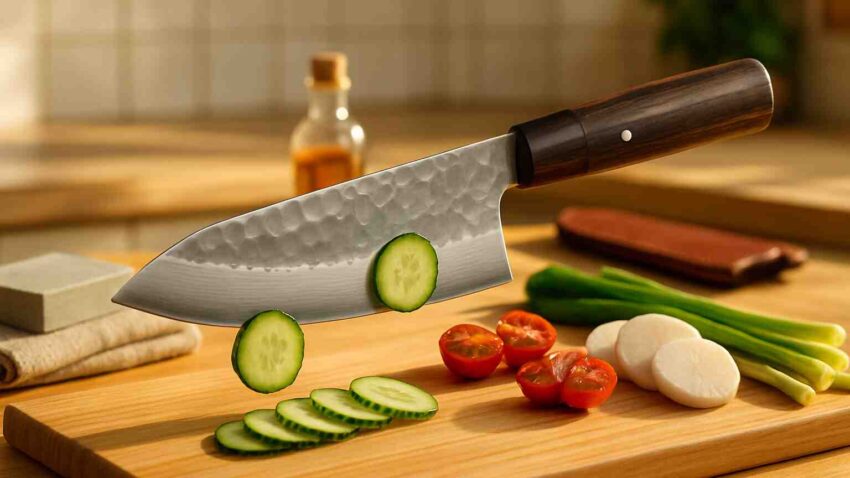 For beginners, the most recommended Japanese knives are those that are versatile and easy to handle. Below are the most suitable types:
- Santoku: This knife is ideal for cutting meat, fish, and vegetables. Its compact design makes it easy to use for daily tasks.
- Gyuto: Equivalent to the Western chef’s knife, it is perfect for cutting all kinds of food and making quick, precise cuts.
- Petty: Although not as large as the other two, it is excellent for detailed work such as peeling fruits or small vegetables. Its compact size makes it ideal for precise tasks.
These knives cover most basic kitchen needs and are easy for beginners to handle.
How does steel hardness affect the durability of Japanese and Western knives?
Steel hardness — measured on the Rockwell scale (HRC) — is key to the durability and performance of knives:
- Japanese knives: They use harder steels (generally between 58 and 66 HRC), which allows them to maintain their edge much longer and make very precise cuts. However, greater hardness also implies less flexibility: the blade is more prone to chipping or breaking if used incorrectly (for example, when cutting bones or very hard foods). In addition, these knives require more careful maintenance (sharpening with specific stones) and are more sensitive to corrosion, especially in carbon steels.
- Western knives: They use softer steels (usually between 54 and 58 HRC), which causes the edge to wear out faster and need to be sharpened more frequently. The advantage is that the blade is more resistant to impacts, twists, and rough use, so it better withstands demanding tasks (cutting meats with bone, hard vegetables, etc.). They are more versatile and require less specialized maintenance.
In summary, the hardness of the steel in Japanese knives extends the life of the edge but reduces resistance to misuse, while in Western knives it shortens edge retention but increases overall durability against impacts and bad practices. The choice depends on the type of use and the care one is willing to give the knife.
What cutting techniques are most effective with Japanese knives?
The most effective cutting techniques with Japanese knives include various specializations depending on the type of food and the knife used. Below are some of the most common techniques:
- Sogi-Giri: This is an angled cut used to create thin pieces of meat and fish. This cut is ideal for preparations such as sashimi.
- Hira-zukuri: Refers to a straight and uniform cut, widely used to prepare sashimi and other fresh fish cuts.
- Kaku-zukuri: This technique involves cutting into cubes, especially useful for decorative preparations.
- Usu-zukuri: Used for very thin cuts, ideal for delicate fish.
- Hangetsu-Giri: Consists of cutting vegetables into half moons, which facilitates uniform cooking.
- Wa-Giri: This technique is used to cut vegetables into round slices, such as cucumber or eggplant.
- Katsuramuki: Used to cut vegetables into thin, continuous sheets, ideal for decorations.
- Julienne: Although not exclusive to Japanese cuisine, Japanese knives are effective for cutting into thin, uniform strips, ideal for stir-fries.
What is the difference in maintenance between Japanese and Western knives?
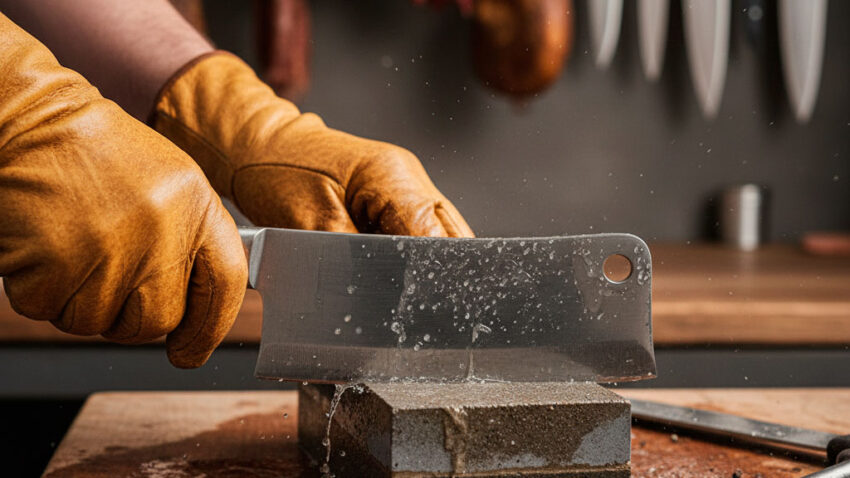 The main difference in maintenance between Japanese and Western knives lies in the hardness of the steel and the type of sharpening they require. Japanese knives are made with harder steel and thinner blades, so they need more careful and frequent sharpening with whetstones of various grits, as well as more delicate handling to prevent chipping. In addition, it is important to use a honing steel to set the edge regularly and avoid professional sharpening unless absolutely necessary. In contrast, Western knives usually have softer steel and thicker blades, are more resistant to impacts and hard cuts, require less maintenance in terms of sharpening, and are less prone to damage from daily use.
In summary:
- Japanese knives: harder steel, thinner and sharper edge, require sharpening with specific stones, care to avoid chipping, delicate and regular maintenance.
- Western knives: softer steel, thicker and stronger blade, require less sharpening and are more tolerant of rough use.
Caring for Japanese knives is more demanding to preserve their edge and prevent damage, while Western knives are more robust and easier to maintain.
| Mineral oil | High penetration, does not degrade or attract dirt | Regular protection and maintenance |
| Camellia oil | Natural, acid-free, non-volatile | Antioxidant protection, lubrication |
| Lithium grease | Dense, durable, does not evaporate | Long-term storage, protection |
-
- Mineral oil
- Camellia oil
- Lithium grease
The final choice is not about which cleaver is objectively better, but which tool is right for your tasks and your philosophy in the kitchen. The Western cleaver is an infallible ally for those seeking power, durability, and hassle-free maintenance. The Japanese cleaver, on the other hand, rewards those who value precision, presentation, and are willing to dedicate the care an artwork deserves. Are you looking for the strength that breaks barriers or the precision that creates beauty? The answer, now, is on your cutting board.
VIEW KITCHEN CLEAVERS | VIEW CHEF KNIVES | VIEW ALL KITCHEN KNIVES