
The blade whistles as it cuts through dense undergrowth. One motion. Precise. Effective. But behind that perfect cut lies a critical decision every professional, farmer or bushcraft enthusiast must face: carbon steel or stainless steel? This choice is not a mere aesthetic whim, but a matter of performance, durability and adaptation to the environment that will determine whether your machete becomes your most reliable ally or a tool that will let you down when you need it most.
The battle between these two steel titans has divided experts and users for decades. Each material has unique characteristics that make it superior in certain circumstances, yet unsuitable in others. Understanding the fundamental differences between carbon steel and stainless steel will allow you to make an informed decision based on your actual work needs, your region’s climate and your willingness to perform maintenance.
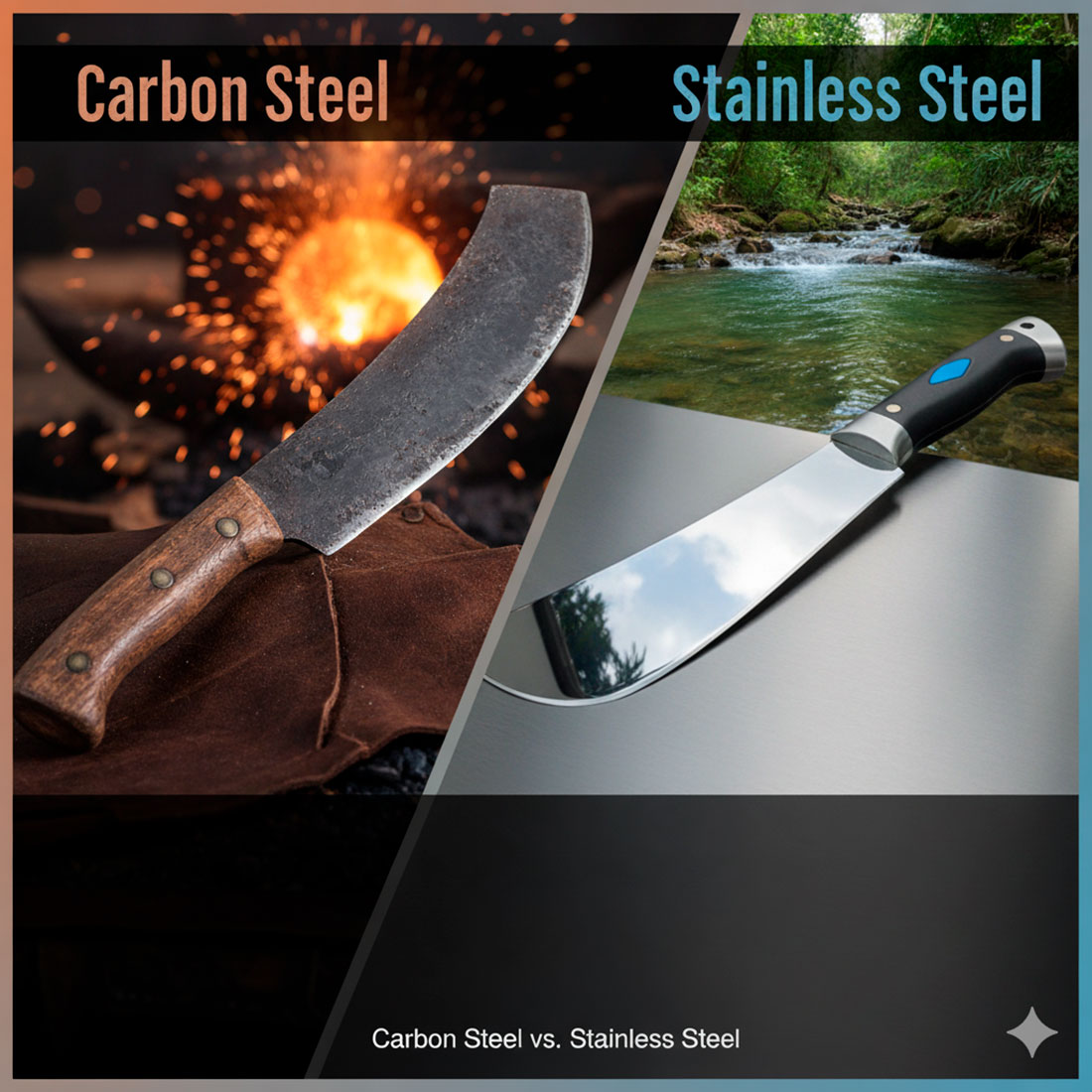
In this technical and practical analysis, we will break down every relevant aspect: from the chemical composition that defines each steel’s behavior, to edge retention, corrosion resistance and maintenance requirements. You will discover which machete is ideal for intensive agricultural work under the tropical sun, which withstands the constant humidity of the jungle best, and which will reward you with a long-lasting edge if you are willing to give it the care it deserves.
Understanding the two steel titans: chemistry and behavior
Contents
- Understanding the two steel titans: chemistry and behavior
- Carbon Steel: the traditional warrior with an unforgiving edge
- Stainless Steel: the sentinel that resists the elements
- Direct technical comparison: face-to-face on the battlefield
- Decisive factors: how to choose according to your real situation
- Special alloys and modern technology: beyond the basic classification
- Clearing up doubts about machete durability and maintenance
- Maintenance for carbon steel machetes
- Maintenance for stainless steel machetes
- Advantages of stainless steel in corrosion resistance
To make the right decision, you must first understand what fundamentally differentiates these two types of steel. This is not simply a matter of brand names or subjective preferences, but of distinct chemical compositions that produce radically different mechanical properties and corrosion resistance.
Carbon steel is an alloy of iron and carbon, with a carbon content that typically ranges between 0.5% and 1.5%. That carbon is responsible for giving the steel its characteristic hardness and its ability to hold a sharp, durable edge. However, carbon steel contains less than 13% chromium, which makes it vulnerable to oxidation when exposed to moisture or corrosive environments.
By contrast, stainless steel contains at least 13% chromium in its composition. This key element forms a passive layer of chromium oxide on the metal surface, an invisible but extraordinarily effective film that protects the steel from corrosion. This layer has a notable property: it is self-regenerating. If the surface is scratched or damaged, the chromium oxide layer rebuilds itself automatically in the presence of oxygen, ensuring continuous protection.
This fundamental chemical difference explains why each type of steel shines in some scenarios and fails in others. Carbon steel sacrifices corrosion resistance in exchange for superior edge performance and ease of sharpening. Stainless steel trades a bit of cutting performance for exceptional resistance to the elements and minimal maintenance.
Carbon Steel: the traditional warrior with an unforgiving edge
Carbon steel is the classic material for heavy-duty machetes, revered by generations of farmers, woodsmen and explorers. Its reputation rests on three fundamental pillars: superior edge retention, ease of sharpening and toughness. When you need a machete that keeps cutting power after hours of intensive work, carbon steel is the undisputed champion.
The molecular structure of carbon steel allows a thinner, keener edge than stainless steel. This edge is not only sharper initially, but it keeps its keenness for prolonged periods under heavy use. When it finally needs re-sharpening, the process is relatively straightforward: a sharpening stone and proper technique will return your machete’s original bite without excessive effort.
However, this exceptional performance comes at a cost: constant, disciplined maintenance. Carbon steel is highly prone to oxidation. Moisture, contact with acidic or salty substances, and even the sweat from your hands can start the corrosion process. A neglected carbon steel machete will develop rust stains that are not only unsightly but that structurally weaken the blade and increase the risk of accidents.
| Advantages of Carbon Steel | Disadvantages and Requirements |
|---|---|
| Exceptional edge retention, keeps cutting longer | Highly prone to rust without proper maintenance |
| Easy to sharpen, even in the field with basic tools | Requires cleaning, drying and oiling after each use |
| Greater wear resistance under intensive use | Vulnerable in humid or tropical environments |
| Allows a thinner, sharper edge | Accelerated deterioration from contact with acidic or salty substances |
| Excellent value in traditional models | Rusty blades represent a higher risk of serious accidents |
- Advantages of Carbon Steel
-
- Edge retention: Exceptional, keeps cutting longer
- Ease of sharpening: Easy to sharpen, even in the field with basic tools
- Wear resistance: Greater resistance under intensive use
- Edge quality: Allows a thinner, keener edge
- Price: Excellent value in traditional models
- Disadvantages and Requirements
-
- Rust: Highly prone to rust without proper maintenance
- Maintenance: Requires cleaning, drying and oiling after each use
- Vulnerability: Vulnerable in humid or tropical environments
- Corrosive substances: Accelerated deterioration from contact with acids or salts
- Safety: Rusty blades pose a higher risk of serious accidents
Carbon steel is your ideal choice if you work in a relatively dry environment, are willing to spend time maintaining the tool after each day, and value cutting ability and edge durability above all. It’s the machete of the professional who knows their tool and respects it enough to care for it properly.
Stainless Steel: the sentinel that resists the elements
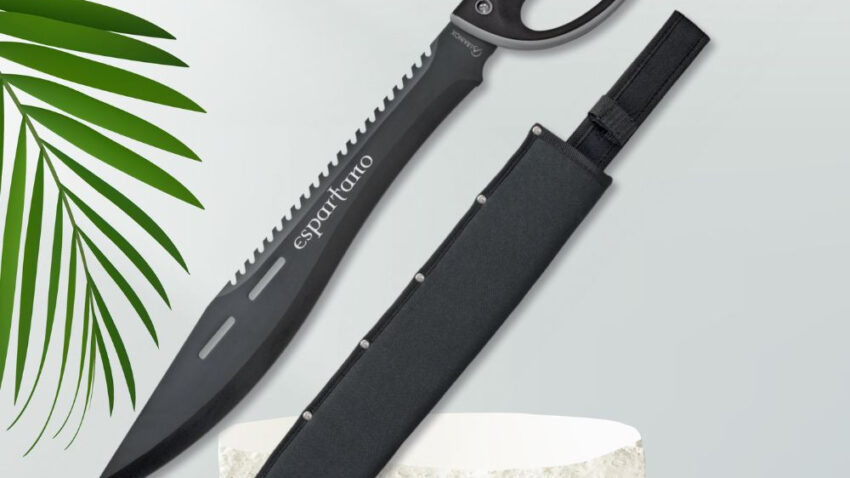
Stainless steel represents the modern evolution of the machete, designed for users who face adverse environmental conditions or who simply cannot devote time to constant maintenance. Its defining characteristic is exceptional corrosion resistance, an advantage that makes it the perfect ally for humid climates, tropical environments or work near saline conditions.
The passive layer of chromium oxide that protects stainless steel is a marvel of metallurgy. This microscopic film forms spontaneously when the chromium in the steel reacts with oxygen in the air. If the blade is scratched during work, the layer regenerates automatically, maintaining active protection without your intervention. This feature allows a stainless steel machete to withstand exposure to rain, constant humidity, saltwater splashes and other corrosive agents that would rapidly destroy a carbon steel machete.
However, this corrosion resistance entails trade-offs in other performance areas. Stainless steel tends to lose its edge faster than carbon steel under heavy use. The denser molecular structure and the presence of chromium make stainless steel more difficult to sharpen: it requires more time, better technique and quality tools to restore a truly sharp edge.
| Advantages of Stainless Steel | Disadvantages |
|---|---|
| Excellent resistance to rust and corrosion | Lower edge retention, dulls faster |
| Minimal maintenance, ideal for busy users | Harder to sharpen, requires tools and technique |
| Perfect for humid, tropical or coastal climates | Edge less sharp than carbon steel |
| Self-regenerating protective chromium oxide layer | Greater hardness can result in less flexibility |
| Durable appearance, resists staining | Typically higher price for quality models |
- Advantages of Stainless Steel
-
- Corrosion resistance: Excellent resistance to rust and corrosion
- Maintenance: Minimal maintenance, ideal for busy users
- Harsh environments: Perfect for humid, tropical or coastal climates
- Protection: Self-regenerating protective chromium oxide layer
- Appearance: Durable look, resists staining
- Disadvantages
-
- Edge retention: Lower edge retention, dulls faster
- Sharpening: Harder to sharpen, requires tools and technique
- Edge quality: Edge less keen than carbon steel
- Flexibility: Greater hardness can result in less flexibility
- Cost: Typically higher priced in quality alloys
Stainless steel is the right choice if you work frequently in the rain, in regions with high ambient humidity, near the sea, or if your priority is a tool that will perform reliably with minimal maintenance. Expect to sharpen more often, but enjoy the peace of mind that your machete won’t develop rust even if you occasionally store it damp.
Direct technical comparison: face-to-face on the battlefield
To help your decision, here is an exhaustive comparison of both types of steel across the aspects most relevant to the real user. This table lets you quickly evaluate which material best fits your specific needs and working conditions.
| Characteristic | Carbon Steel | Stainless Steel |
|---|---|---|
| Edge retention | Excellent – Keeps a keen edge for prolonged periods | Good – Edge wears faster under heavy use |
| Ease of sharpening | Easy – Responds well to basic sharpening stones | Hard – Requires technique, time and quality tools |
| Corrosion resistance | Low – Rusts quickly without protection | Excellent – Resistant to rust, humidity and saline environments |
| Maintenance required | High – Cleaning, drying and oiling after each use | Low – Occasional cleaning and basic drying sufficient |
| Edge durability | Very high if properly maintained | Moderate-high due to structural resistance to corrosion |
| Resistance to heavy use | Excellent – Withstands abuse and heavy work | Good – Durable, but the edge needs frequent attention |
| Ideal climates | Dry or low-humidity areas | Humid, tropical, coastal, rainy |
| Price | Generally more economical | Typically higher for quality alloys |
- Edge retention
-
- Carbon Steel: Excellent – Keeps a keen edge for prolonged periods
- Stainless Steel: Good – Edge wears faster under heavy use
- Ease of sharpening
-
- Carbon Steel: Easy – Responds well to basic sharpening stones
- Stainless Steel: Hard – Requires technique, time and quality tools
- Corrosion resistance
-
- Carbon Steel: Low – Rusts quickly without protection
- Stainless Steel: Excellent – Resistant to rust, humidity and saline environments
- Maintenance required
-
- Carbon Steel: High – Cleaning, drying and oiling after each use
- Stainless Steel: Low – Occasional cleaning and basic drying sufficient
- Edge durability
-
- Carbon Steel: Very high if properly maintained
- Stainless Steel: Moderate-high due to structural resistance to corrosion
- Resistance to heavy use
-
- Carbon Steel: Excellent – Withstands abuse and heavy work
- Stainless Steel: Good – Durable, but the edge needs frequent attention
- Ideal climates
-
- Carbon Steel: Dry or low-humidity areas
- Stainless Steel: Humid, tropical, coastal, rainy
- Price
-
- Carbon Steel: Generally more economical
- Stainless Steel: Typically higher for quality alloys
Decisive factors: how to choose according to your real situation
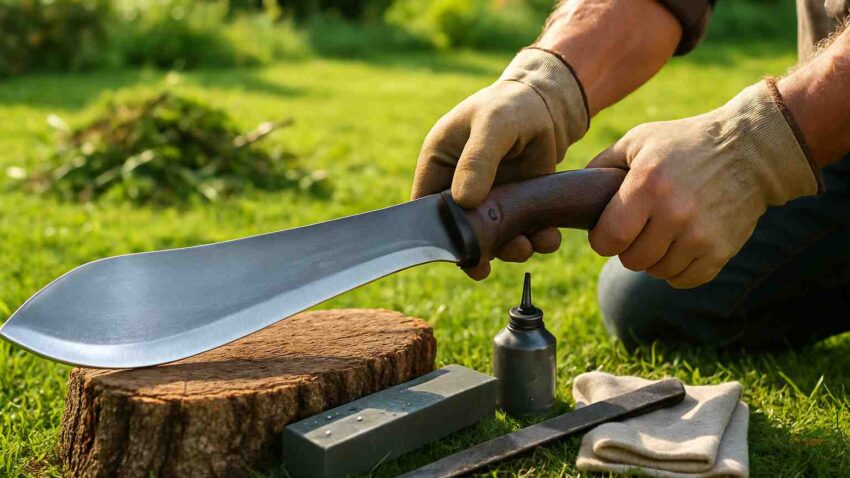
Theory is fascinating, but the final decision must be based on your operational reality. There are three main factors that should guide your choice: the climate and environmental conditions where you will work, the type and frequency of use, and your real willingness to perform maintenance.
Climate and environmental conditions
The environment where you will use your machete is probably the most determining factor. If you live or work in regions with high ambient humidity, frequent rain, or near coastal areas, stainless steel is practically mandatory. Constant exposure to moisture will destroy a carbon steel machete within weeks or months, regardless of how much effort you put into maintenance.
In tropical or jungle environments, where humidity regularly exceeds 70–80% and rains are unpredictable, stainless steel will save you countless hours of maintenance work and prevent the frustration of seeing your tool deteriorate prematurely. Saline environments, such as marine or coastal zones, are especially aggressive: salt dramatically accelerates corrosion of carbon steel.
By contrast, if you work in dry or semi-arid climates with low humidity and scarce rainfall, carbon steel will shine. Under these conditions, the risk of oxidation is much lower, and you can fully take advantage of its edge retention and ease of sharpening without suffering the consequences of constant corrosion.
Type of use and frequency
The second critical factor is how and how often you will use your machete. For intensive daily agricultural work requiring precise, repetitive cuts — such as clearing land, harvesting sugar cane, or maintaining trails — carbon steel offers significant advantages. Its ability to keep a sharp edge for hours of continuous work reduces fatigue and increases efficiency.
If your use is occasional or recreational — bushcraft expeditions, camping, sporadic property maintenance — stainless steel may be the most practical option. You won’t have to worry about oiling the blade before storing it for months, and when you need it, it will be ready to work without rust problems.
For professionals who depend on their machete as a primary work tool, carbon steel justifies the extra maintenance with superior performance and lower long-term replacement costs. For casual users or those who use multiple tools, stainless steel offers the convenience of a “ready-to-use” tool with minimal upkeep.
Real willingness for maintenance
Be honest with yourself about your commitment to maintenance. Carbon steel does not forgive neglect. If you’re not willing to clean, thoroughly dry and apply a protective coat of oil to your machete after each use, carbon steel will disappoint you quickly.
Maintenance of carbon steel is not complicated, but it must be consistent and disciplined. After each workday you should wash the blade with warm water and mild soap, dry it meticulously with a cloth (making sure no residual moisture remains), and apply a thin layer of mineral oil. If you cut acidic materials or work in high-sweat conditions, this process should be carried out even during the workday.
If this routine seems excessive or unrealistic given your lifestyle and schedule, stainless steel is your answer. Although it is not completely immune to corrosion (especially in extremely salty or humid environments), it tolerates use and storage much better without special care.
Special alloys and modern technology: beyond the basic classification
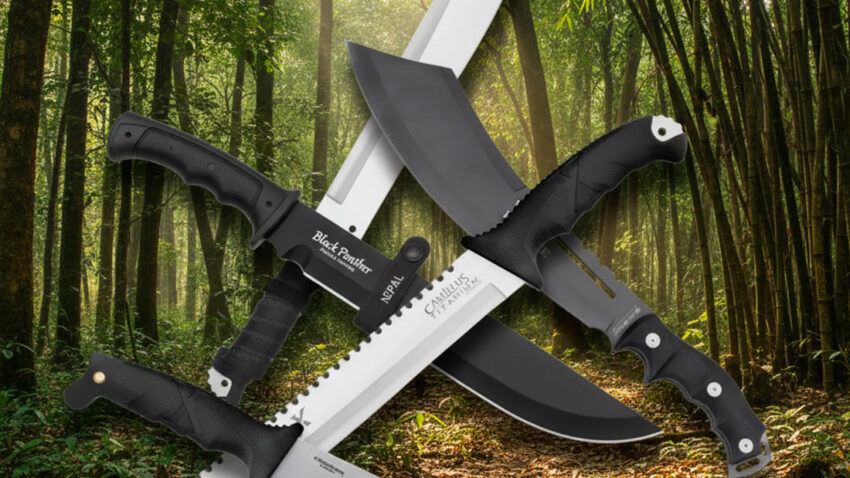 The split between carbon steel and stainless steel is useful as a conceptual framework, but the modern market reality is more complex and exciting. High-end machete makers have developed specialized alloys that optimize performance for specific applications, overcoming the traditional limitations of each category.
Alloys like Böhler N690 steel represent the cutting edge of blade technology. This high-quality stainless steel, used in professional machetes like the Extrema Ratio Mato Grosso, combines a hardness of 58 HRC with excellent corrosion resistance. The result is a machete that holds a respectable edge for extended periods and resists corrosive environments without the intensive maintenance required by traditional carbon steel.
Other high-end models use modified 420 steel or proprietary alloys that incorporate molybdenum, vanadium or nickel to improve specific characteristics. Molybdenum increases corrosion resistance and hardness; vanadium refines the metal grain structure for a sharper edge; nickel improves toughness and impact resistance.
In addition to the base material, many manufacturers apply specialized protective coatings. Treatments such as MIL-C-13924 Burnishing finish (military standard) provide an extra layer of protection against corrosion and wear, dramatically extending the tool’s service life even under extreme conditions.
These technological advances mean that, if your budget allows, you can access machetes that offer the best of both worlds: edge retention close to carbon steel with the corrosion resistance of high-quality stainless steel. Models like the JKR “Gran Chaco”, YAKUZA Third, or Albainox Amazonas use these advanced alloys for professionals who accept no compromises.
Clearing up doubts about machete durability and maintenance
What is the average durability of a carbon steel machete compared to a stainless steel one?
The average durability of a carbon steel machete is greater regarding its ability to keep a keen edge and resist wear under intensive use, but it requires maintenance to prevent rust. In contrast, a stainless steel machete has lower edge durability but offers greater resistance to corrosion and less need for maintenance.
| Characteristic | Carbon Steel | Stainless Steel |
|---|---|---|
| Edge durability | Higher, keeps edge longer | Lower, edge wears faster |
| Corrosion resistance | Low, rusts without maintenance | High, resistant to oxidation |
| Maintenance required | High (clean and oil regularly) | Low |
| Overall durability | High if well maintained | Moderate-high due to resistance to rust |
- Edge durability
-
- Carbon Steel: Higher, keeps edge longer
- Stainless Steel: Lower, edge wears faster
- Corrosion resistance
-
- Carbon Steel: Low, rusts without maintenance
- Stainless Steel: High, resistant to oxidation
- Maintenance required
-
- Carbon Steel: High (clean and oil regularly)
- Stainless Steel: Low
- Overall durability
-
- Carbon Steel: High if well maintained
- Stainless Steel: Moderate-high due to resistance to rust
What kind of maintenance do carbon steel and stainless steel machetes require?
Maintenance for carbon steel machetes
- Immediate cleaning: Wash them by hand with warm water and mild soap after each use. Never leave them soaking or expose them to prolonged moisture.
- Thorough drying: Completely dry the blade and handle with a dry cloth, making sure no residual moisture remains.
- Rust protection: Apply a thin layer of food-grade mineral oil after cleaning, especially if the machete will be stored for a long period.
- Avoid acidic and salty foods: Contact with citrus fruits, tomatoes, salt or seafood accelerates oxidation; if you cut these, clean and dry the machete immediately afterwards.
- Regular sharpening: Keep the edge sharp with a stone or honing rod, since carbon steel loses edge more easily.
- Proper storage: Store the machete in a dry, ventilated place, preferably in a sheath, avoiding wooden blocks that retain moisture.
Maintenance for stainless steel machetes
- Simple cleaning: Wash them with warm water and mild soap after each use; you can rinse and dry them without worrying too much about rust.
- Avoid rough use: Although more resistant, do not use them as levers or strike hard objects to avoid damaging the edge or blade.
- Moderate sharpening: The edge lasts longer, but when it dulls it is harder to re-sharpen due to the material’s greater hardness.
- Less concern about rust: Stainless steel is much less prone to corrosion, but in very humid or salty environments it is advisable to clean and dry the tool well.
- Avoid the dishwasher: Although more resistant, heat and harsh detergents can damage both the blade and the handle.
How do climate and environmental conditions affect the choice between carbon steel and stainless steel?
The choice between carbon steel and stainless steel depends significantly on the climate and environmental conditions in which the material will be used. Here are some key points to consider:
- Corrosion resistance: Stainless steel is more resistant to corrosion due to its chromium content, making it ideal for humid environments or those with high salinity, such as marine applications or locations near the sea. On the other hand, carbon steel is susceptible to corrosion in humid environments, making it better suited to dry climates.
- Hardness and strength: Carbon steel has greater hardness and mechanical strength, but is more prone to rust and corrosion, especially in high-humidity environments. Stainless steel, although softer, resists adverse conditions such as humidity and low temperatures better.
- Environmental impact: Steel production in general has a significant environmental impact due to greenhouse gas emissions. However, stainless steel and carbon steel do not differ substantially in this respect. Although stainless steel is more expensive and its production may require more energy, its high corrosion resistance can reduce replacement needs over the long term, which may offset some environmental costs through more efficient use.
Climate and environmental conditions can influence the choice of steel type based on the need for corrosion resistance, durability and mechanical strength.
What advantages does stainless steel have in terms of corrosion resistance?
Advantages of stainless steel in corrosion resistance
Self-regenerating capacity:
Stainless steel forms a protective layer of chromium oxide on its surface, extremely thin but very effective. This layer is self-regenerating: if it is damaged, it rebuilds automatically in the presence of oxygen, ensuring continuous protection against corrosion.
Resistance in harsh environments:
Thanks to this passivating layer, the material maintains its integrity in humid, corrosive or water-exposed environments, making it ideal for applications in kitchens, bathrooms, the food industry, medical fields and construction.
Low maintenance and long durability:
It does not require special treatments or paints to prevent corrosion, which reduces maintenance costs and effort. Its durability allows it to retain its aesthetic and functional properties for a long time, even under intensive use.
Versatility and adaptability:
There are different grades of stainless steel, each with specific levels of corrosion resistance, allowing selection of the most suitable grade for the intended environment. In addition, adding other alloying elements like nickel and molybdenum can further improve resistance in especially aggressive environments.
What is the difference in ease of sharpening between carbon steel and stainless steel machetes?
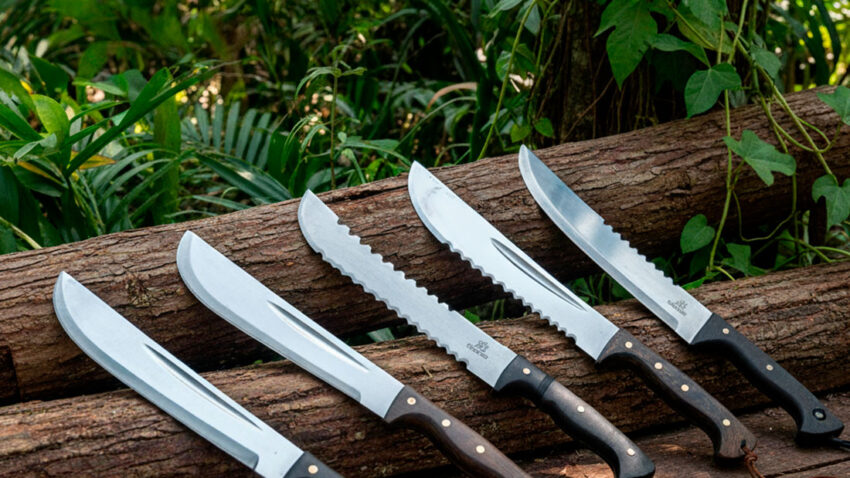 Carbon steel machetes are easier to sharpen than stainless steel ones. Carbon steel allows a finer edge and maintaining it requires less sharpening effort, while stainless steel, although more corrosion resistant, is usually harder and more difficult to sharpen, requiring more time and technique to achieve a good edge.
Your machete is more than a tool; it is an extension of your will in the field, forest or farm. The choice between carbon steel and stainless steel will define the relationship you build with this essential tool. Carbon steel will reward you with an unforgiving edge and exceptional durability if you give it the care and respect it deserves. Stainless steel will be your reliable companion in the harshest conditions, ready to work without demanding constant maintenance rituals.
There is no universal answer. Honestly evaluate your work environment, your frequency of use, and your willingness to perform maintenance. If you work in dry climates and value maximum cutting performance, carbon steel is your natural ally. If you face constant humidity, frequent rain or simply need a low-maintenance tool, stainless steel will serve you faithfully for years.
Remember that a well-sharpened machete — regardless of the steel type — is safer, more efficient and lasts longer. Invest in learning the correct sharpening techniques for your specific type of steel. Choose quality sheaths that protect the blade during storage and transport. And above all, respect the tool: a well-cared-for machete becomes a legacy that can serve for generations.
The final decision is in your hands. Choose the steel that fits your reality, not abstract theories. Your ideal machete is waiting, ready to become the tool you trust when the work gets tough and every cut counts.