Properly carving and serving meat is almost a culinary art form, a fundamental part that enhances the gastronomic experience for your diners. To achieve this with mastery, the carving knife becomes an indispensable tool in any self-respecting kitchen or steakhouse. Its ability to glide through meat fibers without tearing them is what sets it apart, ensuring that each portion retains its juiciness and ideal texture, elevating the presentation of any main course.

What Makes a Carving Knife So Special?
Contents
- What Makes a Carving Knife So Special?
- Key Features of a Professional Carving Knife
- Versatile Uses in the Kitchen and on the Grill
- The Indispensable Companion: The Carving Fork
- Carving Knife vs. Other Meat Knives: Why Specialization Matters?
- How to Choose the Ideal Carving Knife
- Tips for Carving Like a Pro at Home
- Care and Maintenance for a Long Lifespan
The history of the carving knife dates back to the traditions of roasting large cuts of meat, from lavish medieval banquets to the modern barbecues we enjoy today. Its name comes from the verb “trinchar,” which means to cut meat into individual portions for serving. It is a utensil that has evolved over the centuries, adapting to the needs of the kitchen and the table, always with the aim of facilitating a clean and elegant cut.
This knife differs from a traditional chef’s knife by the shape of its blade, which is notably lighter and narrower. This characteristic is key, as it allows for more precise and delicate cuts. The thinness of its blade minimizes friction with the meat, which translates into less damage to muscle fibers. By using a proper carving knife, the meat suffers much less abuse, which helps preserve its essential properties and natural juices, crucial elements for a superior culinary experience.
Beyond its design, the specialization of the carving knife lies in its ability to glide smoothly through cooked meat, whether it’s a juicy roast beef, a roasted turkey, or a glazed ham. It is not designed for chopping or cutting bones, but for the fine task of slicing, which makes it an indispensable precision instrument for serving.
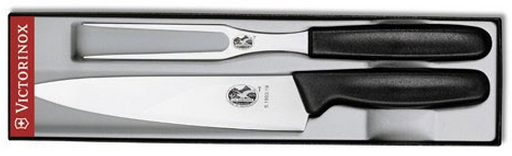
Key Features of a Professional Carving Knife
To understand its effectiveness and select the best one for your needs, it is important to know the characteristics that define a good carving knife:
- Long and Sharp Blade: They feature an elongated, rigid, and exceptionally sharp blade. This length, which can vary between 15 and 25 centimeters, is fundamental for making long, continuous cuts in large pieces of meat, facilitating filleting with great comfort and minimizing the need for multiple passes. A well-maintained edge is the basis of an impeccable cut.
- Firm and Narrow Tip: Its tip is designed to be firm enough to guide the cut with precision, allowing for straight and delicate incisions, and maneuvering around bones or joints with ease. The narrowness of the blade near the tip contributes to its agility.
- Ideal Length: As mentioned, the blade length of a carving knife usually ranges between 15 and 25 centimeters. This makes it slightly shorter than a salmon knife or meat filleting knife, which can be more flexible and longer, but longer than a standard chef’s knife, which gives it its specialization for medium to large pieces.
- Specialized Blade Design: For use in grills or barbecues, some carving knives may have a slightly wider and more robust blade, optimized for cutting roasted meats more easily, especially those with crusts or firmer layers. However, the general and most desirable characteristic is that the blade is thin and sharp for effortless cutting, allowing the knife to glide through the meat with minimal resistance. The thinness of the blade is crucial to prevent tearing of the fibers.
- Blade Material: Most professional carving knives are made of high-carbon stainless steel. This material offers an excellent combination of hardness (to maintain the edge), corrosion resistance (for easy cleaning and durability), and some flexibility to prevent breakage. Some high-end models may use special steels or even Damascus steel, which not only offer superior performance but also impressive aesthetics.
- Balance and Weight: A good carving knife should feel balanced in the hand. The weight should be distributed so that the knife feels like a natural extension of the arm, which reduces fatigue during cutting and allows for greater control and precision.
Versatile Uses in the Kitchen and on the Grill
The carving knife is a multifaceted tool, ideal for various culinary tasks involving the handling of cooked meats. Its specific design makes it irreplaceable in certain scenarios, guaranteeing professional results in every cut:
- Carving Large Roasts: It is perfect for carving large pieces of roasted meat, such as beef, pork, or lamb roasts, whole turkeys, stuffed chickens, cooked hams, and other large meats. Its long blade allows for cutting in a single pass, maintaining the integrity of the portion.
- Filleting Cooked Meats: Its design makes it ideal for slicing and cutting all types of meats once cooked, from a duck breast to a pork loin. It allows for obtaining thin and uniform fillets, essential for an elegant presentation and uniform cooking when reheating.
- Preparation of Meats and Fish (Raw and Cooked): Although its main use is for cooked meats, it is also used to clean and portion raw meats and fish, especially those that require fine and precise cuts, such as preparing carpaccios or removing tendons and fats from pieces of meat before cooking. Its precision is valuable for these delicate tasks.
- Serving at the Table: Beyond kitchen preparation, the carving knife is often the protagonist at the table, especially at special events or family dinners, where the meat is carved and served directly in front of the diners, adding a touch of spectacle and tradition.
- Combination with Other Utensils: Although excellent on its own, it is often combined with other accessories or knives for cutting meat with bones or splitting ribs. For example, for a rack of pork or a large chop, a butcher’s knife or an axe may be needed for the bone part, while the carving knife handles the meat.
The Indispensable Companion: The Carving Fork
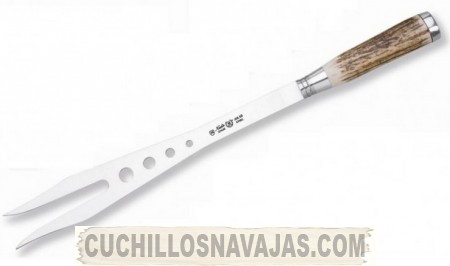
A good carving knife almost always goes hand in hand with its perfect companion: the carving fork. This utensil is fundamental for firmly holding the piece of meat in the most practical position for cutting. Without it, the meat could move, making cutting difficult and increasing the risk of accidents. Its two long tines are designed to damage the meat as little as possible when penetrating it, ensuring that the juices remain inside and the presentation is not affected. It is crucial that its tips are very well sharpened so that they penetrate the meat firmly without tearing it.
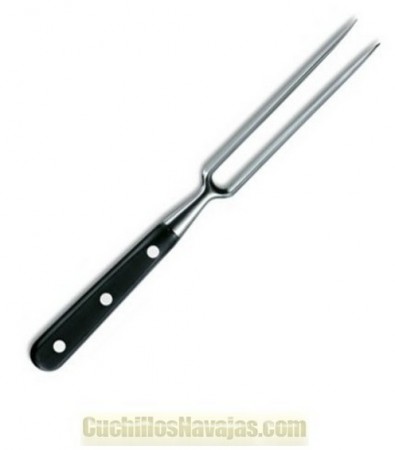
The carving fork aids in the precision of meat cutting, as they have strong and wide handles, as well as side tines so that the meat can be held in more than one direction. This provides unmatched stability, allowing the cook or carver to maintain absolute control over the piece, even the largest and slipperiest ones.
Carving forks vary in design, with tines that can be straight or slightly curved, and ergonomic handles made of various materials such as stainless steel, wood, or resistant plastics. The choice of handle is as important as that of the knife, as it must offer a secure and comfortable grip. In addition to holding, this fork is also useful for turning the meat while cooking and for serving the cut portions, acting as a versatile and essential complement in the art of carving.
Carving Knife vs. Other Meat Knives: Why Specialization Matters?
In the vast universe of kitchen knives, each tool has its purpose. While many knives can “cut” meat, the carving knife is specifically designed for the task of slicing large, cooked pieces with maximum efficiency and delicacy. Understanding its differences from other common knives will help you appreciate its value and choose the right tool for each task.
Carving Knife vs. Chef’s Knife
The chef’s knife is the workhorse of the kitchen, a multi-purpose tool with a wide, curved blade, ideal for chopping, slicing, and dicing a wide variety of ingredients. However, its generalist design makes it less optimal for carving large roasts.
- Blade: The chef’s knife has a wider and more robust blade, designed to withstand repetitive chopping and contact with the cutting board. The carving knife, on the other hand, has a thinner and narrower blade, which reduces friction when cutting cooked meat and allows for cleaner and more uniform cuts without tearing.
- Length: Both can have similar lengths, but the blade shape is key. The carving knife’s blade is straighter or has a very gentle curve, optimized for long, straight cuts.
- Function: While the chef’s knife is versatile for general preparation, the carving knife excels at the specific task of slicing cooked meat into thin and presentable portions, preserving juices and texture. Using a chef’s knife for carving can result in irregular portions and greater juice loss.
Carving Knife vs. Fillet Knife
The fillet knife is designed to separate meat from bone and fillet fish. It often has a more flexible and thinner blade than the carving knife.
- Blade Flexibility: Fillet knives usually have very flexible blades that conform to the contours of bones. The carving knife, on the other hand, has a more rigid blade, which is essential for making long, straight cuts in roasted meat without the blade bending or deflecting.
- Length and Width: Fillet knives can be longer and narrower than carving knives, especially those designed for salmon. The carving knife has a width and rigidity that allow it to handle the weight of a large roast.
- Main Use: The fillet knife is for preparing raw meat and fish, while the carving knife is for presenting and cutting cooked meat.
Carving Knife vs. Butcher Knife
The butcher knife, or boning knife, is a robust tool with a thick, curved blade, designed to cut through cartilage, tendons, and, in some cases, small bones. It is a brute force tool compared to the delicacy of the carving knife.
- Blade Robustness: The butcher knife has a much thicker and stronger blade, built for heavy-duty work. The carving knife is thinner and sharper, not suitable for cutting bones.
- Purpose: The butcher knife is used for butchering animals, cutting large pieces of raw meat, and separating meat from bone. The carving knife focuses on thin, clean slices of already cooked meat.
- Precision vs. Force: The carving knife seeks precision and presentation, while the butcher knife prioritizes strength and butchering capability.
In summary, the specialization of the carving knife lies in its ability to offer clean, uniform, and aesthetically pleasing cuts in cooked meats. Although other knives can perform the task, none do so with the same efficiency, precision, and respect for the integrity of the meat. Investing in a good carving knife is investing in the quality of your culinary presentations.
How to Choose the Ideal Carving Knife
When selecting your next carving knife, consider these key features to ensure optimal performance and a lasting investment. The right choice will not only facilitate your work but also improve the quality of your cuts and the overall kitchen experience:
- Blade Quality: Look for a knife with a high-quality steel blade, preferably high-carbon stainless steel. This material not only guarantees durability and resistance to corrosion and stains but also helps the edge stay sharp longer and be easier to resharpen. German or Japanese steels are often synonymous with superior quality in cutlery.
- Blade Length: The appropriate blade length is crucial, as it will determine the ease of cutting according to the size of the piece of meat you usually carve. For small or medium roasts (chickens, loins), a 15-20 cm blade may suffice. For larger pieces (turkeys, whole roast beef), a 20-25 cm blade will offer greater comfort and allow for longer, continuous cuts with a single pass.
- Handle Ergonomics: A comfortable and secure handle is essential to prevent accidents and facilitate handling, especially when working with hot or greasy meat. Look for a handle that fits well in your hand, that does not slip even if wet, and that offers a good balance with the blade. Materials such as wood (treated for water resistance), micarta, G-10, or high-quality synthetic polymers are excellent options for their durability and hygiene. A non-slip and well-designed handle is ideal for maintaining control.
- Edge and Edge Retention: An excellent edge is indispensable for achieving clean, effortless cuts. A good carving knife should offer an optimal balance between edge retention (how long it stays sharp) and ease of sharpening. Investigate whether the knife comes with an appropriate edge angle for carving (generally between 15 and 20 degrees per side) and whether it is easy to maintain with a home sharpener or a honing steel.
- Balance and Weight: The balance of the knife is key for effortless handling. A well-balanced knife feels light and controllable, reducing hand fatigue and allowing for more precise cuts. The total weight of the knife also influences; some prefer a lighter knife for agility, while others opt for a heavier one to feel the “presence” of the knife in hand.
- Construction: Most quality knives are full tang, meaning the blade extends through the entire handle, providing greater strength and durability. This is especially important for a knife that will be used to cut large pieces.
Tips for Carving Like a Pro at Home
Mastering the art of carving not only requires the right carving knife but also refined technique and some chef’s tricks. Follow these practical tips to make your carving experience impeccable and your roasts look and taste better than ever:
- Rest the Meat: This is perhaps the most important tip. Before carving, let the meat rest for a while out of the oven. Resting time varies depending on the size of the piece (e.g., 10-15 minutes for a chicken, 20-30 minutes for a large roast beef). This allows the juices, which concentrate in the center during cooking, to redistribute throughout the piece, preventing them from being lost when cutting. The result will be much juicier and more tender meat.
- Proper and Sharp Tools: Make sure you have a well-sharpened carving knife. A dull knife not only makes cutting difficult but can also be dangerous, as it requires more force and increases the risk of slipping. You can opt for a traditional knife or, for greater convenience, an electric one; the important thing is that it cuts cleanly and without sticking. Always have your carving fork handy to hold the meat firmly.
- Optimal Cutting Board: A good cutting board for meat is essential. Look for a wood or bamboo board (which are kinder to the knife’s edge) or high-density polyethylene. Some boards have a non-slip base for greater stability, or even perimeter grooves to collect juices, which can be used for sauces or for serving the meat, adding flavor and avoiding messing up the work surface.
- Specific Cutting Technique:
- For Poultry (Turkey, Chicken): If the bird has twine, cut it. Start by removing the thighs and wings. For the thighs, guide the knife along the hip joint, always cutting through the tendon and without touching the bone. For the breasts, find the central bone (sternum) and make a cut along it. Then, cut the breasts into slices transversal to the fibers, obtaining smaller and more tender strips.
- For Roasts (Roast Beef, Loin): Firmly hold the piece with the carving fork. Always cut against the grain of the meat. This shortens the muscle fibers, making each bite more tender and easier to chew. Make long, uniform cuts, using the full length of the carving knife blade, with a gentle sawing motion if necessary, but ideally with a single fluid motion.
- For Hams or Shoulders: While a specific ham knife is used for cured ham, for cooked or roasted hams, the carving knife is ideal. Secure the piece and cut into thin, consistent slices.
- Safety First: Always cut away from your body. Keep the fingers of the hand holding the meat bent inward (forming a “claw”) to protect them from the knife’s edge. A good grip on the handle and a stable board are crucial to prevent slips.
Care and Maintenance for a Long Lifespan
To prolong the lifespan of your carving knife and ensure its optimal performance over the years, follow these care and maintenance recommendations. A well-cared-for knife is a knife that will serve you faithfully on every occasion:
- Hand Washing: Always hand wash it with warm water and mild detergent immediately after each use. Avoid the dishwasher at all costs. Extreme heat, aggressive detergents, and impacts with other utensils in the dishwasher can damage the edge, corrode the steel, and deteriorate the handle.
- Immediate Drying: Dry it immediately with a soft, clean cloth after washing. Leaving the knife wet, even if it’s stainless steel, can cause water spots, corrosion, or pitting on the blade, especially on the edge.
- Avoid Abrasives: Do not use metallic scourers or abrasives, or powdered cleaners that can scratch the blade or damage the handle’s finish. A soft cloth or a non-abrasive sponge is sufficient for cleaning.
- Safe Storage: Store it in a safe and protected place to prevent the edge from being damaged and to prevent accidents. Options include:
- Knife blocks: They are convenient and protect the edge.
- Magnetic strips: They allow easy access and display your knives, but be sure to place them carefully so as not to damage the edge.
- Edge guards (sheaths): Ideal if you store the knife in a drawer with other utensils.
- Knife cases or rolls: Perfect for transport or for larger collections.
- Regular Sharpening: It is advisable to sharpen it periodically with a quality sharpener (whetstones, manual or electric sharpeners) to maintain its edge in optimal condition. The frequency will depend on the intensity of use. In addition to sharpening, the regular use of a honing steel between sharpenings will help realign the edge and keep it sharper for longer.
- Periodic Inspection: Occasionally check the knife for signs of wear, looseness in the handle, or damage to the blade. Preventive maintenance can prevent major problems.
A well-maintained carving knife is not only a pleasure to use but also a safe and efficient tool that will accompany you in countless celebrations and family meals.


Having a good carving knife not only facilitates the meat cutting process but also guarantees safety and precision in each slice. Its specialized design will allow you to obtain thin and uniform portions, enhancing the presentation of your dishes and ensuring that each diner enjoys the best part of your roast. A quality knife with an optimal edge reduces the need to apply excessive force, which helps maintain the integrity of the meat without tearing it, thus preserving all its juices and flavor.
In short, the carving knife is an essential tool for any kitchen enthusiast, from the beginner looking to improve their skills to the expert who yearns for perfection in the art of cutting and serving meat. Investing in a good knife can transform your culinary experience, allowing you to show off at the table with every perfect cut.
SELECTION OF PROFESSIONAL CARVING KNIVES
If you are looking to complement your equipment, we invite you to explore other essential tools for meat handling: