Spain is world-renowned for its rich cutlery tradition, and within this vast legacy the Catalan folding knives hold a special place. These pieces are not just tools, but true works of art that encapsulate centuries of history and artisanal mastery. If you’ve ever wondered about the origin, design or evolution of these fascinating knives, join us on this journey.
What Makes Catalan Folding Knives Unique?
Contents
In Catalonia there is a long tradition of making folding knives and blades dating back many years. Among the towns where this type of knife was made since the 17th century, we can highlight: Barcelona, Solsona and Ripoll. This type of knife reached its heyday between the 17th and 19th centuries and, unfortunately, declined in the 20th century.
Collections of antique folding knives often treasure large, exquisitely made examples, frequently identified as of Catalan origin. Although these knives share certain common characteristics that allow their identification and cataloguing, determining their exact origin can be a challenge. This is because few antique Catalan knives bear stamps or inscriptions indicating their precise provenance.
It is common that, due to their morphological and decorative similarities, a Catalan knife is mistakenly catalogued as from Albacete or even the Roussillon. The influence of the famed Albacete knives spread through Catalonia in the 19th century and from there their style reached Perpignan and the Roussillon, where Catalan-style knives were imitated and produced more abundantly and for a longer period than in Catalonia itself. Interestingly, the term “couteau catalan” used in France often refers to French knife models that imitate the Spanish style in general.
The typology we are discussing focuses mainly on defensive or large-sized folding knives, handcrafted in Catalonia during the 19th century and the early 20th, until the outbreak of the Spanish Civil War. Earlier pieces from the 17th and 18th centuries are scarce and do not fit a defined typology, being considered unique exceptions, such as the notable Navaja of Olot dated 1699.
Distinctive Design Characteristics
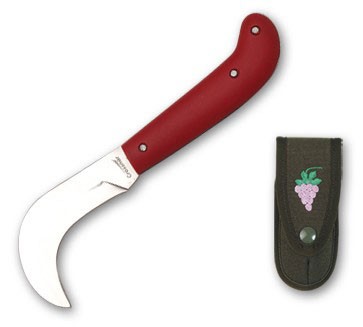
The Catalan folding knife is a simple knife that adapts very well to its different functions. There are five types of Catalan knives (Solonesa, Ripollesa, Gabacha, the Cut-Point Knife and the Pruning Knife) and in each type the handle design remains the same, though made from different materials ranging from plastic to exotic woods. What distinguishes each type of Catalan knife is the shape of the handle.
Antique Catalan knives, especially those from the late 19th century, have very particular features that make them recognisable.
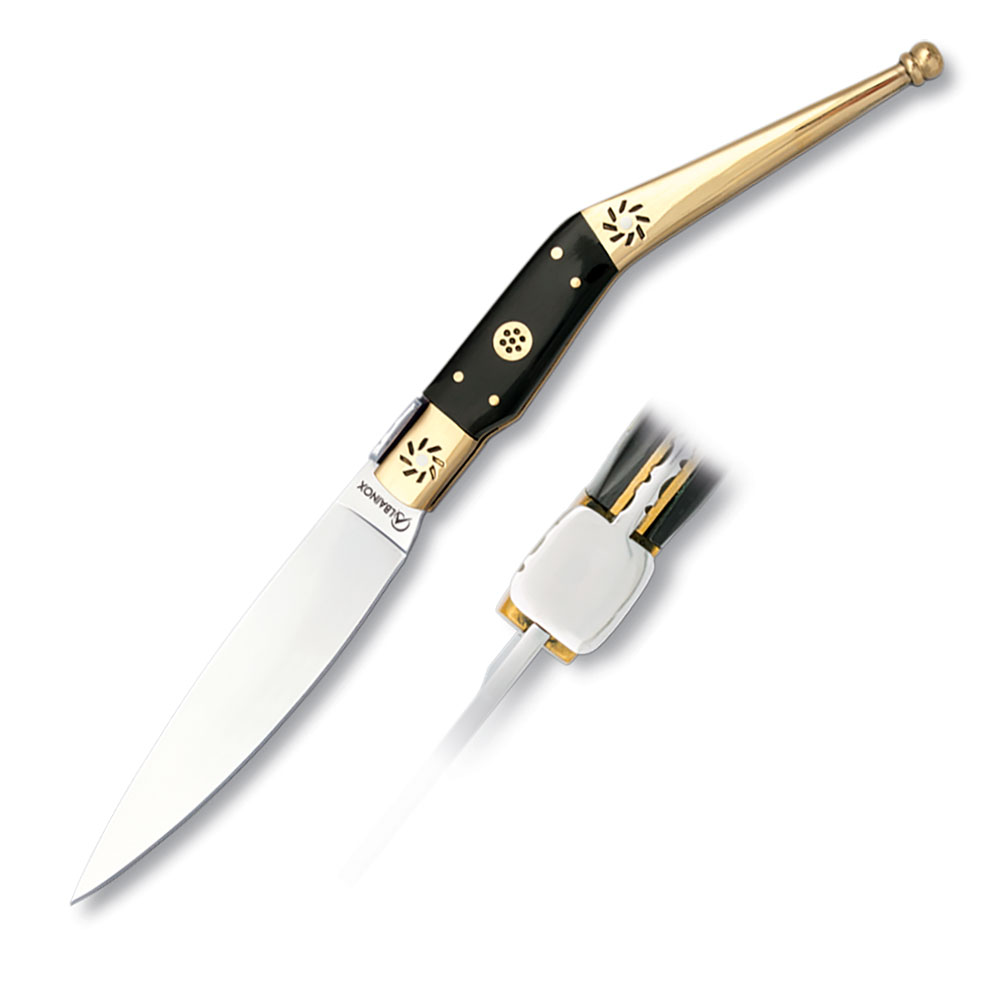
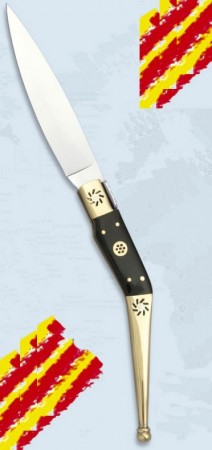
- Blade: Generally, the blade has a lanceolate shape, evoking the silhouette of a bay or myrtle leaf.
- Handle: The handle is unmistakable, characterised by a very pronounced angle at the end of the scales. In addition, the ricasso (the rear part of the blade that joins the handle) also forms a distinctive angle with the rest of the handle.
- Scales: They usually have a flattened surface and are richly decorated. It is common to see them adorned with
and delicate twisted-wire inlays. - Ricasso: It tends to have a conical shape.
- Closures: The most frequent closing systems on old knives are the window and the ring. More modern pieces, already from the 20th century, incorporate a lever lock.
Often these knives include details that add character, such as engraved inscriptions – for example, “Viva Mi amo” – or specific decorations like the Cross of Saint George on the ricasso, or inlays of small copper mirrors dyed red in their blond horn scales.
Solsona: The Heart of Catalan Cutlery
When speaking of Catalan folding knives, it is impossible not to mention Solsona, a town with a deep cutlery tradition. Historians suggest that the cutlery industry in Solsona dates back to the Middle Ages, although the first clear written sources appear in the 17th century.
It was in the 17th and 18th centuries that Solsona’s cutlery tradition reached its peak, rivalling other important centres such as Ripoll, Olot and the famed Albacete. During this period of expansion of Catalan craftsmanship, especially towards the Spanish colonies and the markets of Spain and the Americas, Solsona had at least 24 workshops, employing over a hundred people.
The greatest boost to this industry coincided with the First World War, a time when Spain remained neutral. This situation produced a significant increase in demand for knives from Spanish factories, especially from France. However, the family-run nature of Solsona’s cutleries, while allowing them to flourish during the war, also hindered the modernization needed to compete with the French industry once it recovered after 1918.
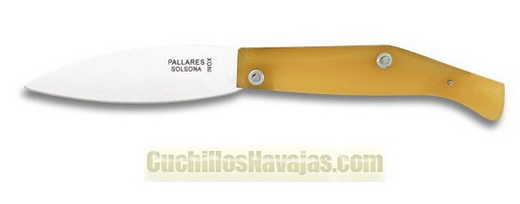
Solsona’s industry declined, and by the second third of the 20th century only three workshops remained. Today only one workshop still manufactures Catalan folding knives daily. Its name is Pallarés and it is located in Solsona. Currently the Solsona knife-making tradition is continued by a single workshop: Casa Pallarés, founded in 1917, a recognised brand that preserves this valuable legacy.
Notable Makers: The Legacy of Joan Costa
Within Solsona’s rich history stands the figure of Joan Costa y Atento (1903-1989), considered one of the town’s most creative artisans. From the 1930s until 1987, Joan Costa worked in his own workshop, dedicating himself to creating custom folding knives and blades with exceptional skill and creativity.
Among his own creations, the model known as the Gran Solsonès stands out, one of the most imposing knives he made, reaching eighty centimetres when opened. These knives, generally dated between 1930 and 1970, testify to their large size and quality. Joan Costa’s skill was even evident in unique designs, such as a Solsona knife shaped like a fish.
A Legacy That Will Endure
Catalan folding knives are much more than simple objects; they are living testaments to a deep artisanal tradition and to the history of a region. Their beauty, engineering and the stories they hold make them highly valued pieces for collectors and cutlery enthusiasts. Through their distinctive characteristics and the tireless work of artisans such as those in Solsona, Catalan folding knives remain a proud emblem of Spanish ingenuity and craftsmanship.