Do you feel the latent power in the steel? In one hand, the brute force of the cleaver, forged to break bones with a single blow. In the other, the lethal elegance of the chef’s knife, an instrument of surgical precision. They are not just two knives; they are two opposing cutting philosophies. Discover which one is destined to become the extension of your will in the kitchen and learn to master the tool you truly need.

Functional evolution and use of the cleaver and chef’s knife
Contents
- Functional evolution and use of the cleaver and chef’s knife
- Cleaver: The Power of Impact Forged in Steel
- Chef’s Knife: The Dance of Precision
- Head to Head: Technical Comparison
- Discover the Masters’ Tools
- Edge Geometry: The Secret is in the Angle
- When to Wield Each Blade? Your Definitive Buying Guide
- Resolve your doubts about kitchen knives: differences, uses, and durability
To understand their purpose, one must first know their evolution. Each design responds to a need, to a technique perfected over time.
| Functionality | Result |
|---|---|
| Functional origin and design | |
| Cleaver design | Wide and rectangular blade, solid, robust and wedge-shaped; designed to withstand repetitive impacts and generate force through its own weight. |
| Chef’s knife design | Resistant blade with optimized weight for general use; intended as a multi-purpose and versatile utensil for finer and more varied cuts. |
| Specialization in kitchen tasks | |
| Main function of the cleaver | Specialized in force and impact cuts: breaking down meat and bones, chopping cartilage, nerves, ribs and poultry pieces. |
| Main function of the chef’s knife | Utensil for chopping and cutting fruits, vegetables, raw meat and fish; prioritizes precision and versatility over heavy blows. |
| Cutting techniques and use of the spine | |
| Cleaver technique | Requires a striking movement (chopping) that uses the mass to generate impact and separate pieces with less physical effort. |
| Chef’s knife technique | Uses oscillating cut or rocking motion, combining pressure and displacement for precise and controlled cuts. |
| Use of the spine | The spine of the cleaver is usually thick and can be used to tenderize meat with blows; the chef’s spine provides rigidity and balance and can also be used to crush ingredients. |
| Sharpening angles and maintenance | |
| Cleaver sharpening angle | It is sharpened with larger angles, typically 20–25° per side (40–50° in total), seeking a reinforced edge that withstands effort and impacts. |
| Chef’s knife / filleting sharpening angle | For fine cuts (filleting), sharper angles are used, for example ~10° per side (20° in total), prioritizing penetrability and sharpness. |
| General maintenance | Both tools require periodic sharpening to maintain their edge; the cleaver must respect its original angle (20–25° per side) during sharpening. |
| Clarification of use and confusions | |
| Confusion with the Chinese Cleaver | The western cleaver is often confused with the Chinese Cleaver, which has a similar rectangular blade but, in many variants, is designed for chopping vegetables, meat and fish and not for cutting bones. |
| Domestic adoption and recommendations | |
| Domestic need for the cleaver | Recommended when habitually preparing large cuts of meat or pieces with bone; typical household models of 15 to 20 cm are sufficient for home use. |
| Domestic need for the chef’s knife | It is the most popular knife and is usually sufficient for those who perform lighter cutting tasks or cook less frequently; its versatility makes it indispensable in general cooking. |
Cleaver: The Power of Impact Forged in Steel
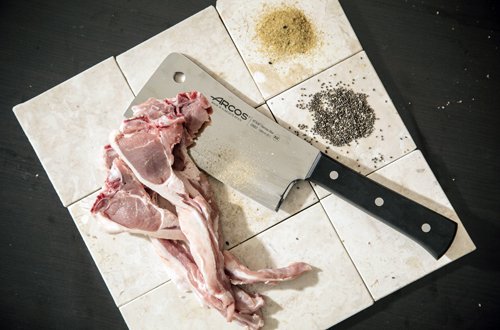 The cleaver doesn’t ask permission. Its wide, rectangular, and massive blade is designed as a conquest weapon against the most challenging ingredients. With significant weight and a thick spine, its wedge-shaped design is optimized to withstand repetitive impacts without yielding. Don’t look for delicacy in it, but pure power.
Its mission is clear: to chop bones, break down large pieces of meat, cut through cartilage and tendons, or make its way through extremely hard vegetables like pumpkins. It is a tool of strength, where the knife’s own weight generates the necessary momentum for a clean and forceful cut.
Chef’s Knife: The Dance of Precision
If the cleaver is strength, the chef’s knife is skill. Considered the all-rounder and the true workhorse of any kitchen, it is the fundamental tool for 90% of daily tasks. Its noticeably thinner and lighter blade features a characteristic curve that turns it into an extension of your hand.
This design is no accident. It allows for the rocking cut technique, an oscillating movement over the board that chops, slices, and juliennes with unparalleled speed and ergonomics. From finely dicing an onion to filleting a fish or carving a roast, its versatility consecrates it as the undisputed king of preparation.
Head to Head: Technical Comparison
| Feature | Cleaver (Kitchen Axe) | Chef’s Knife |
|---|---|---|
| Main Function | Force and impact cuts (bones, cartilage, hard ingredients) | Versatile all-rounder (chopping, slicing, filleting) |
| Cutting Technique | Dry, downward strike, leveraging weight | Rocking or oscillating motion for precise cuts |
| Blade Design | Thick, wide, rectangular and robust (15-20 cm) | Thin, with a pronounced curve and sharp tip (20-30 cm) |
| Weight | Heavy, to generate momentum | Light to medium, to reduce fatigue |
| Versatility | Low, it is a specialized tool | Extremely high, covers most needs |
| Ergonomics | Designed for a strong grip, less comfortable in prolonged use | Optimized for comfort and safety in repetitive tasks |
- Cleaver (Kitchen Axe)
-
- Main Function: Force and impact cuts (bones, cartilage, hard ingredients)
- Cutting Technique: Dry, downward strike, leveraging weight
- Blade Design: Thick, wide, rectangular and robust (15-20 cm)
- Weight: Heavy, to generate momentum
- Versatility: Low, it is a specialized tool
- Ergonomics: Designed for a strong grip, less comfortable in prolonged use
- Chef’s Knife
-
- Main Function: Versatile all-rounder (chopping, slicing, filleting)
- Cutting Technique: Rocking or oscillating motion for precise cuts
- Blade Design: Thin, with a pronounced curve and sharp tip (20-30 cm)
- Weight: Light to medium, to reduce fatigue
- Versatility: Extremely high, covers most needs
- Ergonomics: Optimized for comfort and safety in repetitive tasks
Discover the Masters’ Tools
Cleavers
Chef’s Knives
The right steel choice is the first step to mastering your kitchen. Each task requires a specific blade, forged to perform with maximum efficiency. Explore a selection of tools designed for professionals and enthusiasts who settle for nothing less than perfection.
Edge Geometry: The Secret is in the Angle
Not all edges are created equal. The cleaver demands a robust and durable edge, so it is sharpened with a larger angle, between 20 to 25 degrees per side. This creates a reinforced edge (40-50 degrees in total) that withstands the brutal effort of hitting bones without chipping.
Conversely, the chef’s knife prioritizes superior penetration capability. Its edge is much sharper, with angles that can be around 10-15 degrees per side. This razor-sharp edge glides through food with minimal resistance, ensuring clean cuts that preserve the integrity of the ingredients.
When to Wield Each Blade? Your Definitive Buying Guide
The answer to “which one to buy?” is not in the knife, but in your kitchen and the challenge you intend to conquer.
You should choose the Cleaver if:
- You habitually work with butchering: If you need to separate ribs, chop whole poultry, or process large cuts of meat with bone, it is an indispensable tool.
- You face hard ingredients: Cutting pumpkins, yams, or even frozen meats ceases to be a struggle and becomes a simple task.
- You are looking for a tool for professional or high-performance domestic butchery, where strength and efficiency in butchering are crucial.
You should choose the Chef’s Knife if:
- You need a single versatile tool: It is the most versatile knife, capable of performing the vast majority of cutting, chopping, and slicing tasks in the kitchen.
- You prioritize precision and ergonomics: Its design is optimized for prolonged and comfortable use, allowing detailed cuts and total control.
- Your cooking focuses on vegetables, fish, boneless meats, and general preparations. For the home cook, it is usually more than enough.
An important note: do not confuse the Western butcher’s cleaver with the Chinese chef’s knife (Cleaver). Although its rectangular shape is similar, the latter is often a multi-purpose tool with a thinner blade, used for chopping and slicing, not for breaking bones.
Resolve your doubts about kitchen knives: differences, uses, and durability
What is the main difference between a chef’s knife and a cleaver?
The main difference between a chef’s knife and a cleaver lies in their design and function: the chef’s knife has a thinner, wider, and curved blade, designed to make precise and versatile cuts, applying a rocking motion to chop, cut, and slice; while the cleaver has a wide, thick, and rectangular blade, specially manufactured to cut with force, ideal for chopping bones, cartilage, and large pieces of meat, withstanding repetitive impacts without damage.
What type of knife is best suited for cutting meat?
For cutting meat, the most suitable type of knife depends on the specific task and personal preferences. Here are some outstanding options:
- Carving knife: Ideal for cutting tough portions of cooked or raw meats, such as roasts and hams. Its blade is thick and durable, which facilitates clean and efficient cutting.
- Meat knife with a smooth edge: Preferred by meat connoisseurs for cutting steaks without tearing the meat. However, it requires frequent sharpening.
- Meat knife with a serrated edge: Versatile and less prone to dulling, ideal for cutting steaks, pizzas, cakes, but it can separate the meat rather than cut it cleanly.
- Butcher’s knife: Robust and heavy, perfect for dividing large pieces of meat and cutting small bones.
- Santoku: Ideal for fine and precise cuts in lean meats and poultry.
What characteristics should a good chef’s knife have?
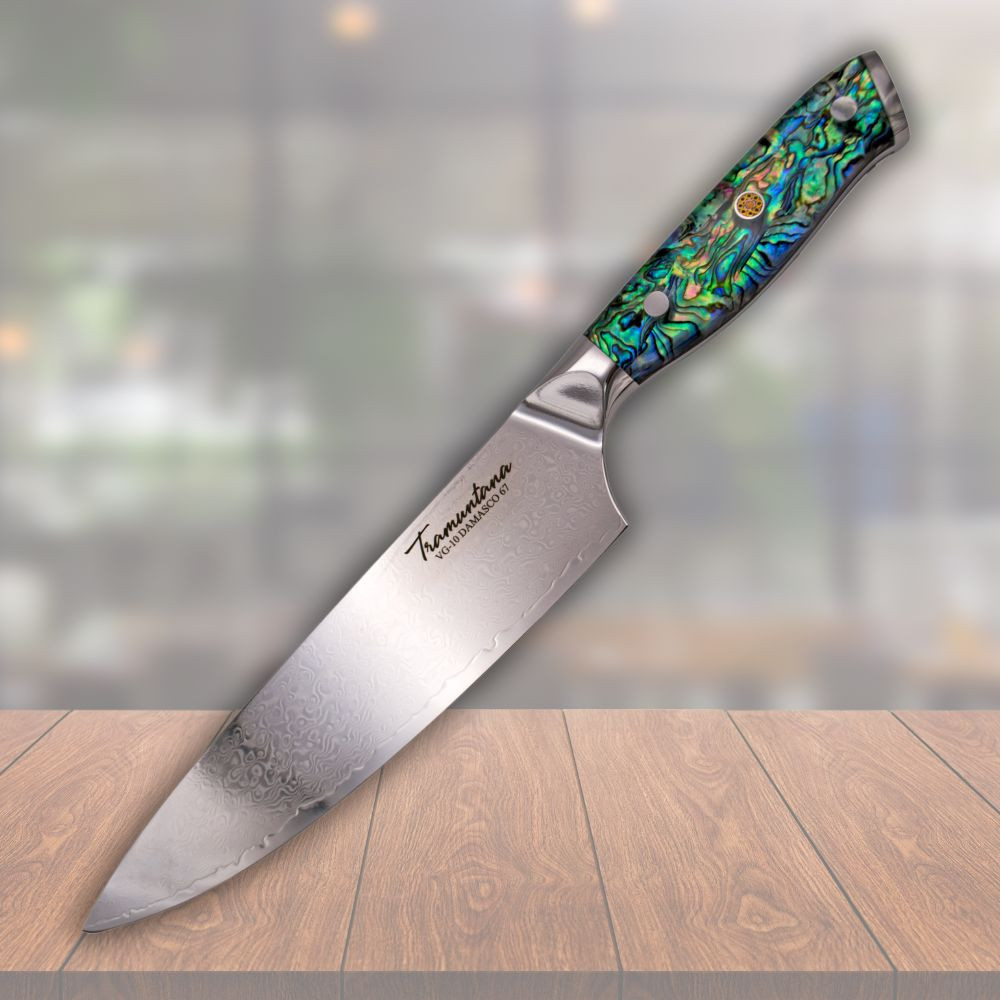
A good chef’s knife should have a high-quality blade, preferably made of high-carbon stainless steel for its durability and edge retention, with an ideal length usually between 18 and 24 cm, with 20 cm being very common. The blade may have a slight curve to facilitate rocking cuts or be straighter depending on preference and use.
It must be ergonomic, with a comfortable handle that fits well in the hand to allow a secure grip and minimize fatigue with prolonged use. A well-balanced knife between blade and handle facilitates control and reduces effort. In addition, the weight must be sufficient to cut dense ingredients but not so heavy as to cause fatigue.
The sharpness and durability of the edge are crucial: it must maintain its edge longer and be easy to sharpen when necessary. Likewise, the knife must be made of wear-resistant and easy-to-clean materials to maintain hygiene.
Finally, its design must be versatile, suitable for multiple kitchen tasks from cutting vegetables, herbs, and meats to filleting, allowing precision and efficiency in preparation.
What is the most common use of the cleaver in the kitchen?
The most common use of the cleaver in the kitchen is to chop bones, cut large pieces of meat with bone, and perform tasks that require force and pressure, such as carving whole poultry or dividing tough cuts like ribs or loin. Its wide, heavy, and robust blade makes it especially useful for jobs where other knives would be insufficient, and it is not intended for delicate cuts as much as for those that require power and stability.
What materials are most durable for kitchen knives?
The most durable materials for kitchen knives are high-carbon stainless steel, carbon steel, and Damascus steel.
- High-carbon stainless steel combines corrosion resistance with good edge retention and durability, being easy to maintain.
- Carbon steel stands out for its ability to achieve and maintain a very sharp edge for longer, although it requires more care to prevent oxidation.
- Damascus steel offers an excellent combination of sharpness, wear resistance, and aesthetic appeal, as it combines layers of hard and softer steel.
Other materials such as ceramic and titanium are resistant to oxidation and lightweight, but ceramic is more fragile to impacts and titanium can be less common and more expensive.
In summary, for an optimal balance between durability, edge, and maintenance, high-carbon stainless steel and Damascus steel are considered the best options for durable kitchen knives.
| Blade shape | Main function | Typical use | Material and design |
|---|---|---|---|
| Wide, curved, thin | Precise and versatile cuts, chopping, slicing with rocking motion | Daily cooking, multiple tasks | Balanced for fine handling |
| Wide, rectangular, thick | Force cuts, chopping bones and large meats | Processing hard and large ingredients | Robust to withstand strong impacts |
- Type of oil
-
- Mineral oil — High penetration, does not degrade or attract dirt
- Camellia oil — Natural, acid-free, non-volatile
- Lithium grease — Dense, durable, does not evaporate
Ultimately, the blade you choose will define your style in the kitchen. The cleaver is the assertion of strength, a tool that imposes its will on matter. The chef’s knife is the expression of skill, an instrument that dances with ingredients. Whether you need the power of a blow or the finesse of a stroke, wielding the correct steel not only facilitates the work, but elevates the very art of cooking.