In the heart of the forest, where pure air mixes with the aroma of damp earth, lies the true essence of mycological gathering. Each mushroom is a treasure, and its extraction, an art that requires the perfect tool. But what is the secret to an impeccable cut that respects forest life? The curved billhook-style knife or the traditional straight one? Get ready to sharpen your knowledge and discover the ideal companion for your days of hunting for porcini and saffron milk caps.
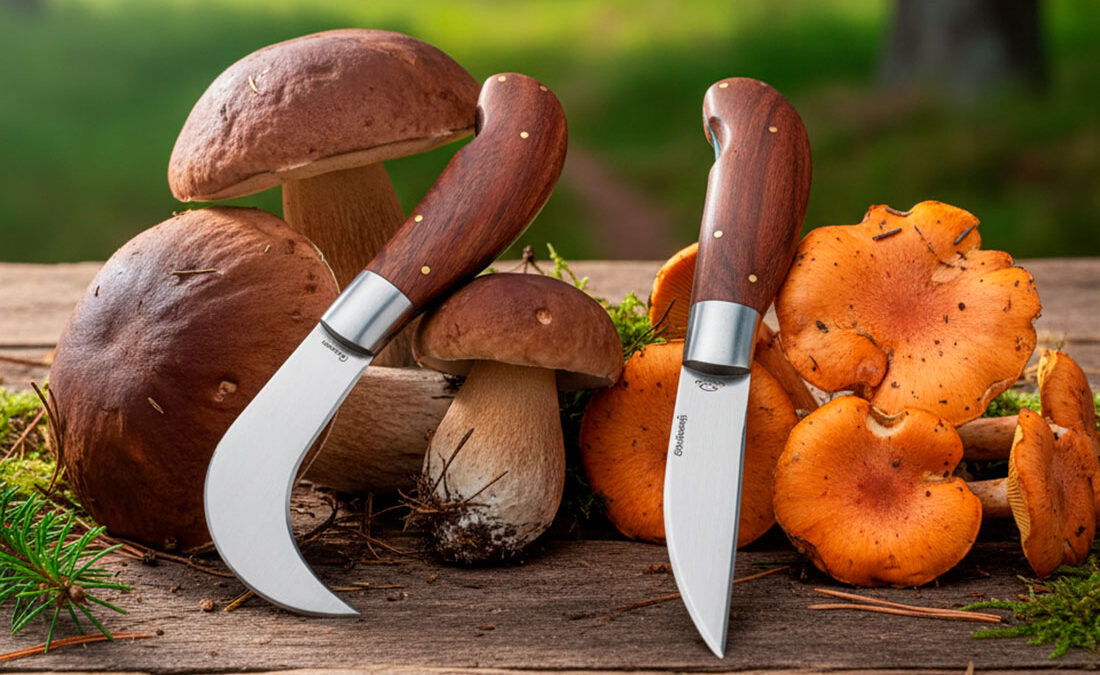
The Crucial Choice: Curved or Straight, the Harvester’s Summer
Contents
- The Crucial Choice: Curved or Straight, the Harvester’s Summer
- The Perfect Curve: Precision and Respect in Every Cut
- The Art of Detail: Essential Accessories in Your Mushroom Knife
- And the Straight Knife? Its Niche and Limitations
- A Species-Specific Approach: Porcini and Saffron Milk Caps in Detail
- Solve your doubts about knives for collecting mushrooms
- Ideal knife type for porcini
- The Legacy of the Forest in Your Hands
Mushroom collecting is more than just a walk; it’s a ritual where the choice of tool makes the difference between a respectful harvest and irreparable damage to the mycelium. Experienced mycologists and gatherers agree: the type of blade on your knife is not a minor detail, but the pillar of a sustainable harvest.
Mycological knives are mainly divided into two large families: those with a curved blade and those with a straight blade. Although at first glance the distinction may seem subtle, its impact in the field is monumental. A curved knife, with its billhook-like silhouette, has proven to be the indispensable ally for those seeking the clean and precise cut that nature demands, especially for such prized species as the porcini and the saffron milk cap.
The Perfect Curve: Precision and Respect in Every Cut
Imagine sliding the blade along the base of a saffron milk cap, feeling just the right resistance before it cleanly separates from the earth, effortlessly, leaving the mycelium intact for future fruiting. This is the promise of the curved blade knife. Its design, often with a concave edge, has been meticulously conceived to cut stems with surgical precision, minimizing damage to the fungus and its delicate underground system.
For flat-capped mushrooms or those that grow close to the ground, the curvature allows for a smooth and efficient cut, facilitating the cleaning of soil and debris. It is a choice that not only benefits your basket, but also the health of the mycological ecosystem.
Maximizing the Harvest: Porcini and Saffron Milk Caps with Your Curved Knife
| Species | Cutting and Cleaning Recommendation |
|---|---|
| Porcini (e.g. Boletus edulis) | The Boletus is a robust fungus. The mycological knife typically includes a serrated back part with slightly blunt teeth. This practical outer edge specifically helps to clean the stems of robust fungi like the Boletus, to leave them clean before storing them. |
| Saffron Milk Caps (Lactarius deliciosus) | The Saffron Milk Cap (or Robellón) is one of the most widespread and appreciated edible species in Spain. The harvesting rule for all mushrooms is to cut them at the base of the stem with an appropriate knife, which is best done with a curved blade. |
The Art of Detail: Essential Accessories in Your Mushroom Knife
A true mycological knife goes beyond a simple blade. It is a compendium of functionalities designed for the demanding gatherer. Most models incorporate a soft bristle brush (often retractable or boar bristle) which becomes your immediate ally for cleaning the mushroom at the very moment of collection. Dirt, dry leaves or small plant debris disappear with a gesture, improving the preservation of the fungus and facilitating its subsequent identification.
In addition, many handles integrate a small ruler, a simple but vital tool to respect minimum size regulations, and its ergonomics guarantee a secure grip even on the longest and wettest days. High-quality stainless steel in the blade, such as 420 or Sandvik, ensures not only a precise cut and a long service life, but also minimal maintenance, resistant to the corrosion that the forest environment imposes.
And the Straight Knife? Its Niche and Limitations
While the curved knife reigns in the world of mushrooms, is there room for straight-bladed knives? Certainly, their robustness makes them useful for tasks requiring greater force or for prying up mushrooms with very rooted stems. However, for the delicacy required in collecting most edible mushrooms, their design can exert excessive pressure or damage the mycelium more easily.
Straight knives are usually more suitable for very firm mushrooms where a more powerful cut is needed, but they lack the versatility of precision cutting and respect for the fungus that the curved knife offers, especially for sensitive species. Therefore, while they may have a role, the specialized mycological knife remains the superior option for the conscious gatherer.
A Species-Specific Approach: Porcini and Saffron Milk Caps in Detail

Each mushroom species has its own peculiarities, and the ideal tool adapts to them. For the majestic Boletus, with its often thick and consistent stem, a knife with a robust curved stainless steel blade is essential. An intermediate size, between 7.5 and 8.5 cm, allows even the largest specimens to be handled comfortably. And don’t forget the brush: it’s your first line of defense against the dirt and debris that cling to its stem.
As for the Saffron Milk Cap, which often hides under pine needles or grows close to the ground, the precision of the curved blade is invaluable. Cleaning is key for this mushroom, and the integrated brush will save you considerable work at home, while the ergonomic handle offers you a firm grip in the wettest forests. The ability to make clean and precise cuts is vital to avoid tearing its delicate flesh and to preserve the richness of its habitat.
Solve your doubts about knives for collecting mushrooms
What is the difference between a curved and a straight knife for cutting mushrooms?
The main difference between a curved and a straight knife for cutting mushrooms lies in their usefulness and effectiveness in different collection contexts.
- Curved Knife: These knives usually have a design similar to a billhook, which allows for flat and precise cuts. They are ideal for flat-capped mushrooms or those that grow close to the ground, as their curve allows them to slide smoothly around the stem, minimizing damage to the fungus. The curvature also facilitates the cleaning of soil and other debris from the stem.
- Straight Knife: Straight knives are usually more robust and are designed to pull out mushrooms with strong stems. They are useful for prying and extracting more deeply rooted specimens, especially those with robust and deep stems. They are not always the best option for delicate or flat mushrooms, as they can exert too much pressure and damage the fungus.
The difference between the two lies in the way the mushroom is worked: curved ones allow for a softer cut at the base of the cap or stem, reducing damage and facilitating extraction; straight ones can be more useful for mushrooms with firmer stems that require leverage.
What type of knife is best for cutting porcini?
Ideal knife type for porcini
The best knife for cutting porcini is a specific mycological knife, specially designed for mushroom collection. The most recommended models usually have the following characteristics:
- Curved stainless steel blade: Allows for a clean and precise cut of the stem, minimizing damage to the mycelium and promoting habitat conservation.
- Intermediate size: A blade between 7.5 and 8.5 cm is ideal, as it allows even large specimens to be cut and handled comfortably.
- Built-in brush: Essential for cleaning dirt, soil or plant debris from the porcini at the moment of collection.
- Small ruler on the handle: Useful for measuring the diameter of the cap and respecting collection regulations.
- Ergonomic handle: Made of wood or non-slip material, for a secure and comfortable grip during long days.
- Protective sheath: To transport it safely and prevent accidents.
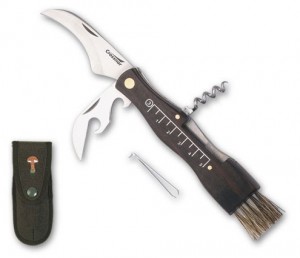 There are advanced models, designed specifically for porcini, which also incorporate a retractable spade or spatula. This tool allows very buried or large mushrooms (such as porcini) to be extracted without damaging the mycelium, acting as a lever to loosen the soil and facilitate extraction.
In summary, the perfect knife for porcini is a specific mycological one, with a curved blade, brush, ruler and, preferably, an extractable spade, all in a manageable format and designed to facilitate clean and respectful collection of the environment.
Are knives with brushes more effective for collecting mushrooms?
Knives with brushes are more effective for collecting mushrooms because they allow for precise cutting of the stem and immediate cleaning of soil and debris while the mushroom is still in the field. This facilitates collection, improves the preservation and appearance of the mushrooms, and helps to identify them correctly, in addition to preventing damage to the mycelium so that the mushrooms can grow back. Having the brush integrated into the knife avoids carrying additional tools and saves time.
What characteristics should an ideal knife for saffron milk caps have?
An ideal knife for collecting saffron milk caps should have the following characteristics:
- Curved blade: Ideally, the blade should be curved to facilitate clean and precise cuts, which helps preserve the underground mycelium and minimizes damage to the fungus.
- Blade length: A length of 7 to 8 centimeters is suitable for making clean and precise cuts without damaging the mushroom stem.
- Steel material: It must be of high quality, such as stainless steel, resistant to corrosion and easy to sharpen to maintain a good edge.
- Handle: The handle must be made of a moisture-resistant material, such as beech or oak wood, to provide a good grip even with wet hands.
- Brush incorporation: A brush at the end of the handle is very useful for cleaning mushrooms immediately after harvesting, improving their preservation and facilitating their identification.
- Safety: A safety locking mechanism is convenient to prevent accidents when the knife is not in use.
Is it better to use a billhook knife or a conventional knife for mushrooms?
To collect mushrooms, it is better to use a billhook knife because its curved blade allows the mushroom stem to be cut cleanly and precisely without damaging the roots, facilitating the mushrooms to grow back in that place; in addition, it is designed to adapt to the shape of stems and branches, which makes it ideal for this purpose.
Conventional knives usually have small and less sharp blades for large mushrooms, while the billhook, with its characteristic curved blade, makes clean cuts at ground level, especially useful for mushrooms that grow stuck to the ground like saffron milk caps or thistle mushrooms. Many billhook knives also include brushes to clean the mushrooms at the time of collection, making the task more complete and comfortable.
In summary, the billhook knife is preferred for mushrooms due to its specialized design and functionality in mycological collection.
The Legacy of the Forest in Your Hands
At the end of the road, with your basket full and the satisfaction of a day well spent, the tool you chose takes on new meaning. The mycological knife, especially the one with a curved blade, is not just an instrument; it is an extension of your respect for nature and your commitment to sustainable harvesting. Every clean cut, every porcini or saffron milk cap collected with precision, contributes to the continuity of this vital cycle. So the next time you delve into the forest, carry with you not only knowledge, but also the right knife to honor the legacy of the fungi kingdom.