
Starting a home landscaping project can be exciting, but a fundamental question soon arises when facing weeds: which tool to buy? Understanding the differences between curved and straight machetes is the first step to avoid wasting money or making unnecessary efforts. Many novice gardeners assume that any sharp blade works for everything, but the technical reality is different.
Curved or straight machete? The novice gardener’s dilemma
Contents

The straight machete is the classic standard. Its linear blade allows clean cuts on flat surfaces and is ideal for clearing low vegetation or chopping soft wood. On the other hand, the curved machete, commonly called a rula or garabato, features a downward-curving tip that facilitates hooking branches and protects the blade from direct contact with the ground. When choosing a garden machete, you should consider whether you will be pruning dense bushes or simply clearing tall grass.
The uses of a straight machete stand out for the versatility of wide movements, while the uses of a curved machete shine in the precision of cutting by traction. In this guide for novice gardeners, we will analyze the battle of the curved vs. straight blade to determine which is the best garden machete for your terrain. Are you looking for a dry, powerful blow or a tool that gathers weeds as you cut? Below, we will clear up all your doubts so that your gardening machete becomes your best ally and not a heavy obstacle during your outdoor workdays. Preparing your green space requires the right tool to avoid injuries and maximize efficiency every day.
Key differences in design and cutting: curved vs straight
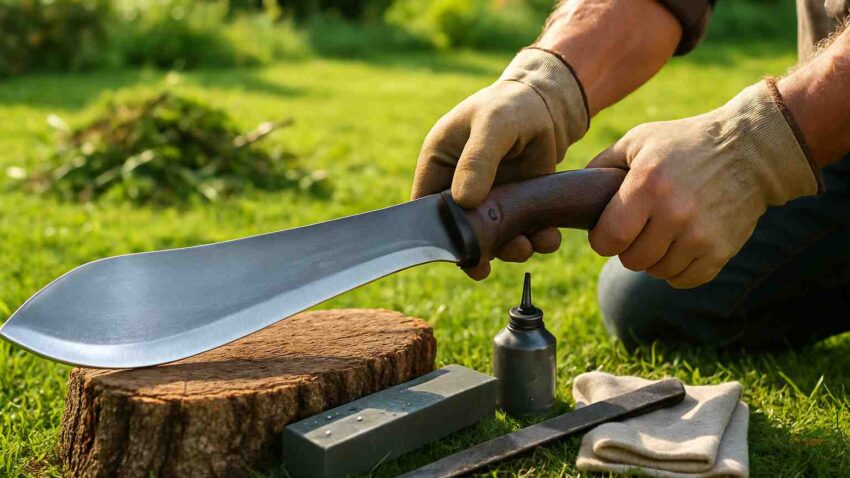 When delving into the differences between curved and straight machetes, the first thing that stands out is the morphology of the blade. The straight machete, similar to a long knife, concentrates its weight in the central body. This allows for downward cuts with great control, making it ideal for thin trunks or branches that require a sharp blow at a specific point. It is the quintessential gardening machete tool if you are looking for an aesthetic and uniform finish on tall or straight ornamental shrubs.
In contrast, the curved machete has a geometry designed for traction. Its hook-shaped tip allows it to “hug” vegetation, which is extremely useful when dealing with fibrous weeds, vines, or dense grass that would otherwise slide off the blade. The uses of a curved machete are fundamental in overgrown terrain, as the curve prevents the blade from being damaged by hitting hidden stones at the base of plants.
When choosing a garden machete, the physics of cutting is vital. The comparison of curved vs straight blade will dictate your fatigue level: the curve takes advantage of the natural dragging motion of the arm, while the straight one relies more on the brute force of impact. For novice gardeners, understanding that the straight machete offers precision and the curved one offers efficiency in volume is key to the perfect purchase. In summary, if your garden has more thin wood, go for the straight one; if it has more wild grass, the curved one is the best garden machete for your case.
Basic uses in the garden: practical examples
 To better understand the differences between curved and straight machetes, there’s nothing like observing real situations you’ll encounter in your home. Imagine you find yourself in a corner of the patio that has been forgotten for months. This is where the uses of a curved machete truly shine. Thanks to its rounded tip, this type of garden machete is ideal for “combing” and cutting tall grasses or weeds with a dragging motion. If you need to clean the base of a hedge without accidentally hitting a trunk you want to protect, the curve allows you to hook only what you want to remove.
On the other hand, the straight machete is the best ally for standard maintenance pruning. If you have overgrown shrubs and need to trim thin branches (such as those of a lemon tree or a bougainvillea), the straight machete provides a larger and more stable contact surface. When choosing a garden machete, think about the density of your vegetation: novice gardeners often get easy tasks or “quick wins” by using the straight format to clear paths and the curved one to clear dense areas of brush.
The comparison of curved vs straight blade boils down to precision versus volume. While the uses of a straight machete focus on direct and clean impact for medium branches, the curved one minimizes the risk of the blade bouncing off soft surfaces. For any gardening machete, remember that the goal is to make your work easier; therefore, the best garden machete will be the one that completely adapts to the predominant vegetation in your particular plot.
Common mistakes, tips, and which one to choose for your garden
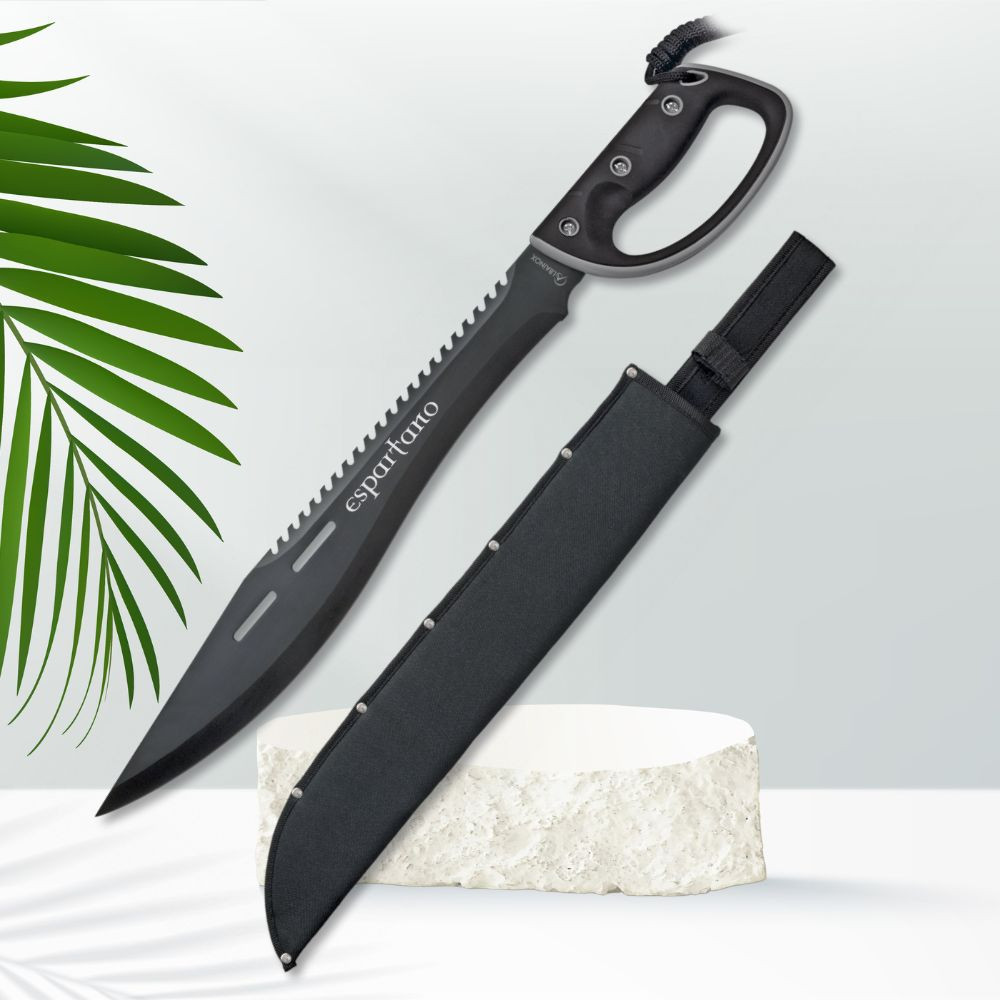
Ultimately, the differences between curved and straight machetes not only lie in their aesthetic form but also in avoiding typical mistakes of novice gardeners. One of the most common mistakes is to buy a straight machete to clear very low weeds and end up hitting rocky ground, which quickly dulls the blade. Conversely, using the curved machete to try to cut thick trunks or dry wood can be dangerous, as the curved tip tends to deflect if there isn’t enough plant fiber to hook or retain.
To keep your gardening machete tool in optimal condition, always clean it after each use to prevent plant sap from corroding the steel. Constant sharpening is key: a dull blade forces you to apply much more physical force, drastically increasing the risk of accidents due to bounce. If you ask yourself, “Which is really the best garden machete?”, the answer depends on your particular green inventory. If you have a small garden with ornamental plants, choose a medium-sized straight model. If you own a large plot with invasive wild grasses, the garden machete with a curve will be your absolute salvation.
The ones you shouldn’t miss if you want them NOW
Looking for a tool that doesn’t just perform, but dominates? The market is flooded with cheap blades that vibrate at the first blow or lose their edge opening a simple box. But if you’re here, you’re not looking for a toy; you’re looking for reliable steel that you can have in your hands tomorrow.
We’ve filtered out the noise to bring you the ultimate machetes that are available right now. No eternal waiting lists or “coming soon.” Just pure power, combat ergonomics, and the guarantee that when the weeds get tough, you’ll be the one to win.
The terrain isn’t going to clear itself. Units of these models fly off the shelves precisely because they are what experts recommend for immediate and real use. Don’t let your next expedition or field work be hindered by a mediocre tool.
In conclusion, understanding the comparison of curved vs straight blade will save you valuable time and much unnecessary muscle fatigue. To choose a garden machete correctly, analyze whether you prefer direct impact or traction. The uses of a straight machete perfectly coexist with the uses of a curved machete; in fact, many professionals recommend having both in the shed. Get ready to transform your garden today with the right tool! Visit your trusted hardware store and try the weight of both styles before deciding.