
When you delve into the fascinating world of diving, at first, your list of essential equipment usually includes wetsuits, masks, or fins. However, as you accumulate dives, you discover the need for accessories you hadn’t initially considered. One such accessory, and believe us, one you’ll want to take with you on every underwater expedition, is the diving knife. As the saying goes in the diving world: “It’s always better to have a knife and not need it than to need it and not have it.”
But what is this intriguing tool actually for? Keep reading and we’ll reveal its secrets!
What is a Diving Knife For? Debunking Myths and Revealing Real Utilities
Contents
- What is a Diving Knife For? Debunking Myths and Revealing Real Utilities
- What Are Diving Knives Like? A Look at Their Technical Characteristics
- Maintenance: Key to Durability and Effectiveness
- Finding Your Ideal Diving Companion
The primary function of a diving knife is, above all, safety. While the idea of using it to defend against sea creatures might sound like a Hollywood fantasy, nothing could be further from the truth. Its fundamental purpose is to help you in emergency situations. It is a survival and liberation tool, designed to solve problems that can unexpectedly arise underwater.
Imagine this: you find yourself entangled in an abandoned fishing net, a fishing line, or even a dense tangle of marine vegetation. In these situations, where every second counts, a knife allows you to free yourself or your buddy quickly. Although it may seem improbable, these situations are more common than one might think, especially near the coast or in environments such as caves and wrecks, where the probability of entanglement increases exponentially. It is such a recognized safety element that, in fact, it is legal to carry it precisely to avoid mishaps with illegal fishing nets, which unfortunately still persist in many coastal areas. The ability to cut a line or a net in seconds can mean the difference between a scare and a serious risk situation.
In addition to self-release, this tool has other vital functions that demonstrate its versatility and why it is an indispensable accessory for any responsible diver:
- Marine Fauna Rescue: Divers often encounter marine animals trapped in abandoned nets or fishing lines. A diving knife allows you to free these creatures, contributing to the conservation of the marine ecosystem. But always with extreme caution and never intervening with large or dangerous animals such as sharks or cetaceans, where your intervention could be more harmful than useful! It is essential to have adequate knowledge of marine fauna and act sensibly.
- Underwater Communication: If your knife has a metallic handle or a stainless steel end, you can tap it against your diving cylinder to produce a metallic sound that propagates effectively underwater, attracting the attention of your buddies. This is an effective form of communication when visibility is limited or you need to alert someone quickly.
- Temporary Anchoring: In situations of strong current or when you need to stabilize yourself to perform a specific task, you can use the tip of the knife to temporarily anchor yourself to the seabed (provided you do not damage the ecosystem, preferably on sand or inert rock). This allows you to maintain a fixed position without drifting.
- For Snorkeling Enthusiasts: Even if you only snorkel, a knife can be a good idea in areas where fishing nets, lines, or algae could cause you problems. An entanglement on the surface can be as dangerous as underwater, and a compact knife can offer a quick solution.
- General Purpose Tool: Outside of emergencies, a diving knife can be useful for minor tasks such as adjusting equipment, cleaning fouling, or even for spearfishing, where it is used to finish off prey (although this latter function is specific to that modality).
Scuba diving or diving, also called self-contained diving, is the act by which we immerse ourselves in water, be it a river, lake, sea, or any type of body of water into which we can enter and delve. It is an activity that connects us with a different world, full of life and mystery, where proper preparation and equipment are fundamental to enjoy each dive safely. And in this context, the diving knife is revealed as a key piece of equipment.
The term “submarinism” accurately defines the practice of diving in the sea, which is also, by far, the most practiced form of diving worldwide. Diving practiced in caves or flooded galleries is called cave diving, and diving in mountain lakes, high-altitude diving. Each of these modalities presents unique challenges, and in all of them, the presence of a diving knife can be a determining factor for safety and the resolution of unforeseen events.
As for self-contained diving, it is diving that uses the self-contained underwater breathing apparatus (SCUBA), which is a regulator powered by one or more compressed air tanks, allowing the diver to breathe normally and without problems of cables or other elements that could hinder progress. This freedom of movement is what makes autonomous diving so popular, but it also underscores the importance of having accessible and efficient tools for any eventuality.
Spain is an ideal destination for scuba diving. There are many interesting places to enjoy dives, some of them of extraordinary beauty. Furthermore, scuba diving can be practiced regardless of one’s level, with modalities existing for all types of people. From the crystalline waters of the Mediterranean to the volcanic depths of the Canary Islands, each dive offers a unique experience, and in all of them, safety is paramount. The presence of a diving knife in your equipment provides an extra layer of confidence and preparation.
The best places to practice it in Spain are the Medes Islands and Cap de Creus in Girona, Columbretes Islands in Castellón, the islands of Formentera and Menorca in the Balearic Islands, El Hierro Island in the Canary Islands, and Cabo de Gata in Almería. In these diverse environments, where marine life is abundant and geological formations are impressive, the possibility of encountering lines, nets, or even dense algae is real. Therefore, carrying a diving knife is a recommended practice by experienced and professional divers.

In Spain, we find FEDAS, which is the organization that regulates sports activities related to the underwater world, such as Sport Diving, Underwater Fishing, Fin Swimming, Underwater Orientation, Underwater Photo and Video. This federation promotes safety and good practice in all disciplines, and the inclusion of a diving knife as part of the safety equipment is a constant in recommendations for divers.
In Recreational Diving, with SCUBA, Spain was a pioneer, organizing numerous schools and developing underwater archaeological research. The first Spanish diving club was founded in 1952, the C.R.I.S of Barcelona, and since then the number of Diving Clubs and Centers in our country has increased extraordinarily. This rich history and the continuous evolution of diving in Spain have consolidated the importance of carrying a diving knife as an integral part of personal safety equipment.
What Are Diving Knives Like? A Look at Their Technical Characteristics
The variety of diving knives is enormous, with different sizes, shapes, materials, and attachment options. Choosing the right one will depend on your diving style, the conditions you dive in, and where you prefer to carry it. Each feature is designed to optimize its performance and safety underwater.
Size and Portability: Every Centimeter Counts
Size is one of the first characteristics to consider when choosing a diving knife. An excessively large knife can be uncomfortable, cumbersome, and prone to snagging on equipment or the marine environment. For recreational diving, where agility and minimal resistance are key, it is recommended to opt for compact knives with blades no longer than 12 cm. These are easier to handle and less intrusive. However, for spearfishing, where the knife has a more active function in catching and dispatching prey, longer and sharper knives of the stiletto type may be preferred, designed for fast and effective penetration.
Regarding attachment, the ideal is that you can reach the knife quickly and efficiently with either hand, even with thick gloves. Accessibility is crucial in an emergency. The most common attachment options and their advantages are:
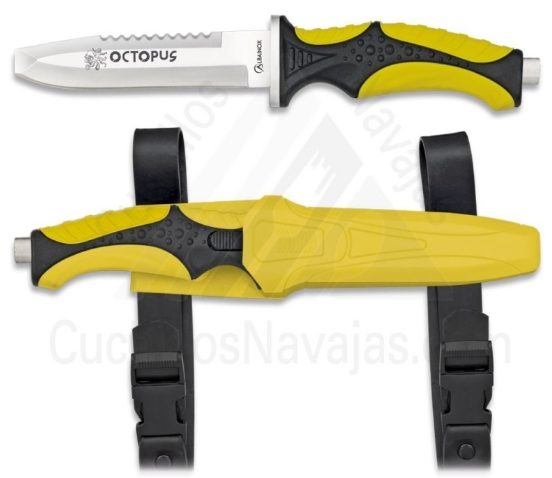
- Leg: Traditionally, diving knives are attached with straps to the calf or thigh, with the left leg being most common for right-handed divers. This position allows quick access and is familiar to many.
- BCD or Jacket: More compact knives can be attached to the pocket of a buoyancy control device (BCD), a harness, or even to the BCD straps. This option keeps the knife closer to the torso, reducing water resistance and the risk of snagging.
- High-Pressure Hose: An option for very compact knives, which are attached directly to the regulator hose. This keeps them extremely accessible and out of the way.
- Mask or Console: Some miniature knives are designed to attach to the mask strap or instrument console, offering immediate accessibility for cutting fine fishing lines.
A distinction is usually made between primary knives (those with a blade longer than 7.5 cm, intended for more robust tasks and as a main safety tool) and backup knives (with a smaller blade, designed to be discreet and serve as a backup or for very specific tasks, such as cutting fine fishing lines).
Fixed or Folding Blade: Speed vs. Compactness
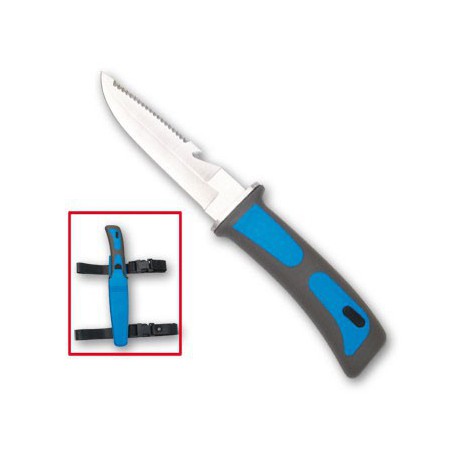
Most diving knives have a fixed blade, meaning the blade is permanently exposed, and you only need to remove them from their sheath to use them. This feature guarantees unmatched deployment speed, vital in emergency situations where every second counts. Folding blades, while offering greater compactness and discretion when not in use, require careful opening to avoid accidental cuts and can be slower to deploy underwater, especially with gloves or under stressful conditions. For this reason, fixed-blade knives are the preferred option for most divers as their primary safety tool.
Manufacturing Materials: Stainless Steel vs. Titanium
The blade material is crucial for its corrosion resistance in the saline environment, its ability to maintain its edge, and its ease of maintenance. The two predominant materials are stainless steel and titanium, each with its own advantages and disadvantages:
Stainless Steel
It is the most common and economical alloy for diving knives. Within stainless steel, we find different grades:
- Grade 304: Very versatile and resistant to surface oxidation, providing a good initial edge. However, it is a softer alloy that requires more frequent sharpening to maintain its cutting ability. It is a solid option for recreational divers looking for good value for money.
- Marine Grade 316: Incorporates molybdenum, which gives it greater hardness and superior corrosion resistance, especially in saltwater environments. It maintains a sharp edge longer than 304. Some models even have a special polish that facilitates water drainage to better prevent oxidation and salt buildup.
Despite being “stainless,” it is fundamental to understand that in constant contact with saltwater and if not dried and maintained correctly, they can rust and lose their edge. They are relatively easy to sharpen with common tools.
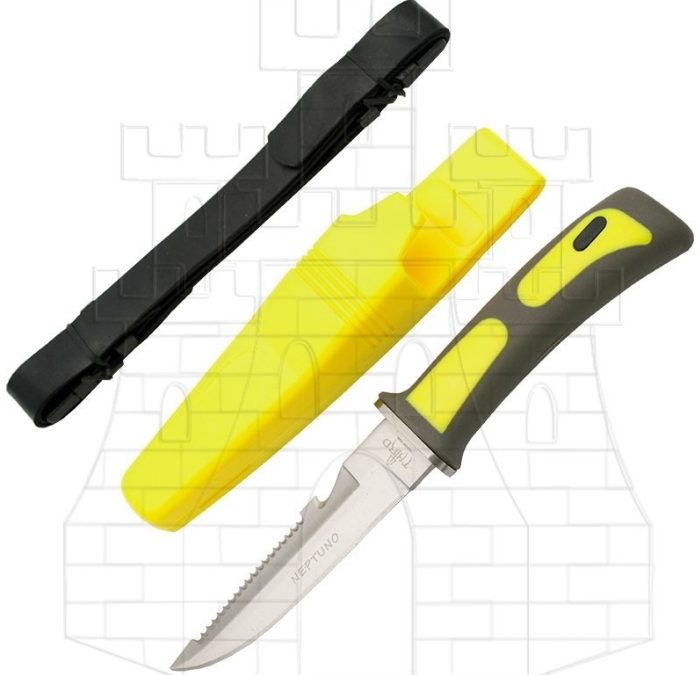
Hardened Titanium
It is a very popular material among more demanding and professional divers. Titanium blades are completely resistant to corrosion, meaning they will not rust, even if exposed to saltwater for long periods without immediate drying. In addition, they are extremely lightweight and noticeably harder than stainless steel. They maintain an excellent edge for a long time, making them superior cutting tools for saltwater environments where durability and edge retention are critical. However, their hardness also means they are more difficult to sharpen than stainless steel ones, requiring specific tools and greater skill.
Cutting Edges: Smooth, Serrated, or Combined
The cutting efficiency of a diving knife is maximized by combining different types of edges, each designed for specific tasks:
- Smooth Edge: Ideal for clean, precise cuts with a pushing motion, such as filleting a fish or cutting soft materials. They are easy to maintain and sharpen, allowing for fine control over the cut.
- Serrated Edge: Composed of teeth, it is designed for saw-like cuts on tough and fibrous materials such as thick ropes, lines, fishing lines, nets, or hard algae. A thick rope, which would be tedious or almost impossible to cut with a smooth edge, is easily sectioned with the serrated edge thanks to the concentration of force in the teeth. This edge stays sharp longer, although it is more difficult to sharpen and requires specific tools for its maintenance.
Practically all modern diving knives include both types of edges, often on the same cutting plane. Typically, the smooth edge is located near the tip, for precision cuts and perforations, and the serrated edge, near the handle to improve support and leverage in forceful cuts of resistant materials. On longer blades, the edges can be separated, dedicating a longer length to the serrated edge and a shorter one to the smooth edge to maximize the efficiency of each type of cut.

Knife Tips: Designed for Every Need
The shape of the knife tip also varies significantly depending on its primary function and the desired level of safety:
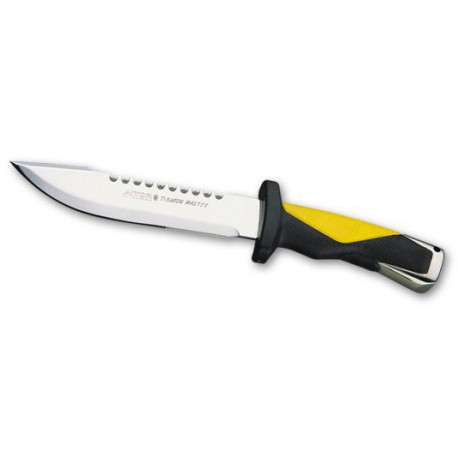
- Chisel Tip (Blunt): Flat and blunt, designed for prying rather than piercing. It is considered the safest, drastically reducing the risk of accidental cuts or punctures to equipment, wetsuits, or, more importantly, to oneself or a buddy during a stressful underwater situation. They are excellent for unscrewing or opening shells.
- Sharp Tip: Offers various shapes, each with its own advantages.
- Drop Point: This is a strong and versatile tip, easy to control for precise cutting or piercing. It is one of the most common due to its balance between strength and penetration capability.
- Clip Point: This is narrower and sharper, making it very useful for sticking into a very tangled line, for example, on a boat propeller, to initiate a clean and precise cut.
- Tanto Tip (Japanese): Combines elements of both chisel and sharp tips, with a more angled and sharper end for cutting. It offers a very strong and durable tip, suitable for prying with less risk of breakage and for cutting in narrow or hard-to-reach places. Some models may have a small blunt point on the tanto tip for added safety without sacrificing cutting ability.
Sheath and Attachment System: Safety First
Diving knife sheaths are usually made of plastic, polymer, or Kydex, hard and resistant materials that withstand marine conditions. Their compact design prevents the knife from taking up too much space and getting snagged. It is essential that the sheath has a secure system for gripping the knife and a good closing mechanism, whether it’s a snap button, a rubber strap, or a clip system, ensuring that it is not lost or accidentally opened during the dive. Ease of single-handed extraction is a key factor to consider.
Other Additional Features
Some diving knives incorporate extra functionalities that can be very useful, turning them into multi-function tools:
- Line Cutting Notches: Sharp semicircular indentations, often on the top of the blade or handle, specifically designed to cut small but strong fishing lines that are difficult to manage with the main edge.
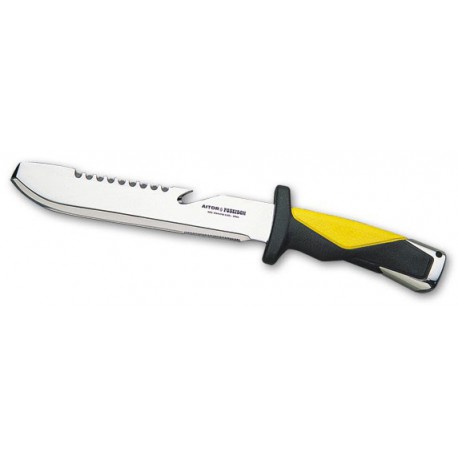
- Integrated Tools: Some models may include functions such as bottle openers, shackle openers (for releasing rusted or stuck shackles), or even small hex wrenches for minor equipment adjustments.
- Multi-function Handles: With stainless steel ends or hard materials that can be used as a signaling hammer (by striking the tank) or as an impact tool to break small objects or pry.
- Lanyard Hole: A small hole in the handle for passing a safety lanyard, preventing the loss of the knife if it accidentally comes loose.
Maintenance: Key to Durability and Effectiveness
It’s no use having the best diving knife if it doesn’t cut when you need it most. Proper maintenance is crucial to prolong its lifespan, maintain its functionality in extreme conditions, and prevent corrosion or wear. A well-maintained knife is a reliable tool; a neglected one can fail at the most critical moment.
Here are some simple steps to ensure your diving knife is always in perfect condition, ready for any eventuality:
- Rinse after each use: It is vital to thoroughly rinse the knife with fresh water immediately after each dive, especially if it has been in saltwater. Saltwater is highly corrosive. If it was in seawater, you can briefly immerse it in a mild vinegar solution (one part vinegar to ten parts water) before rinsing with fresh water. This helps neutralize salts.
- Complete drying: After rinsing, completely dry the knife with a soft, clean cloth. Pay special attention to grooves, teeth, and joints. Don’t forget to also dry the inside of the sheath, as trapped moisture can accelerate corrosion. You can gently use compressed air to dry difficult areas.
- Regular lubrication: Apply a thin layer of petroleum jelly, anti-corrosion oil (specific for marine equipment), or silicone grease to the metallic parts of the blade and the sheath mechanism before storing it again. This creates a protective barrier against moisture and salt.
- Periodic sharpening: The edge can dull over time, even without frequent use, due to water exposure and occasional use. Regular sharpening ensures your knife is always ready to cut with maximum efficiency. Use the appropriate sharpening stone or sharpener for each type of edge (smooth and serrated).
- Inspection of the attachment system: Before and after each dive, ensure that the knife extracts and secures easily and safely in its sheath. Check the straps and closing mechanisms for signs of wear or breakage.
- Proper storage: Avoid leaving the knife exposed to direct sunlight or in hot, humid places. Store it in a cool, dry place, preferably out of the sheath if you are going to store it for a long period, to allow for better ventilation.
- Correct use: Use the knife only for the purposes for which it was designed. Avoid using it as a screwdriver, hammer, or for opening cans, unless it has a specific function for that. Improper use can damage the edge and the structure of the knife.
Even titanium knives, while highly resistant to corrosion, should be rinsed after each use to remove salt residues and maintain their shine. Regular inspection for any mechanical damage, such as nicks on the edge or deformations in the tip, is also important to ensure their reliability.

Finding Your Ideal Diving Companion
As with much diving equipment, the ideal knife is a very personal choice. There is no universal “best knife,” but rather the best knife for you. It will depend on your particular diving style: how you dive (recreational, technical, spearfishing), where you dive (open water, caves, wrecks), what activities you like to do underwater, and how you prefer to carry your equipment. A diver exploring wrecks in cold water will have different needs than a tropical diver who snorkels. Consider the type of materials you might need to cut and the frequency of your dives.
The good news is that, with the enormous variety of diving knives available in different sizes, shapes, materials, and attachment options, finding the perfect companion for your underwater adventures should not be a difficult task. Take your time to research, read reviews, and, if possible, try different models to see which one best fits your hand and your equipment. Your ideal diving knife is waiting for you to strap it on and dive in to explore the underwater world with the peace of mind of knowing you are prepared for any situation.