If you are a culinary professional or simply a cooking enthusiast, you know that a sharp knife is the most important tool. It not only facilitates the task of cutting, but also guarantees your safety. And when it comes to keeping your knives in top condition, choosing the right tool is essential. This is where the French brand Fischer, with over 160 years of history, stands as a benchmark of quality and tradition.
Often, the terms “sharpener” and “honing steel” are used interchangeably, but do you really know the difference? In this article, we will unravel the characteristics of both and show you why Fischer products are the preferred choice of experts worldwide. From the brand’s history to the science behind its tools, we will guide you to choose the ideal product for your needs.

Fischer’s history in the world of French cutlery is impressive, spanning over 160 years. It all began in 1849, when Monsieur Fischer asked Monsieur Rameau, an artisan from Sens, to manufacture sharpening steels, thus giving life to the Fischer brand. Almost a decade later, in 1859, Etienne Bargoin established his own artisanal cutlery in Thiers, a region recognized as the heart of the bassin coutelier (cutlery basin) in France. The destiny of the two companies, Fischer and Bargoin, intertwined in 1978 when the Bargoin and Raynaud families acquired Fischer, moving their operations to Thiers to be at the epicenter of cutlery. Finally, in 2010, the two entities merged, giving rise to Fischer-Bargoin, consolidating itself as one of the most important cutleries in France. Since 2017, the brand has chosen to communicate and market its products exclusively under the Fischer name.
The Secret to a Perfect Edge: Sharpeners vs. Fischer Honing Steels
Contents
The main confusion arises from thinking that both tools perform the same function. Although both seek to improve a knife’s cutting ability, they do so in very different ways. Understanding the difference will help you maintain your knives most efficiently and prolong their lifespan.
What is a Honing Steel or Steel Rod?
A honing steel, or steel rod, is a steel rod with a finely grooved surface. Its function is not so much to sharpen, but rather to maintain and realign the knife’s edge. When you use a knife, the edge, which is incredibly thin, bends or twists slightly, losing its cutting ability. The honing steel, by rubbing against the edge, straightens these micro-deformations and restores the perfect alignment of the edge. It removes hardly any material from the knife, making it ideal for daily maintenance. In other words, it “wakes up” your knife’s edge to make it operational again.
Fischer’s traditional steel honing steels are the choice of many professionals. With expert heat treatment that guarantees a hardness of 62 to 64 HRC and an 8-micron hard chrome coating, these tools not only realign the edge, but also polish and improve its wear resistance. In addition, most Fischer honing steels are magnetized to retain the small metal particles that come off during the process, ensuring a clean and safe working environment.
Fischer offers different types of cuts on its honing steels, adapted to different sharpening needs:
- Standard Cut: Very abrasive, ideal for very dull or worn knives.
- Fine Cut: Combines sharpening and honing, impeccably restoring the edge and burr of professional blades.
- Extra-Fine Cut (FISCHROM Series): Perfect for maintaining the edge of already sharpened knives, providing a “razor-like” sharpening.
What is a Sharpener?
In a broader context, sharpeners are tools that do remove material from the knife blade to create a new edge. This includes diamond and ceramic sharpeners, as well as sharpening stones. Unlike a honing steel, a sharpener is the tool you will use when your knife is noticeably dull and the honing steel is no longer enough to restore its cutting ability. Its job is to create a new, sharp edge from scratch.
Fischer’s diamond sharpeners are robust and efficient. They are capable of sharpening even the hardest steels quickly, although it is important to use them carefully so as not to remove too much material. They are the perfect solution when you need quick and powerful sharpening.
Fischer’s ceramic sharpeners, on the other hand, work more finely and slowly. They are ideal for obtaining an extremely sharp edge, similar to a scalpel. While they take a little longer to act, the result is an exceptionally precise edge.
A honing steel (in a broader context, referring to ceramic or diamond ones) is a rod that removes material from the knife blade. It is capable of sharpening a relatively dull knife without the need for prolonged sharpening. Diamond honing steels are thicker and more solid, ideal for quickly sharpening knives even from the hardest steels, although they can remove a lot of material. Ceramic honing steels are finer, work slower, but offer sharper results.
Fischer: The Science of Sharpening at the Service of the Professional
Fischer’s reputation has been built on an unwavering commitment to quality and innovation. The brand has earned its worldwide prestige for manufacturing high-precision sharpeners and honing steels, indispensable tools for chefs, butchers, and any demanding professional in the culinary field. The key to its success lies in maintaining traditional manufacturing techniques, to which a touch of innovation and modernization is added. In fact, Fischer is currently the last manufacturer of sharpening steels in France.
Fischer products are manufactured in France under strict quality controls. Top-quality materials are used to ensure efficient sharpening without damaging the blade’s edge. These materials include:
- Special steels: with a high carbon percentage (such as 100C6 steel with 1% carbon), selected for sharpening harder stainless steel knives.
- Ceramic.
- Diamond.
The manufacturing process includes expert heat treatment that guarantees a hardness of 62 to 64 HRC in their honing steels, allowing any type of knife on the current market to be sharpened. In addition, all their honing steels have an 8-micron thick hard chrome coating, which increases the surface hardness of the edges by 3 or 4 HRC. A crucial feature is the magnetization of the honing steels, a fundamental operation that retains the tiny steel particles generated during sharpening, thus protecting food.
Which Fischer Sharpener to Choose According to Your Profile?
Choosing the right tool depends on your needs and the condition of your knives. Here’s a quick guide to help you make the best decision:
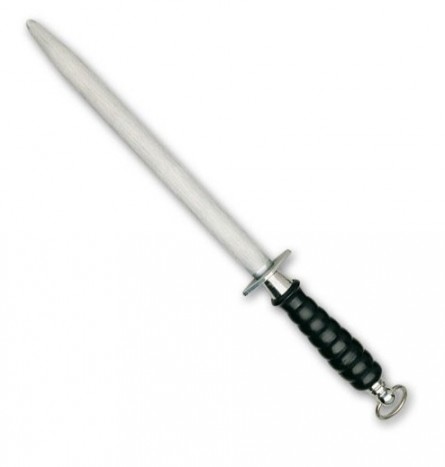
- For Daily Maintenance (Professional or Domestic Use): A steel honing steel with a fine or extra-fine cut is perfect. It will allow you to realign the edge of your knives every time you use them, keeping them sharp without the need for more aggressive sharpening. The Professional Honing Steel in the image below is an excellent example of a tool that will last for years and perform flawlessly.
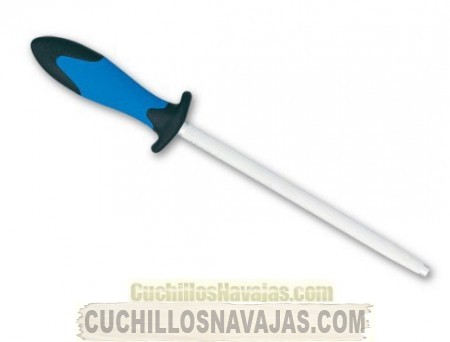
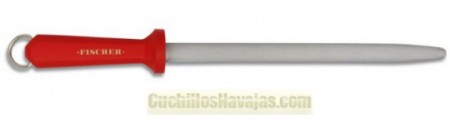
- For Dull Knives (Occasional Sharpening): If your knives have lost their edge and need a complete “tune-up,” a diamond sharpener or a honing steel with a standard cut will be the right tool. Both remove the necessary material to create a new edge, albeit with different aggressiveness.
The Technique for Impeccable Sharpening
Regardless of the type of Fischer tool you choose, technique is key. The key is to maintain the correct sharpening angle. Generally, an angle of approximately 15 degrees is recommended for Japanese knives and 20 degrees for European knives. You can rest the tip of the honing steel on a flat surface like a countertop or cutting board for greater stability, or even sharpen freehand if you have experience. Start at the heel of the blade and slide the knife along the honing steel until you reach the tip, making sure that the entire edge comes into contact with the tool.
Sharpeners and honing steels are perfect tools for daily maintenance and minor touch-ups of knives. They can even sharpen serrated knives, such as bread knives, as long as the diameter of the honing steel is similar to the size of the serrations.
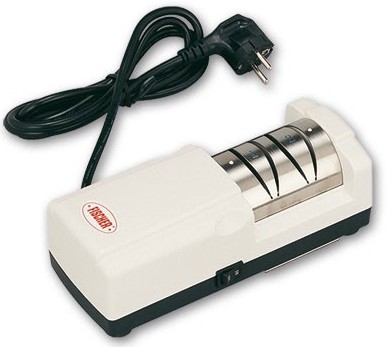
The reputation of Fischer products, both their renowned honing steels and Bargoin knife blades, extends beyond the Thiers region. Bargoin knives, for example, are highly valued by professional chefs worldwide, found in both Michelin-starred kitchens and more traditional restaurants. Fischer defends its savoir-faire internationally, exporting its products to over 60 countries. The brand has earned the trust of thousands of professionals in the gastronomic sector thanks to the consistency in its performance and its long lifespan. Investing in one of these tools is choosing French mastery, precision, and durability that will accompany you for many years.
Discover the wide range of Fischer sharpeners and honing steels and experience the pleasure of effortless cutting. You can see more models and options at the following link SEE MORE HONING STEELS AND SHARPENERS.