Today we want to address a very common question among our customers: Why is there such a marked difference in price between handcrafted knives and mass-produced ones? Today, we are going to delve into this exciting topic to unveil the art and technique behind each type of production, helping you understand their true value and why each has its particular charm.
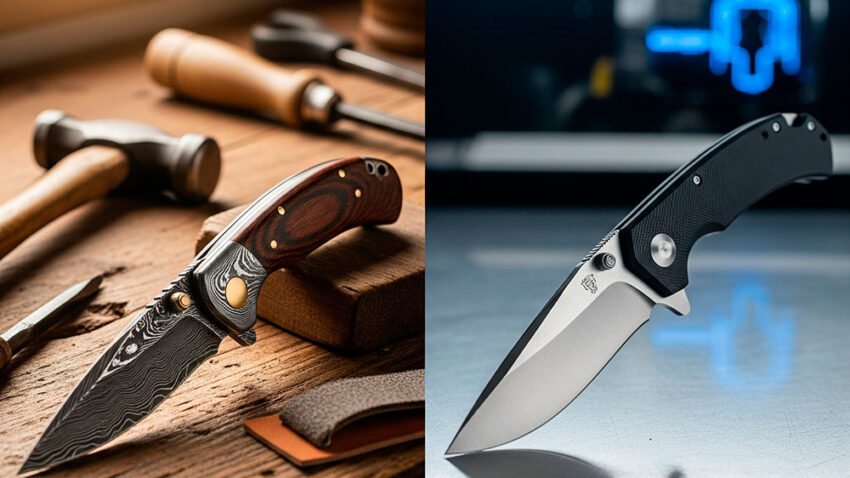
One of the most beautiful and unforgettable experiences is having the privilege of visiting those authentic forges where knives and pocket knives are made, where production is done by hand and with manual tools, hearing that characteristic sound of the steel being struck, glowing red hot from the fire produced by wood or charcoal, to be forged and then tempered at different temperatures.
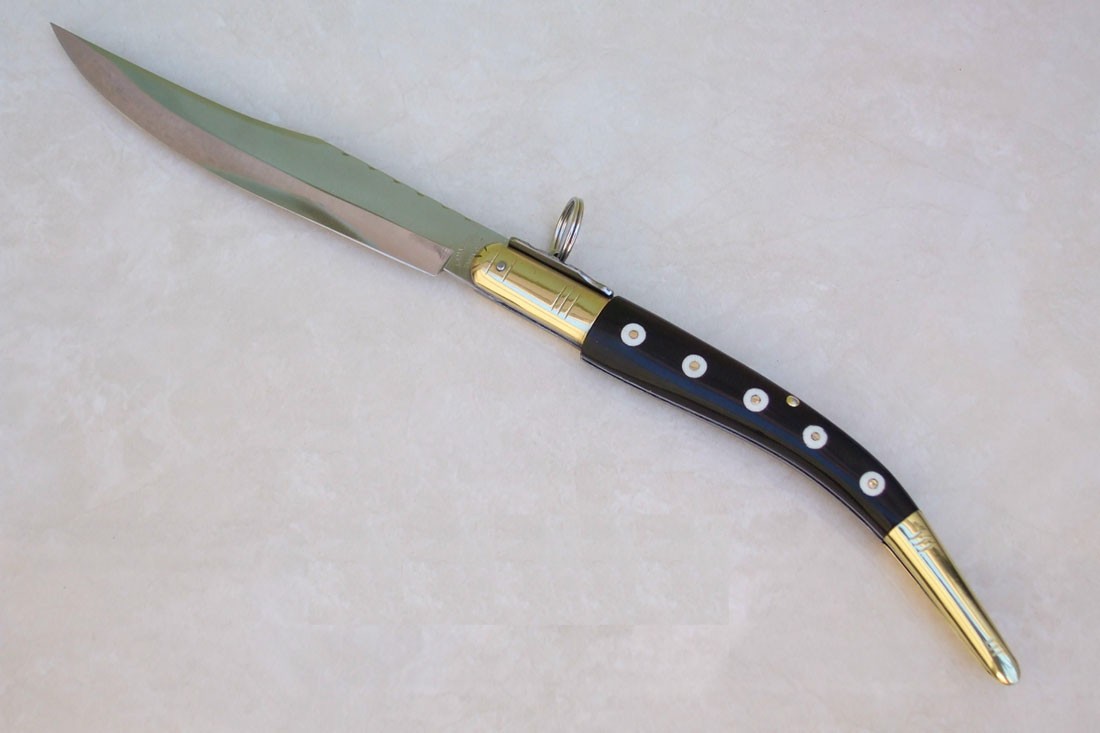
It is about reliving a sound, a smell, and a taste of yesteryear, in those places where time ran more calmly to manufacture these tools of enormous beauty and high quality due to the nobility of their materials and their sharp edges.
The Mass-Produced Knife: Precision and Efficiency for Everyone
Contents
Industrial knives, mass-produced, are designed for efficiency and precision. Their manufacturing process could be compared to building a puzzle, where many of their parts — such as ferrules, bolsters, and liners — are created in a standardized manner using injection molds. This method allows for faster and more consistent production.
Despite the agility in manufacturing, it is important to note that these knives also involve a considerable amount of labor. For example, transforming bull horn, a natural material, still requires manual skill and precision. Mass production allows us to offer more accessible products, adapting to different budgets and consumer needs, thanks to the ability to produce a larger volume in less time.
Craftsmanship: A Detailed and Personalized Art
The creation of a handcrafted knife is a completely different experience; it is a deeply personal and detailed process. Each piece is unique, reflecting not only the knowledge and wisdom, but also the feelings of the artisan who molds it. Craftsmanship prioritizes quality over quantity.
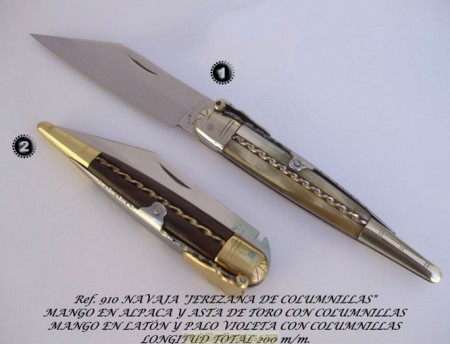
Handcrafted knives are characterized by their originality and exclusivity, by the quality of the steel blades that pass through the forge to achieve the exact tempering point.
Uniqueness and Extreme Dedication
A handcrafted knife is the result of hours of meticulous manual labor and extreme dedication, which makes it a true functional work of art. It is a unique piece that encapsulates the skill and passion of its creator.
Selection and Treatment of Noble Materials
The process begins with a careful selection of high-quality materials. When working with bull horn for the handle, for example, the artisan must be extremely meticulous to ensure there are no imperfections, as any flaw would render the material unusable. Other common materials for blades include carbon steel, titanium, and damascus, while noble woods, bone, ivory, or deer antler are used for handles.
The Creation Process Step by Step
The crafting of a handcrafted knife is a long and laborious journey that combines traditional techniques with a deep mastery of the trade. Key stages include:
- Handle Making: The horn is selected, its tip is sawn, and it is heated in the forge to soften it, shaping it manually and with tools such as the rasp. Metal elements such as the ferrule and bolster are measured, cut, hammered, and fixed with rivets. Finally, the handle is sawn to house the blade. Working with bull horn is particularly demanding, requiring preparation such as cooking, roughing, heating, and pressing.
- Blade Making: The steel is heated in the forge and hammered on the anvil to give it its initial shape. Then, tempering is performed, a thermal shock by immersing the hot blade in oil and water, an operation sometimes guided by traditional prayers for the precise time. The blade is sharpened to define the edge and other characteristics, and the “pinions” are shaped on the heel, responsible for the distinctive ratchet sound when opening the knife. To conclude, a fine polish and a final touch-up are applied.
- Spring Making: The steel intended for the spring is also heated and forged. It is perforated to create the “spring entrance,” a small window that, by interacting with the blade’s pinions, produces the characteristic sound and secures the blade. The spring is filed, molded, and polished before assembly.
- Assembly and Final Finishing: The spring, handle, and blade are joined, ensuring a perfect fit. They are drilled and riveted with pins for a solid union. The final phase, known as “acicalado,” involves cleaning, refining, and polishing all components of the knife to eliminate any imperfections and give it an impeccable finish. The artisan, who is sometimes compared to a “goblin” for their mastery, observes their finished work, the result of more than 40 meticulous operations.
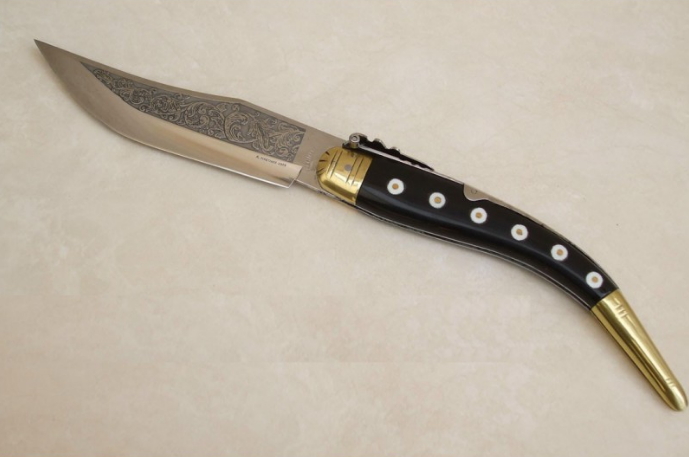
The finish of the scales or handles made of different materials guarantees a unique product in any of its varieties and designs.
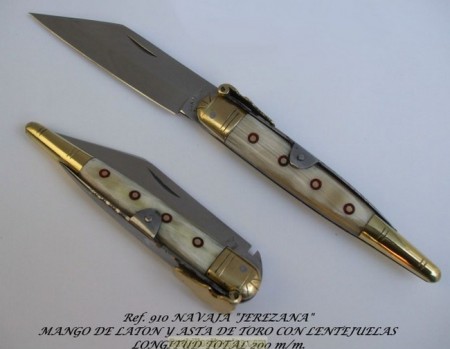
Why the Price Difference Between a Handcrafted Knife and an Industrial One?
The fundamental reason behind the price difference between handcrafted knives and mass-produced ones lies in the enormous investment of time, effort, and obsessive attention to detail that each piece requires.
- A handcrafted knife is a work of art that demands countless hours of manual labor, and this level of dedication logically translates into its final cost. Each one is unique and embodies the skill and passion of its creator.
- In contrast, mass production, while also involving skill and labor, is a process designed for efficiency and large-scale production. This allows industrial knives to be more economically affordable.
The value of a handcrafted knife goes beyond its monetary price; it is the acquisition of a legacy of tradition and mastery, a functional tool designed to last for generations and that tells its own story.