
The silence of the forest is broken by the crunch of leaves beneath your boots. You’ve found that corner where porcini peek out shyly among the leaf litter. Your hand instinctively reaches for the knife on your belt, that tool that has become an extension of your fingers. But when you return home after days of foraging, do you really know how to care for that faithful companion that climbs the hill with you?
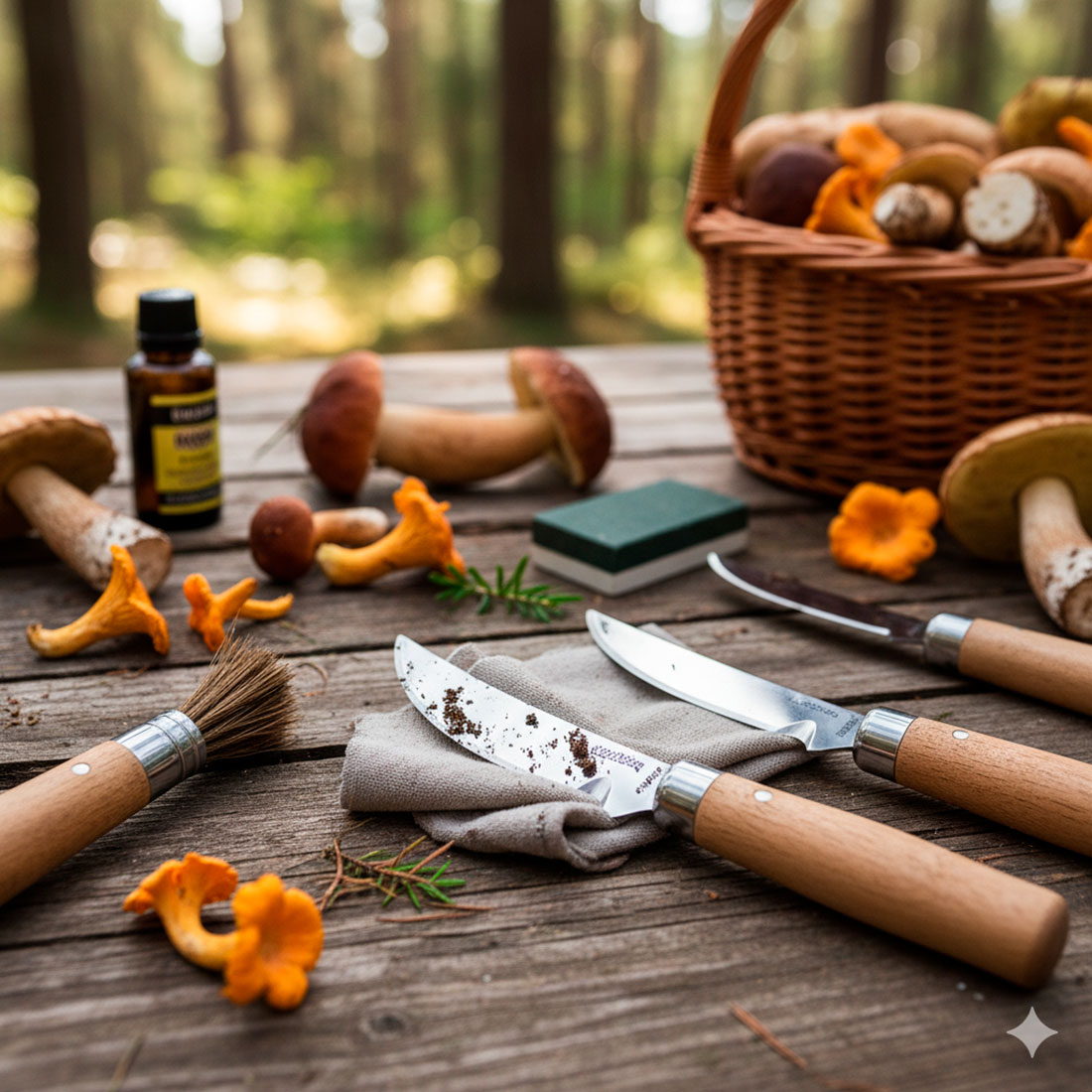
The mycological knife is not a simple knife. It is the result of centuries of evolution in the art of foraging, designed specifically to protect both the fruit and the mycelium that sustains it. And like any precision tool, it requires meticulous care that goes beyond a simple rinse under the tap.
In this article you will discover professional techniques to keep your mushroom knife in optimal condition, from field cleaning to edge maintenance that will guarantee clean cuts season after season. You will learn how to use every integrated element of your knife, how to protect the steel from oxidation and how to apply the practices that expert foragers have perfected over generations.
The anatomy of a mycological knife: design made for the woods
Contents
- The anatomy of a mycological knife: design made for the woods
- Field cleaning: the first line of defense
- Essential care when returning from the woods
- Edge maintenance: the art of perfect sharpening
- Protection against rust: an invisible shield for your steel
- Smart storage: your knife at rest
- Common mistakes that ruin your knife
- Disinfection and hygiene: beyond visible cleanliness
- The forager’s ritual: make care part of your routine
- Signs your knife needs professional attention
- Passing on the knowledge: a knife that endures generations
- Answering your questions about knife care and maintenance
A knife specialized for mushroom gathering is the result of intelligent design where each element serves a specific function. It is not an aesthetic whim, but integrated tools that facilitate both cutting and initial cleaning right on the forest floor.
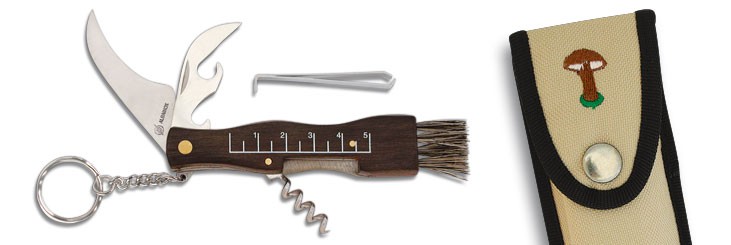
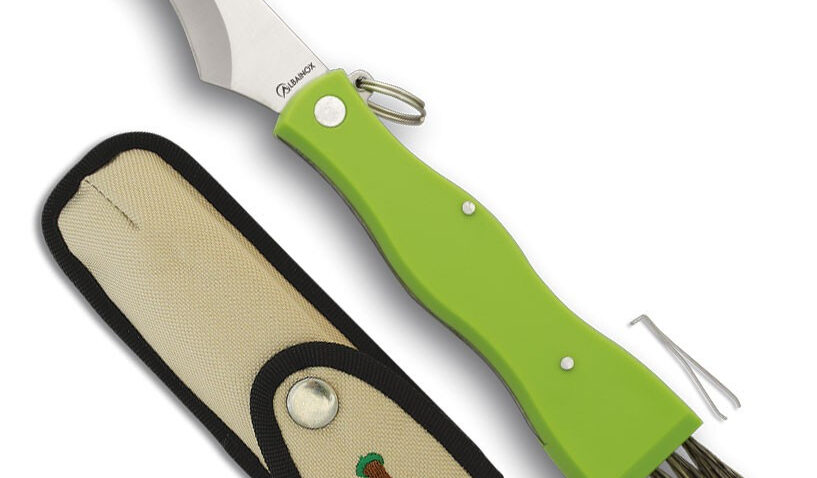
The most visible feature is the integrated brush, usually located at the end of the handle. This brush, made with natural bristles or badger hair on premium models like the Maserin, is designed to remove leaf litter, soil and small insects that cling to the freshly cut specimen. Cleaning in the woods is not just about appearance: it prevents dirt from spreading to the rest of the mushrooms in your basket and greatly eases the work later at home.
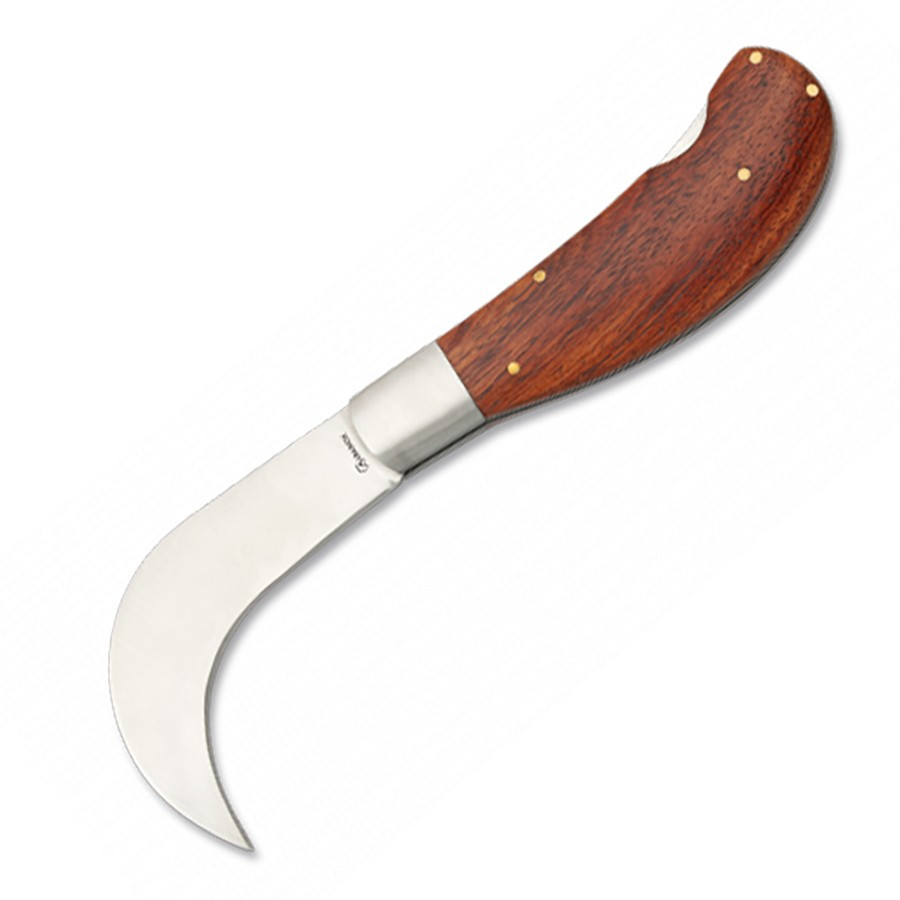
The curved blade with a concave edge allows you to make clean, precise cuts at the base of the stem, just above the substrate. This design respects the underground mycelium, the fungal lifeline that will ensure future harvests. Some models also include a serrated section on the back of the blade, with slightly blunt teeth that help clean the robust feet of porcini without damaging the mushroom flesh.
Materials that defy the forest’s humidity
The heart of a mycological knife is its steel. Quality models use 420 stainless steel or Sandvik steel, alloys specifically chosen for their corrosion resistance and their ability to hold an edge with minimal maintenance. In the damp forest environment, where condensation and substrate moisture are constant, inferior steel would begin to rust after only a few days of use.
Sandvik stainless steel, found in high-end knives, offers the perfect balance between ease of sharpening and edge retention. That means you can restore its cutting ability with just a few passes on a sharpening stone, yet it will keep its sharpness throughout a day of foraging.
Handles are also designed to endure. Varnished French oak, common on traditional models, repels moisture and provides a secure grip even with wet hands. Other manufacturers opt for technical polymers that combine lightness with extreme durability.
Field cleaning: the first line of defense
 The real cleaning of your mycological knife begins at the moment of harvest. Every mushroom you cut leaves residues: clinging soil, spores, plant sap. Allowing these residues to accumulate and dry on the blade is the quickest path to a dulled edge and compromised steel.
After cutting each specimen, use the integrated brush to immediately remove any soil or vegetation from the blade. This gesture, which will take only a few seconds, prevents moisture from the substrate combined with organic matter from creating an abrasive paste that would act like microscopic sandpaper on the edge.
The rear serrated edge is your ally for cleaning the mushrooms themselves. Before placing them in the basket, use this section to gently scrape the base of the stem and remove clinging soil. This process protects both your mushrooms and your knife: the mushrooms arrive cleaner at home and your knife does not accumulate unnecessary dirt.
Cutting technique that preserves the edge
The way you cut determines how long your knife’s edge will last. A clean, decisive cut, made in a single smooth motion, minimizes steel wear. Avoid sawing or excessive back-and-forth movements, especially if the substrate contains small stones or sand.
Always cut above ground level, without allowing the blade to penetrate the soil. Not only do you protect the mycelium: you avoid particles of silica, extremely abrasive, from dulling your edge. A properly used knife can keep its cutting ability throughout the season with minimal maintenance.
Essential care when returning from the woods
The end of the day marks the crucial moment for maintaining your tool. The knife has been exposed to moisture, organic matter, possible plant resins. Leaving it uncleaned until the next outing guarantees premature deterioration.
The process begins with a rinse under warm water. You don’t need boiling water or harsh chemicals: warm water and a drop of neutral soap are enough to remove organic residues and soil. Open the knife fully and pay special attention to the pivot, where small particles tend to accumulate and, if they dry, can impede the opening and closing mechanism.
Use a soft toothbrush to reach difficult areas: the gap between the blade and the handle, the recesses of the integrated brush, any carving or texture on the handle. These nooks are where persistent moisture can start corrosion processes.
Complete drying: the step you must never skip
This is where many foragers make the fatal mistake. Cleaning the knife and leaving it to air dry may seem sufficient, but the moisture trapped in the pivot and under the handle is an open invitation to rust.
Immediately dry every surface with a clean, lint-free microfiber cloth. This type of fabric absorbs moisture better than cotton and doesn’t leave fibers that could interfere with the mechanism. Pay special attention to the pivot area: open and close the knife several times while drying, making sure to remove any trapped drops of water.
Leave the knife open in a horizontal position for at least 30 minutes in a dry environment. This allows natural evaporation to finish the job, eliminating that residual moisture your eyes don’t perceive but the steel does.
Edge maintenance: the art of perfect sharpening
 A perfect edge is no accident. It’s the result of understanding steel geometry and applying the correct technique with the right tools. The mycological knife, with its characteristic curved blade, requires a slightly different approach than a straight kitchen knife.
Sharpening frequency depends on your use. An occasional forager who goes out two or three times a season can get through the campaign with an initial sharpening. A professional or dedicated enthusiast who spends full weekends in the woods will need to resharpen every few trips.
Tools for home sharpening
The sharpening stone of medium grit (between 1000 and 3000) is the fundamental tool. Japanese water stones offer exceptional results but must be soaked before use. Arkansas stones, of natural origin, are the traditional choice and work with a drop of mineral oil.
For the curved blade of the mycological knife, a flat stone of medium size (about 20 cm long) will allow you to follow the natural contour of the edge. Maintain a consistent angle of approximately 15-20 degrees and make smooth movements from the heel to the tip of the blade, following the natural curvature.
The honing rod or ceramic sharpener is your ally for maintenance between full sharpenings. A few passes before each outing to the woods realign the microscopic edge and restore cutting ability without removing material from the steel. This preventive maintenance significantly extends the time between deep sharpenings.
| Type of stone | Recommended grit | Main use | Preparation required |
|---|---|---|---|
| Japanese water stone | 1000-3000 | Regular sharpening and edge restoration | Soak 10-15 minutes before use |
| Arkansas stone | Medium-fine | Maintenance and polished finish | Apply a few drops of mineral oil |
| Ceramic stone | 2000-5000 | Fine finish and edge polishing | Use dry or with water |
| Ceramic honing rod | – | Edge realignment between uses | None, use directly |
- Japanese water stone
-
- Recommended grit: 1000-3000
- Main use: Regular sharpening and edge restoration
- Preparation required: Soak 10-15 minutes before use
- Arkansas stone
-
- Recommended grit: Medium-fine
- Main use: Maintenance and polished finish
- Preparation required: Apply a few drops of mineral oil
- Ceramic stone
-
- Recommended grit: 2000-5000
- Main use: Fine finish and edge polishing
- Preparation required: Use dry or with water
- Ceramic honing rod
-
- Recommended grit: –
- Main use: Edge realignment between uses
- Preparation required: None, use directly
Edge check: the paper test
How do you know if your knife has reached the proper edge? The traditional paper test never fails. Hold a sheet of newspaper by the top edge and perform a downward cut without applying pressure. A properly sharpened edge will slice the paper with a clean, almost musical sound, without tearing or crumpling it.
If the paper bends or crumples before it cuts, the edge needs more work. If the cut is irregular or requires sawing, the sharpening angle is probably not consistent along the blade.
Protection against rust: an invisible shield for your steel
The stainless steel of your mycological knife is tough, but not invulnerable. Rust is a silent enemy that can appear after a single wet day if you don’t apply the right protective measures.
After complete drying, apply a thin layer of food-grade mineral oil over the entire blade. This oil has superior penetration ability, forms a durable barrier against moisture and, crucially, does not degrade or go rancid over time. Unlike vegetable cooking oils, which can oxidize and leave sticky residues, mineral oil keeps its stability for months.
Camelia oil, traditional in Japanese cutlery, is another excellent option. Natural, acid-free and practically non-volatile, it penetrates the steel and forms a protective layer that stands up even in very humid environments. It is especially recommended if your knife includes carbon steel elements, which are more prone to rust than pure stainless steel.
Technique for applying protective oil
Place two or three drops of oil on a clean microfiber cloth. Spread the oil over the blade with gentle circular motions, ensuring you cover the entire surface, including the edges and the area near the handle. You don’t need to soak it: a film so thin it’s barely visible is enough.
Let the oil sit for a few minutes then remove any excess with a clean part of the cloth. The goal is to leave a microscopic film, not a visible layer that will attract dust and dirt. Also apply a few drops to the knife pivot, opening and closing it several times to distribute the lubricant.
If you use lithium grease for long-term off-season storage, the process is similar but with a slightly more generous layer. Lithium grease doesn’t evaporate and provides protection for months — ideal for storing the knife from October until the following spring.
Smart storage: your knife at rest
Where and how you store your mycological knife between outings determines its longevity as much as how you use it in the woods. Neglectful storage can undo all the care you’ve put into cleaning and maintenance.
The ideal place is dry, ventilated and at a stable temperature. Avoid humid kitchen drawers, uninsulated garages where condensation is frequent, or closed cabinets with no air circulation. A shelf in your workspace or study, where temperature remains steady, is preferable.
The leather sheath is an ambivalent ally. It protects the blade from knocks and the edge from accidental contact, but if the knife isn’t completely dry when you sheath it, the leather will retain moisture and speed up rusting. Use the sheath only when the knife is impeccably dry and oiled. For long-term storage, consider keeping it out of the sheath, wrapped in wax paper or a cloth treated with oil.
Periodic checks during the off-season
Even if you don’t use it during winter, inspect your knife at least once a month. Open the blade fully and examine every inch of steel under good light. Any initial spot of rust shows as a small dark or brownish mark. If detected early, it can be removed with an oil-soaked cloth and a bit of gentle friction.
If you find rust that doesn’t come off with oil, use a baking soda paste (a teaspoon of baking soda with a few drops of water until it forms a paste) applied with a soft cloth. Rub gently in the direction of the steel’s polish, rinse with water, dry completely and re-oil. This method removes superficial rust without scratching the steel.
Common mistakes that ruin your knife
Knowledge is also built from what we must avoid. These are the most frequent mistakes that dramatically shorten the lifespan of mycological knives, even among experienced foragers.
Washing in the dishwasher is mistake number one. Harsh detergents, high temperatures and prolonged humid environments attack both the steel and handle components. A single dishwasher cycle can leave your knife with permanent corrosion spots. Always, without exception, clean by hand.
Storing the knife wet or dirty after the day, intending to clean it later, creates the perfect conditions for rust and the buildup of hard-to-remove residues. forest soil, rich in tannins and organic matter, can permanently stain the steel if left to dry on the blade.
Using abrasive products like metal scouring pads, powdered cleaners or wire brushes to clean stains will irreversibly scratch the steel finish. The micro-scratches created are starting points for future corrosion and mar the steel’s appearance.
Incorrect sharpening that destroys the edge
 Sharpening with an excessive angle (more than 25 degrees) creates a thick edge that cuts poorly and dulls quickly. Conversely, an overly acute angle (less than 12 degrees) produces a fragile edge that chips at the first contact with a hard stem or a small stone in the substrate.
Applying excessive pressure during sharpening is counterproductive. The weight of the knife and your hand is enough; additional pressure does not speed the process, it only heats the steel locally and can alter the blade’s temper in extreme cases.
Using high-speed electric sharpeners on a quality mycological knife is like using a hammer to adjust a precision watch. These devices remove excessive material, generate heat that can affect the steel’s temper and do not respect the blade’s specific curvature. For maintenance sharpening, always use a manual stone.
Disinfection and hygiene: beyond visible cleanliness
Although visually clean, your knife may harbor bacteria and spores after contact with forest mushrooms. Periodic disinfection, especially if you collect unknown species or in areas where you’ve found damaged specimens, is a recommended practice.
After full cleaning and drying, immerse the blade in 70% isopropyl alcohol for 10 minutes. This specific percentage is more effective than higher concentrations because water helps alcohol penetrate bacterial cells. 90% alcohol or higher evaporates too quickly to ensure complete disinfection.
Alternatively, a solution of water with a few drops of food-grade bleach (following the manufacturer’s instructions for disinfecting kitchen utensils) is effective. After immersion, rinse thoroughly under running water, dry meticulously and apply protective oil immediately. Bleach, while disinfecting, can start oxidation if residues remain.
When disinfection is necessary
It is not necessary to disinfect after every outing if you have collected known edible species in good condition. Reserve disinfection for specific situations: after handling suspicious mushrooms that you cut for examination, at the end of the season before long-term storage, or if you lent your knife to another forager.
If your knife has been in contact with clearly toxic mushrooms (which you cut for identification or study), disinfection is mandatory. Some fungal toxins can persist as microscopic residues and, although the amount would be minimal, it is a sensible precaution.
The forager’s ritual: make care part of your routine
The true secret to keeping your mycological knife in optimal condition isn’t complex techniques or expensive products. It’s turning care into a natural ritual, as automatic as checking your basket before entering the woods.
Develop a post-harvest sequence you follow without thinking: get home, empty the basket, clean the mushrooms, clean the knife, dry completely, apply oil, store. This chain of actions, repeated consistently, ensures you never go to bed leaving the knife dirty on the table, never store it wet, never forget protection.
Before each season, dedicate an afternoon to preparing your gear. Inspect the knife calmly, check the edge with the paper test, verify that the mechanism opens and closes smoothly, confirm there are no signs of emerging corrosion. If a deep sharpening is needed, do it now, unhurried, with good light and concentration. This time investment will save you frustration in the woods.
Keep a basic maintenance kit always accessible: a small bottle of mineral oil, clean microfiber cloths, a ceramic honing rod for quick touch-ups. Having everything at hand removes the temptation to postpone care because “I don’t have the oil on hand” or “I’ll do it when I buy new cloths.”
Signs your knife needs professional attention
No matter how careful you are, there are situations where home maintenance is not enough and you need to turn to a professional sharpener or directly to the manufacturer.
If the edge has chips or visible nicks in the steel, trying to remove them at home with conventional stones would require removing so much material that you would alter the blade’s geometry. A professional has access to coarse-grit stones and the experience to restore the profile without compromising the structure.
Deep oxidation, which has created pitting in the steel rather than superficial stains, requires specialized treatment. These pits are points of structural weakness and, although they can be polished away cosmetically, the underlying metal is compromised. An expert can assess whether the knife is recoverable or if the damage requires replacement of the blade.
Persistent problems with the opening mechanism after cleaning and lubrication indicate wear of internal components. Forcing the mechanism can cause greater damage. Manufacturers like Maserin offer maintenance service where they can replace springs, pivots or specific components.
Passing on the knowledge: a knife that endures generations

A quality mycological knife, properly cared for, is not a tool with an expiration date. It is an instrument that can accompany you for decades of foraging and, eventually, pass to the hands of your children or grandchildren with the same cutting ability as the day you first used it.
Every time you meticulously clean the blade after a day’s work, every time you spend those minutes on perfect sharpening, you are not only maintaining a tool. You preserve respect for the craft, the connection to the woods, and the patience required to do things properly.
An experienced forager recognizes another not by the number of mushrooms in his basket, but by the condition of his knife. A bright blade, free of rust, with an edge that cuts cleanly without effort, speaks of someone who understands that respect for tools is inseparable from respect for the forest and its fruits.
When your mycological knife draws its edge through a perfect porcini, leaving a clean cut that will not damage the mycelium, when the brush gently removes the soil without mistreating the cap, when after twenty seasons the steel still shines like the first day, you’ll know the time spent on care was not a sacrifice. It was an investment in the tool that turned casual foraging into a respected craft.
Answering your questions about knife care and maintenance
What is the most effective method to clean mushroom knives?
The most effective method to clean mycological knives after foraging starts with a rinse under warm water with a drop of neutral soap, paying special attention to the pivot and hard-to-reach areas. Use a soft toothbrush to remove residues accumulated in crevices. After washing, complete and immediate drying with a microfiber cloth is crucial to prevent rust. Leave the knife open in a horizontal position for 30 minutes in a dry environment to remove residual moisture. Finally, apply a thin layer of mineral or camellia oil to the blade to form a protective barrier. This process, performed consistently after each use, guarantees the longevity and optimal performance of your tool.
What type of oil is best to maintain a knife’s edge?
The best type of oil to maintain a knife’s edge is food-grade mineral oil, due to its high penetration ability, stability and because it does not degrade or go rancid over time. Camelia oil is also recommended; it penetrates metal well and forms a long-lasting protective layer, especially suitable for knives or blades made of carbon steel. Vegetable oil should be avoided because it degrades and leaves sticky residues. For lubricating moving parts, special cutlery oils are also recommended as economical, specific lubricants that prevent dryness and dirt.
How can I prevent knives from rusting after cleaning them?
To prevent knives from rusting after cleaning them, follow these steps:
- Complete drying: Make sure to dry the knife completely with a soft cloth after washing it. It’s crucial to remove all moisture to prevent rust formation.
- Application of oil: Apply a light layer of knife oil or mineral oil on the blade. This acts as a protective barrier against moisture and helps prevent oxidation.
- Appropriate storage: Store the knife in a dry, well-ventilated place. Consider using a leather sheath or a case to protect it from a humid environment.
- Avoid corrosive substances: Avoid exposing the knife to corrosive substances like salts or acids, as they can accelerate rust formation.
- Regular inspection: Periodically inspect the knife for any signs of rust or wear. Regular maintenance helps prevent larger problems in the long term.
Is it necessary to disinfect knives after cleaning them?
Yes, it is necessary to disinfect knives after cleaning them to eliminate bacteria and germs that may remain after washing. This is achieved by submerging them in 70% isopropyl alcohol or a specific disinfectant for at least 10 minutes. Then they should be dried completely to avoid corrosion and, if it’s a razor-style knife, apply lubricating oil before storing it in a dry place.
What type of cloth is most recommended for cleaning knives?
For cleaning knives, it is recommended to use a soft, lint-free cloth. Microfiber cloths are particularly effective because they are lightweight and do not leave fibers that could damage the knife surface. In addition, microfiber cloths clean surfaces well and remove fingerprints, which is useful to keep the knife free of dirt and grease. A cotton cloth can also be appropriate, provided it is soft and you prefer to avoid microfiber.
| Type of oil | Main characteristics | Recommended use |
|---|---|---|
| Mineral oil | High penetration, does not degrade or attract dirt | Regular protection and maintenance |
| Camelia oil | Natural, acid-free, non-volatile | Antioxidant protection, lubrication |
| Lithium grease | Thick, long-lasting, does not evaporate | Long-term storage, protection |
- Mineral oil
-
- Characteristics: High penetration, does not degrade or attract dirt
- Recommended use: Regular protection and maintenance
- Camelia oil
-
- Characteristics: Natural, acid-free, non-volatile
- Recommended use: Antioxidant protection, lubrication
- Lithium grease
-
- Characteristics: Thick, long-lasting, does not evaporate
- Recommended use: Long-term storage, protection