A dull butcher’s cleaver is just dead weight in your hand. Its true power lies not in brute force, but in the precision of an edge that sings as it cuts, capable of separating bone and meat with a single, accurate blow. This is no ordinary knife; it’s an impact tool, and its edge must be robust, durable, and, above all, respected. In this guide, we will unveil the art of bringing your cleaver back to life, transforming it from a simple piece of metal into an extension of your will in the kitchen or workshop.
The Anatomy of a Cleaver’s Edge: Resilience over Sharpness
Contents
- The Anatomy of a Cleaver’s Edge: Resilience over Sharpness
- The Attack Angle: The Secret to an Enduring Edge
- Sharpener’s Arsenal: Essential Tools
- The Sharpening Ritual: Step-by-Step Guide for an Impeccable Cut
- Beyond Sharpening: How to Protect Your Tool
- Cleavers for all tastes
- Clarifying doubts about sharpening butcher knives and tools
- Advanced techniques for sharpening butcher knives
- Professional Recommendations
Unlike a filleting knife, designed for delicacy, a cleaver’s edge is built for impact. The priority here is not extreme sharpness that can bend or chip at the first blow. Instead, we seek stability and resilience. A well-sharpened cleaver has the perfect geometry to concentrate force and cleanly cut through tough materials without losing its integrity. Sharpening, therefore, is the process of restoring this original geometry, returning its ability to conquer bones and tendons effectively.
The Attack Angle: The Secret to an Enduring Edge
The soul of a durable edge lies in its angle. For an impact tool like a butcher’s cleaver, this angle must be wider than that of a conventional knife. We recommend an angle of between 20 and 25 degrees per side, resulting in a total edge of 40 to 50 degrees. Why so wide? Because this thicker bevel creates a reinforced edge that withstands the toughest impacts without failing. Although it sacrifices some fine cutting ability, it gains formidable resistance, ensuring you don’t have to sharpen it after every intensive use.
Sharpener’s Arsenal: Essential Tools
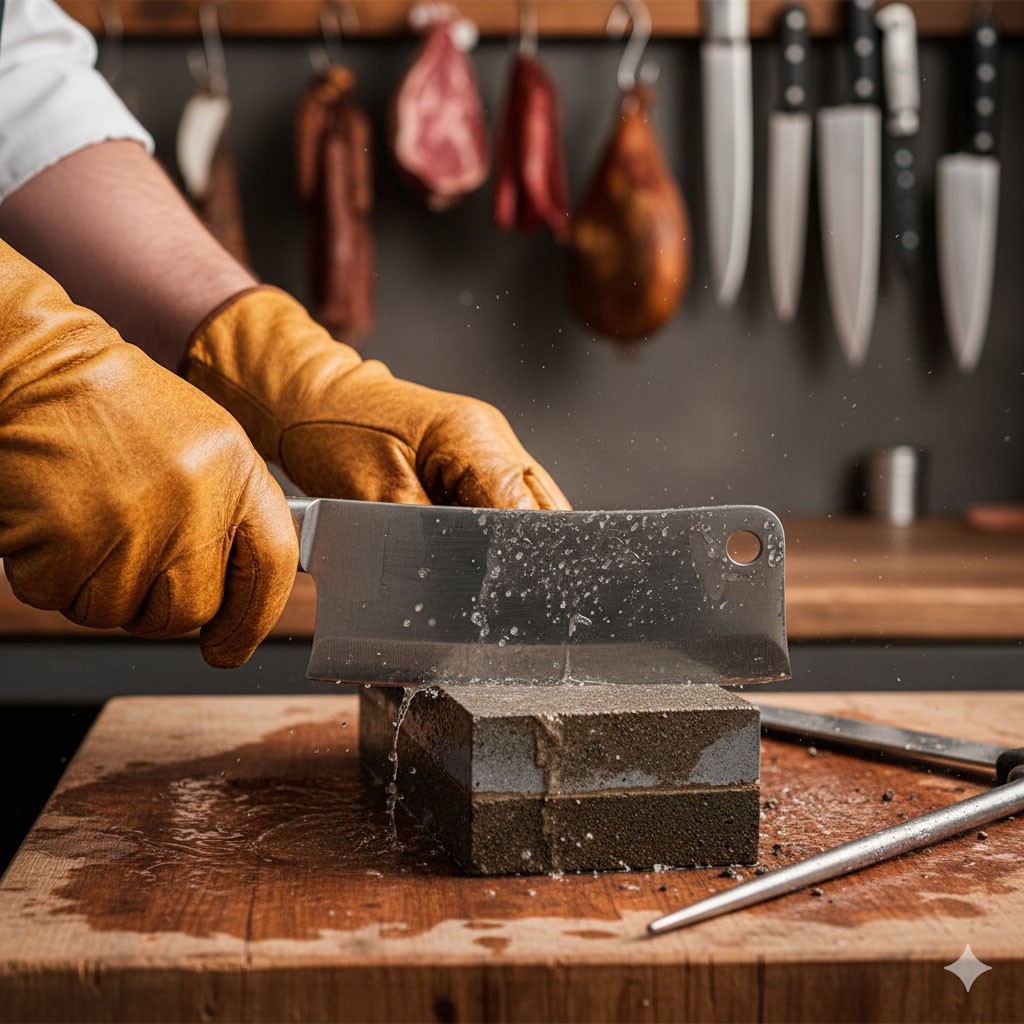
The traditional method, and the most respectful of your cleaver’s steel, is manual sharpening with water stones. This process cools the blade, preventing overheating that can temper the steel and ruin its hardness. Stay away from electric grinders and quick “V” sharpeners, which tear away metal and create a weak, rough edge. Your arsenal must be precise and functional.
| Tool | Grit / Type | Function in the Process | Usage Recommendation |
|---|---|---|---|
| Coarse-Grit Stone | ~400-800 Grit | Grinding or “Hollowing”: Rectifies nicks, deep wear, and restores the initial geometry of the edge. | Use it only when the blade shows visible damage or is extremely dull. |
| Medium-Grit Stone | ~1000-2000 Grit | Refining: Perfects the edge created by the coarse stone, defining the bevel and preparing the steel for polishing. | It is the fundamental step to establish a functional and durable edge. |
| Fine-Grit Stone | ~4000-6000 Grit | Polishing and Honing: Polishes the edge to a superior level, eliminating micro-serrations for cleaner, smoother penetration. | The final touch for a professional finish. Reduce pressure at this stage. |
| Smooth Metal Honing Steel | Smooth Surface | Maintenance or “Burnishing”: It does not sharpen, but rather straightens and realigns the microscopic edge of the blade that bends with use. | Pass it gently before or after each intensive use to keep the edge aligned. |
- Sharpening Tools
-
- Coarse-Grit Stone (~400-800 Grit): For grinding and repairing damage.
- Medium-Grit Stone (~1000-2000 Grit): For refining and defining the edge.
- Fine-Grit Stone (~4000-6000 Grit): For polishing and a professional finish.
- Smooth Metal Honing Steel: For daily maintenance and realigning the edge.
The Sharpening Ritual: Step-by-Step Guide for an Impeccable Cut
Sharpen with patience and method. The steel will respond. For a heavy tool like a cleaver, it is often easier and safer to keep the blade still and move the stone over it.
1. Preparing the Ground: Safety and Stability
- Firm Grip: Place the cleaver on a stable surface, such as a thick wooden board, or secure it with a g-clamp or vice. Safety comes first; a moving blade is a danger.
- Stone Hydration: Submerge your water stone for a few minutes and keep it always wet. Water creates an abrasive slurry that improves sharpening and cools the steel. Place the stone on a damp cloth so it doesn’t slip.
- Visual Guide: Use a permanent marker to paint the entire edge. This mark will serve as an infallible guide to know if you are sharpening the entire surface evenly. When the mark completely disappears, you will know that your work in that area is done.
2. From Grinding to Polishing: The Dance of Steel and Stone
With the cleaver firmly held, take your coarse-grit stone (if necessary to repair nicks) or medium-grit stone. The movement should be constant and methodical.
- The Movement: Hold the stone firmly and slide it over the edge with a movement that goes from the spine towards the edge and, at the same time, from the handle towards the tip. Imagine you are “peeling” a thin layer of steel.
- Constant Pressure and Angle: Always maintain the chosen angle (20-25°) and apply firm but controlled pressure. Your wrist should be locked to avoid varying the angle during the pass.
- Perfect Symmetry: Make the same number of passes on each side of the blade. This is crucial to keep the edge centered and prevent uneven wear.
- Grit Progression: Start with the coarse-grit stone until all nicks and the marker have disappeared. Then, switch to the medium-grit stone to refine the edge and, finally, to the fine-grit stone to polish it, reducing pressure as you go.
3. The Master’s Touch: Honing for a Clean Edge
After sharpening, a microscopic burr of steel remains, known as a “repel”. Removing it is the secret to a truly clean edge. To do this, make a few very light passes in the opposite direction of sharpening: from the edge towards the spine, as if you wanted to cut a very thin layer from the stone. This gesture will break the burr, leaving a perfect edge.
4. The Edge Test: Is it Ready for Action?
A well-sharpened edge doesn’t lie. To check your work, perform these simple tests:
- Paper Test: Hold a sheet of paper and make a cut. A well-sharpened cleaver should cut it cleanly, without snagging or tearing.
- Visual Inspection: Observe the edge against the light. A perfectly sharpened edge is so fine that it doesn’t reflect light. If you see bright glints along the edge, it means those areas are still dull.
- Tomato Test: Try to cut a tomato. If the blade slides through the skin with minimal pressure and without crushing the fruit, you have achieved an excellent edge.
Beyond Sharpening: How to Protect Your Tool
A good sharpening deserves to be protected. To prolong the life of the edge and your cleaver, follow these simple rules:
- Immediate Cleaning: Wash the cleaver with warm water and a mild detergent immediately after use. Dry it completely with a cloth to prevent rust, the silent enemy of steel.
- Maintenance with Honing Steel: Between full sharpenings, use a smooth metal honing steel to realign the edge. A few gentle passes before each use will keep the edge in optimal condition.
- Safe Storage: Store it in a dry place, preferably in a sheath, blade guard, or knife block. Avoid contact with other metals that could nick the edge.
Cleavers for all tastes


Clarifying doubts about sharpening butcher knives and tools
What is the best sharpening stone for beginners?
For beginners, the best sharpening stone is a double-sided Japanese water stone, preferably with 1000 and 3000–6000 grit.
- The 1000-grit side is ideal for repairing and sharpening the edge of knives that are slightly dull or require regular re-sharpening (maintenance).
- The 3000–6000-grit side serves to give a final polish and obtain a sharper and more lustrous edge, without the need to use ultrafine materials that do not provide great benefit for daily use.
This type of stone allows learning the technique with a single product, is versatile and sufficient for most household knives. In addition, it is not necessary to invest in natural stones, which are very expensive and require more experience. A synthetic aluminum oxide or corundum stone is durable, easy to use, and economically accessible for beginners.
A practical recommendation is to look for a kit that includes a double-sided stone (for example, 1000/6000), a non-slip base, and an angle guide, which facilitates learning and safety during sharpening.
What advanced techniques exist for sharpening butcher knives?
Advanced techniques for sharpening butcher knives
 Advanced Honing Rods or Steels
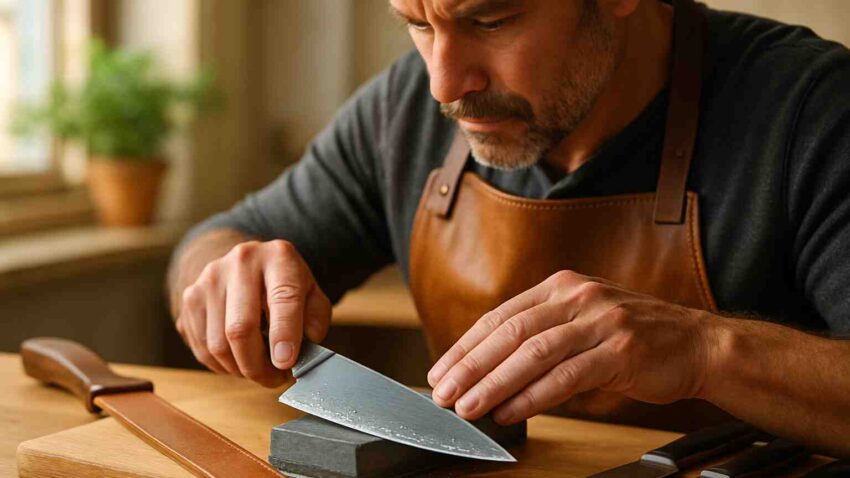
In addition to using traditional steel, there are diamond-coated rods that offer faster and more precise sharpening. These tools are for professional use and require skill, as they remove more metal, adjusting the edge more aggressively and precisely.
Progressive Water Stones
The use of Japanese water stones with different grits (e.g., 400 for deburring, 1000-3000 for sharpening, and 6000-8000 for polishing) allows for total control over the sharpening process. The technique consists of passing the knife at a constant angle (usually between 15 and 20 degrees), applying uniform pressure and alternating sides to avoid uneven wear. For butcher knives, some experts recommend a slightly wider angle for greater resistance, followed by a narrower angle to obtain an extremely sharp final edge.
Guided Sharpening Systems
These devices fix the sharpening angle precisely and repeatably, facilitating work on large and heavy knives such as those used in butchery. They allow for highly accurate sharpening even for those without much manual experience.
“Reduced” and “Seated” Technique
Some professional butchers first perform a reduction with a wider angle to maintain the structural resistance of the knife, removing excess metal. Then, they give the “seating” or final edge with a narrower angle, achieving a finer and more penetrating cut. It is crucial to maintain the same number of passes on each side to equalize the edge.
Sharpening with Stropping and Abrasive Pastes
The use of strops coated with abrasive compounds (such as aluminum oxide or garnet) allows for a mirror finish and the removal of any small burr, leaving the edge extremely fine. This is usually performed as a final step after using stones.
Professional Electric Sharpeners
These devices offer speed and consistency, especially useful in high-volume environments. They allow adjustment of the sharpening angle and intensity, although they require attention not to overheat the edge.
Professional Recommendations
- Consistency in Angle: Maintaining a constant angle throughout the process is key for an efficient and durable edge.
- Controlled Pressure: Apply just enough pressure not to damage the blade.
- Finishing with a Scrubber: Polishing with a scrubber (leather or fabric) impregnated with abrasive paste removes minimal imperfections and leaves the edge in optimal condition.
These techniques, combined with experience and suitable tools, allow obtaining and maintaining the professional edge required by butcher knives.
How to know if my knife’s edge is sharp enough?
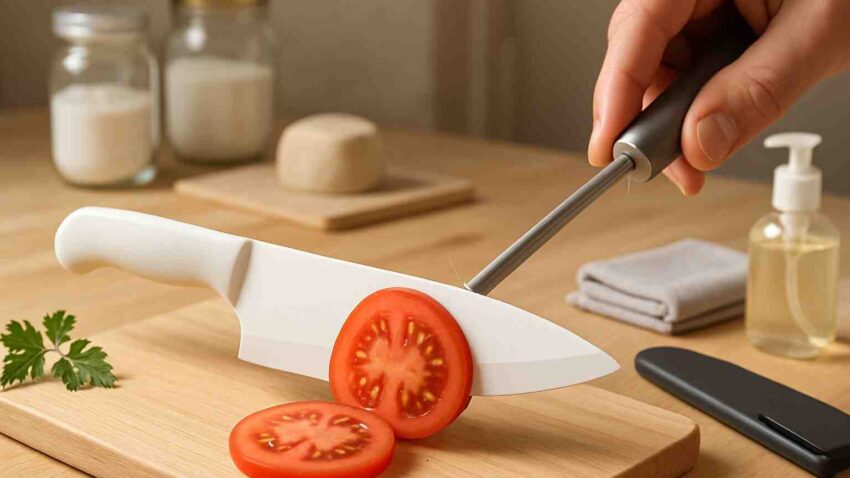 To determine if your knife’s edge is sharp enough, you can perform the following tests and observations:
- Paper Test: Cut a piece of paper. If the knife cuts it smoothly without snagging or tearing, it is well-sharpened. If the paper tears or does not cut cleanly, it’s time to sharpen it.
- Fruit or Vegetable Test: Try cutting a soft fruit or vegetable, such as a tomato. If the knife slides through the skin with ease and produces a clean cut, it is sharp.
- Visual Inspection: Observe the edge of the knife against the light to detect reflections. A sharp knife will have a uniform edge with no abundant reflections. Also, look for nicks or chips, which indicate it needs sharpening.
- Feel: Gently run your finger along the edge (with caution not to cut yourself). A sharp knife should have a smooth edge with no rough spots.
What common mistakes should be avoided when sharpening knives?
When sharpening knives, there are several common mistakes that are important to avoid to ensure proper sharpening and maintain safety:
- Applying inconsistent pressure: This can lead to uneven sharpening, where some areas of the knife are sharper than others. It is crucial to maintain constant pressure to avoid a wavy edge.
- Using inadequate tools: Each type of knife requires a specific tool for sharpening. Using the wrong tool can damage the blade or result in ineffective sharpening.
- Not maintaining the proper angle: The wrong angle can create unnecessary micro-edges and remove too much material. It is important to maintain the manufacturer’s recommended angle.
- Not lifting the knife when sharpening the tip: Shaping the tip of the knife can be tricky. Not lifting the knife when reaching the tip helps to maintain the correct edge.
- Applying excessive pressure: This can damage the blade, create burrs, and shorten its lifespan. It is recommended to apply gentle and constant pressure.
- Moving the wrist improperly: Keeping the wrist firm while sharpening is crucial to prevent the edge from becoming rounded or flat, which affects its cutting ability.
How long should it take to sharpen a butcher’s knife?
Sharpening a butcher’s knife should normally take between 5 and 15 minutes, depending on the knife’s condition and the method used. It is recommended to make several passes on each side of the edge, maintaining a constant angle between 15 to 20 degrees, starting with a coarse-grit stone to reshape the edge if it is very worn, and then moving to finer grits to polish it. Uniformity and precision in sharpening are key to a good result.
If frequent maintenance sharpening is performed, the process is faster, while a very dull knife may require more time to restore the edge correctly. In general, for basic sharpening with a stone, 5 to 6 passes per side are usually sufficient for effective sharpening.
Mastering the sharpening of your cleaver is much more than simple maintenance; it is a ritual that honors the tool and guarantees perfection in every cut. A well-maintained edge is not only a symbol of professionalism, but the extension of your will over matter. Now, the power of a clean, safe, and forceful cut is, literally, in your hands.