
The knife is a fundamental element in any hunter’s equipment. However, its meaning goes beyond that of a simple tool, reaching the status of a symbol when it comes to the finishing knife, intended for big game. This practice, intimately linked to Spanish montería, has remained a secular tradition over the centuries.
Today, we will explore the fascinating history of these knives, their technical features, the keys to safe and effective use, and the deep cultural roots they hold in the world of hunting. No hunter’s gear is complete without a finishing knife for big game. There is an immense variety of shapes, sizes, materials, and designs, but what remains consistent is their quality, robustness, safety, and power. To finish off game, one needs not only courage but, above all, skill and expertise.
We present these two beautiful models of finishing knives that exemplify the beauty and functionality of these essential tools:
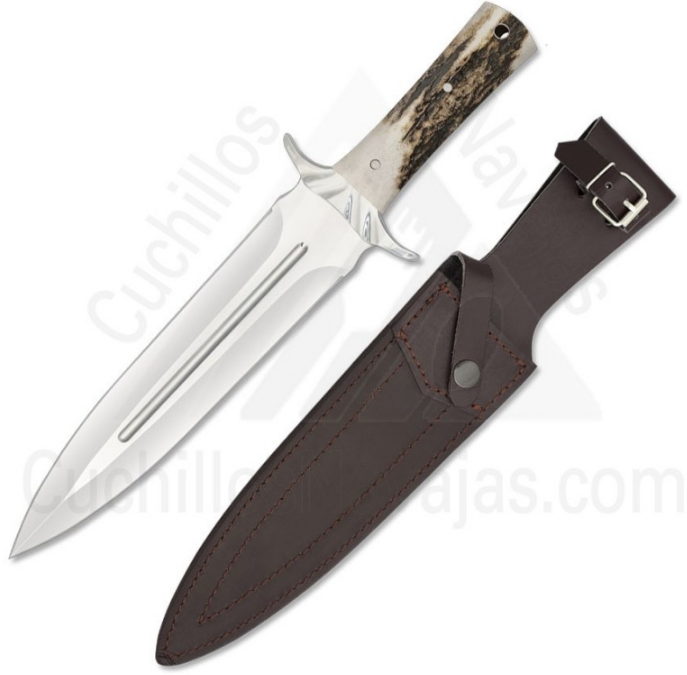
The first is an impressive hunting finishing knife with a stainless steel blade and an elegant stag horn handle, which not only offers a traditional and robust look but also a firm and natural grip. It includes a high-quality leather sheath, perfect for carrying and protecting it in the field.
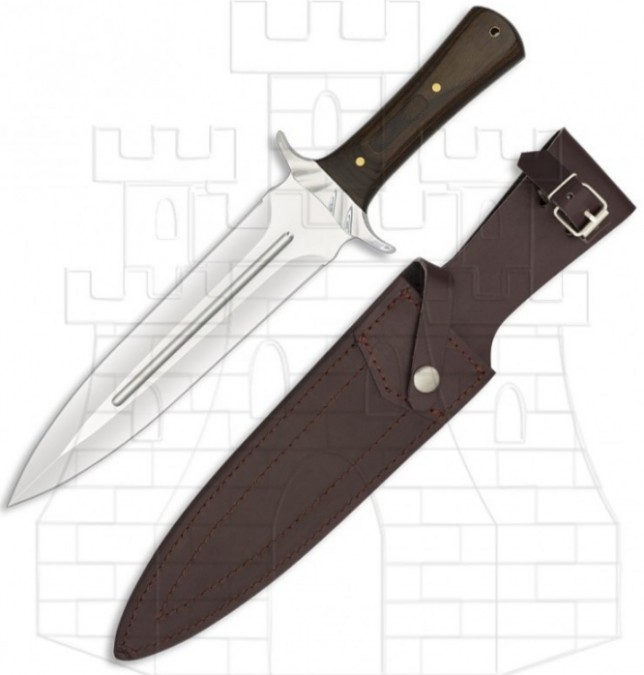
The second model is this Pakkawood hunting finishing knife, which combines a stainless steel blade with a stamina handle decorated with CNC technology, offering a modern design and superior ergonomics. Its steel bolster adds a touch of robustness and balance. Like the previous one, it includes a leather sheath that guarantees its safety and durability.
A Link to Our Hunting Past
Contents
The history of the finishing knife is as old as humanity itself. From the first fire-hardened sticks and sharpened stones, which were the original tools for survival, to the constant evolution of metals and forging techniques, hunting tools were pioneers in human technological development. Over millennia, specialized variants emerged such as spears, arrows, and even specific hunting swords, each adapted to the needs and types of prey of their time.
Despite the astonishing technological advances in firearms and modern optronics, the finishing knife remains almost unchanged in its essence and is considered an “irreplaceable” element for many big game hunters. Its main function is to quickly and safely end the life of a wounded animal, minimizing its agony and, crucially, avoiding the dangers that an injured and cornered animal can pose to hunters and dogs. It is also crucial when an animal is immobilized by the pack, making the use of firearms unfeasible due to the inherent risk to the dogs holding the prey.
A historical modality that highlights the essence and value of the finishing knife is the “Ronda” hunt. Popular in Spain for centuries in mountains and dehesas, this nocturnal practice, carried out under the moonlight, is done without firearms, relying solely on the courage, skill, and power of the dogs to locate, harass, and hold the wild boar, allowing the hunter to complete the action only with the knife. This is a modality that remains alive in various areas of the USA, Australia, or Argentina, and in Spain it is regulated in regions such as Murcia, Extremadura, and the Valencian Community, underscoring its cultural and sporting importance.
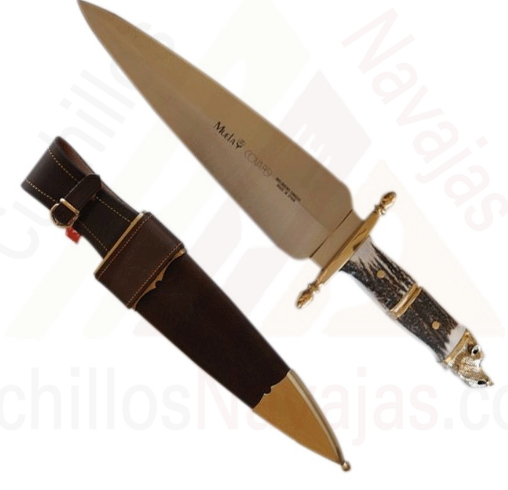
Great figures of Spanish montería, such as Antonio Covarsí, known as “El montero de Alpotreque” (1848-1937), were leading exponents of this hunt, leaving a legacy of bravery and skill. In his memory, Muela, a renowned Spanish brand with a century-old knife-making tradition, has created finishing knives that pay tribute to his figure and to the essence of this ancestral hunt.
Knife making in Spain boasts a rich cutlery tradition and exceptional artisans, resulting in an enviable variety of designs and models of great beauty and artistry. While other countries prioritize pure functionality, in Spain the finishing knife is also, and with much pride, a true work of art, a collector’s item that combines utility with aesthetics.
Designs and Technical Features: The Key to Effectiveness
Choosing a finishing knife is not an easy task and should not be taken lightly. Beyond its appearance or aesthetic considerations, the quality of the materials and the solidity of its design are paramount, given that it is a weapon that will withstand considerable stress in delicate and high-risk situations. It is essential to invest in the best possible quality for our own safety and that of our hunting companions.
The Blade: The Soul of the Knife
The blade of a finishing knife must be robust, safe, and designed for effective penetration. In terms of construction, the main differences are between “tang” and “full-tang” blades, each with their own advantages and resistance characteristics:
- Tang: In this type of construction, the blade’s spine (the part that extends into the handle) is hidden inside the grip, sometimes protruding at the pommel to be screwed or riveted. If well made and the anchoring is solid, it can be very strong and reliable, offering good weight balance.
- Full-tang: Considered by many as the most robust option, the full-tang blade extends from tip to pommel, forming the complete structure of the handle, onto which the scales (the grip pieces) are mounted. Many hunters prefer the perceived robustness and superior durability of this type, as it eliminates weak points at the blade-handle junction.
To be effective and ensure a humane finish, the blade must reach the animal’s vital organs (lungs and heart) with a single well-aimed thrust. Therefore, a minimum length of 20 cm is recommended, with 23 to 25 cm being ideal for most big game, or even up to 30 cm for larger animals or more experienced hunters. Insufficient length would only prolong the animal’s suffering and increase the risk for the hunter. The width of the blade is also crucial, with around 7 cm recommended, as a greater width affects more tissues, blood vessels, and muscles, significantly increasing the effectiveness of the thrust and the animal’s rapid collapse. The blade thickness should be at least 5 or 6 millimeters to avoid the risk of breaking or bending under stress, always seeking an optimal balance between robustness, penetration capacity, and manageable weight.
There are various blade shapes, always designed with double edges and a very sharp point to facilitate penetration. Some of the most common and their particularities are:
- Triangular and double-edged: These blades can be slim and thin or more “flat” and wide, but always retain a triangular cross-section that facilitates penetration and cutting in both directions.
- Higüela: A blade shaped like an isosceles triangle, traditionally used by Spanish monteros. It is characterized by its “muerte” (a disproportionate width near the base) and is defined by the RAE as a “bladed weapon used by the podenquero to finish the prey seized by the dogs.” Its design is optimized for deep penetration and significant internal damage.
- Cow’s tongue or lanceolate: Similar to triangular blades but with less pronounced, softer, and more curved shapes. They are considered very effective for their “suction” or adherence capacity, which makes them harder to remove if they slip during the thrust, maintaining pressure on the vital organs.
- Bayonet type: Straight and narrow blades resembling military weapons. While they are good for stabbing due to their pointed design, they are often made with softer steels that do not hold an edge well, which can be a disadvantage for finishing.
- Bowie type: Characterized by a pronounced false edge on the upper part of the tip. It is recommended that its concave false edge be placed downward when stabbing for a precise thrust and to improve cutting capacity upon penetration.

The Steel and the Handle
The quality of the steel is paramount and largely defines the knife’s performance, durability, and cutting ability. Knives and folding knives are made with carefully selected alloys that seek optimal corrosion resistance and high carbon content, essential for proper tempering, exceptional hardness, and superior cutting ability. Muela, for example, uses martensitic steels alloyed with chromium vanadium, demonstrating excellence and reliability for decades in the most demanding conditions. There are also models in Damascus steel, valued for their beauty and cutting properties, traditional carbon steels, or “next-generation” steels like Swedish Sandvik 14C28N, known for its excellent balance between hardness, corrosion resistance, and ease of sharpening.
The choice between stainless steel and carbon steel is crucial and depends on the hunter’s preferences and the conditions of use:
- Carbon steel: Generally harder, offers a sharper edge and is easier to sharpen. However, it is more prone to corrosion from water, humidity, or blood. It requires constant and meticulous maintenance (immediate cleaning, thorough drying, regular sharpening, and, if necessary, a light layer of oil for protection).
- Stainless steel: More resistant to oxidation and corrosion, making it easier to maintain in humid environments or with exposure to bodily fluids. However, it is usually harder to sharpen and may not achieve the same extreme edge as carbon steel. It is important to remember that “stainless” does not mean “100% stainless,” and it requires at least 12% chromium for its anti-corrosive properties.
The chemical elements present in the steel alloy directly influence its final properties:
- Carbon: The main element that improves the edge, hardness, and retention capacity.
- Chromium: Provides anti-corrosive properties and oxidation resistance, essential in a hunting knife.
- Molybdenum, Tungsten, Cobalt: These elements influence the hardness of the steel, allowing the blade to better resist deformation and wear.
- Vanadium: Provides wear resistance, improves elasticity, and the blade’s ability to withstand impacts without breaking.
- Manganese, Silicon, Nickel: Contribute to wear resistance, impact resistance, and improve the overall elasticity and strength of the steel structure.
The handle is the hunter’s anchor to the knife, so its design and material are critical for safety and control. It must be comfortable, ergonomic, and, crucially, non-slip. Blood, which is slippery at first and then sticky, can cause the handle to slip in the hand, with the imminent risk of serious cuts for the hunter. Natural materials such as deer antler or fine woods are aesthetic and offer a warm grip, while modern polymers (such as micarta, G10, or Zytel) offer greater dimensional stability, moisture resistance, and ease of cleaning. It is vital that the knife incorporates a prominent guard that separates the hand from the edge and prevents excessive hand penetration toward the blade during the thrust. A lanyard can also be an additional safety element, preventing the knife from slipping out of the hand at a critical moment.
The Finish: Technique, Caution, and Respect
The act of finishing with a knife is a culminating moment of the hunt, where the most ancestral and direct form of the encounter between man and prey is manifested. It is an act of responsibility and respect toward the animal, seeking to minimize its suffering. However, it is an action that entails danger and requires not only technical knowledge but also great experience and prudence.
When and How to Finish:
- The right moment: The finishing should only be attempted when the animal is truly held and securely immobilized by the dogs. Never finish off an animal that is not well restrained, no matter how helpless it may seem or how wounded it is, as it can unleash unsuspected strength or make sudden, unexpected movements that put the hunter at risk.
- Approach: Approach the animal as quietly as possible, preferably from behind and, if possible, upwind, so as not to alert it or confuse the dogs, who are already working to hold it.
- The thrust: The knife should be held as a natural extension of the arm, with the thumb extended toward the tip of the blade, functioning as a “sight” to direct the blow with maximum precision. Keep the knife sheathed until the exact moment of stabbing to avoid accidents.
- Position the tip of the knife behind the animal’s shoulder, taking into account the specific anatomy of the prey to ensure the trajectory toward the vital organs.
- Insert the knife decisively and without hesitation, aiming directly at the lungs and heart, seeking a quick and humane death.
- Do not limit yourself to a single “stab”; perform a rapid succession of thrusts without fully withdrawing the weapon, slightly varying the angle of attack so that the action is lethal and definitive as soon as possible, ensuring the animal does not suffer unnecessarily.
- Avoid straddling the animal, as this leaves you completely at the mercy of its movements, exponentially increasing the risk of being injured.
Practice and Learning:
To acquire the necessary skill and confidence in this technique, it is advisable to practice grip and thrust precision on a “target” about 15 cm in diameter, simulating the vital area. However, the best method to acquire sufficient and real practice is to learn from experienced dog handlers, even accompanying them in the field during hunting days, observing and assimilating their knowledge and precautions.
Warnings and Safety:
Finishing is not without risks, and it is essential to be aware of them. Serious accidents have been documented, such as cuts caused by wild boar tusks, powerful kicks, or bites from sows. These incidents can result in serious injuries, even loss of consciousness or fractures (such as broken noses), highlighting the need for extreme caution.
- Blood: Blood, initially lubricating and then sticky, can cause the handle to slip, which is extremely dangerous and can lead to the knife slipping and injuring the hunter himself.
- Responsibility: It is a maxim in hunting that “Only those who know how, not just those who dare, should finish off.” Prudence, experience, and knowledge are fundamental. It is a very serious matter and should never be taken lightly under any circumstances.
Knife Maintenance
After finishing, it is crucial to clean the knife immediately and thoroughly. Blood is a corrosive fluid that can damage the knife blade and leather sheath if not removed quickly. Never sheath a blood-stained blade; clean it with water and soap, dry it completely, and if it is carbon steel, apply a light layer of protective oil before storing it.
Periodic sharpening is essential to maintain the knife’s effectiveness and safety. Good sharpening, ideally at a 12º angle and with a bit of oil to prevent steel particles from embedding in the sharpening stone, is crucial for penetrating the tough hide of game, especially wild boar, which is surprisingly resistant. A well-sharpened knife is not only more effective but also safer, as it requires less force to penetrate, reducing the risk of slipping.
Finally, once the animal has died, it is customary to allow the pack to continue biting it for a few moments. This is a traditional way to reward them for their effort and bravery, and to reinforce their courage for future hunts through contact with the prey’s blood, an ancestral instinct that motivates them.
Legislation and Portability
In Spain, the law states that the use of the hunting knife is only authorized during hunting activities and always under the criteria of the competent authorities. It is important to know the regulations to avoid legal problems. A double-edged knife (dagger) with a blade longer than 12 cm is legal for hunting, as long as it is used in the context of hunting activities. However, those with a blade of 11 cm or less are considered daggers and are prohibited for general portability. No special license is required to purchase a finishing knife, as they are freely sold to people over 18 years old.
However, it is vital to remember that the knife should not be carried on the belt in public spaces, nor in the car cabin. It should be safely stored in the backpack or in the vehicle’s trunk until you are at the hunting post or in the designated area for the activity, to avoid legal problems and ensure public safety.
Finishing knives are much more than a simple hunting tool; they are the echo of thousands of years of human evolution and a pillar of the rich tradition of Spanish montería. Their choice and use require deep technical knowledge, refined technique, and, above all, extreme prudence and unwavering respect for animal life.
Let us enjoy the beauty and heritage of these magnificent knives, knowing that their value lies not only in their steel and design, but in the history they carry and the responsibility they entail. The quality of manufacturers like Muela is a guarantee to preserve and enhance this genuine Spanish hunting tradition, ensuring that future generations can continue to enjoy this ancestral practice with the best tools and the utmost respect.