Have you ever wondered why chefs around the world, from the most experienced to cooking enthusiasts, speak with such passion about Japanese knives? The answer is simple: precision, art, and a fascinating history that dates back centuries of tradition. More than just a simple tool, a Japanese knife is an extension of the cook’s hand, a piece of history and art that transforms the culinary experience. Get ready to immerse yourself in the world of the Japanese blade and discover why these utensils are worth every penny.
Originally, all Japanese kitchen knives were made with carbon steel like the katana itself. Nowadays, stainless steel is often used for Japanese kitchen knives, and laminated blade is used to add corrosion resistance while maintaining strength and durability.
—
I. A Journey Through Time: The Fascinating History of the Japanese Knife
Contents
- I. A Journey Through Time: The Fascinating History of the Japanese Knife
- II. The Soul of the Knife: Materials and Traditional Forging Techniques
- III. Precision Edge: Unique Characteristics of the Japanese Blade
- IV. A Knife for Every Purpose: Popular Types of Japanese Knives
- V. Beyond the Cut: Use, Maintenance, and Essential Care
- VI. The Right Choice: Japanese vs. Western?
- VII. Featured Brands and Masters: Excellence in Japanese Cutlery
- The Investment in a Perfect Edge
Japanese smithing has deep roots in the venerable tradition of samurai sword making. During the 14th century, in a time of conflict, the city of Sakai, in Osaka, established itself as an epicenter of excellence in the production of these prized katanas. Master swordsmiths, like Yoshihiro, whose skill stood out since 1550, created weapons with the coveted tamahagane steel, pieces almost impossible to find.
Much of the high-quality Japanese cutlery originates from Sakai, the capital of Samurai sword making since the 14th century. The production of steel knives in Sakai began in the 16th century, when tobacco was introduced to Japan by the Portuguese, and Sakai artisans began making knives for cutting tobacco.
With the end of the shogunate and the beginning of the Meiji Restoration, the demand for swords decreased, and many manufacturers redirected their ancestral skills and techniques towards the creation of kitchen knives. Today, Sakai Takayuki, for example, preserves this honorable artisanal tradition in kitchen knife manufacturing, being the most recognized in Japan for the precision and history of each piece. Another crucial center for modern cutlery is Seki, Gifu, where cutting-edge technology merges with almost 500 years of forging skills to produce world-class knives.
Seki, Gifu is today considered the center of modern Japanese kitchen cutlery, where the state industry has updated the technique and technology of ancient forging knowledge to produce a series of premium quality stainless steel kitchen knives.
—
II. The Soul of the Knife: Materials and Traditional Forging Techniques
The exceptional quality of Japanese knives is largely due to the raw material (Japanese steel) and the meticulous forging techniques passed down from generation to generation.
Types of Steel: The Foundation of a Superior Edge
The essential material for a knife is steel. In Japan, two main types are used:
Carbon Steel (Yasugi Specialty Steel – YSS):
- It is especially hard and allows for sharper and more durable blades, being easier to resharpen.
- It contains iron, silicon, manganese, phosphorus, sulfur and, crucially, carbon, without which iron cannot harden.
- There are varieties of YSS, classified by colors due to the paper labels originally used:
- White Paper Steel (Shirogami): The purest carbon steel and base for other YSS. It is extremely difficult to forge and is said to cut like no other steel, although it oxidizes easily.
- Blue Paper Steel (Aogami): White Paper Steel with added chromium and tungsten. It is very popular in knife forging and its oxidation can be prevented with camellia oil.
- Silver Paper Steel (Gingami): White Paper Steel with at least 13% chromium, which makes it stainless.
- Carbon steels, despite being more delicate and requiring more attention, are preferred by professionals.
Stainless Steel:
- It is obtained by adding at least 12% chromium to carbon steel, which improves corrosion resistance and prevents oxidation. Although it forms a protective film, it can oxidize if exposed to salts, chemicals or acids for too long.
- Molybdenum: Helps prevent steel deterioration due to temperature changes, improves corrosion resistance, and facilitates tempering. It alleviates the disadvantages of chromium when used with stainless steel.
- Examples of high-quality stainless steels include VG10 (very resistant, from the Takefu region), ACUTO440 (owned by Glestain, with multiple heat treatments), High 16 Chromium and Molybdenum (used in Misono 440), and AUS10.
Forging Techniques: Precision and Strength
There are two main traditional Japanese manufacturing techniques:
Honyaki:
- Handcrafted from a single piece of hard, high-carbon steel.
- It is the technique most similar to that of a traditional Japanese sword.
- Honyaki knives retain their edge longer, are durable, and are often heavier.
- They are difficult to forge, require a lot of experience, and are knives for professionals due to their sharpening difficulty and propensity to chip.
Kasumi (Awase):
- More affordable and easier to maintain than Honyaki.
- A less hard steel or alloy (Jigame) wraps or is laminated with a carbon steel core (Hagame), which is responsible for the edge.
- They are excellent for both beginners and experts.
Damascus Blades:
- Increasingly popular, they are forged in layers.
- Typically, a central layer of high-quality steel (such as 60 HRC Swedish steel, 63 HRC SKD-11, or 61-63 HRC ZA-18) is protected by outer layers of another steel.
- They can have hammered finishes, known as Tsuchime, which help prevent food from sticking to the blade.
The artisanal forging process, such as that of Sakai Takayuki, involves meticulous steps like Haganetsuke (joining steels at 1000ºC), Sakizuke·Kiriotoshi (shaping and cutting at 800ºC), Nakagotori·Seikei (forming the tang), Yakinamash (gradual cooling in straw ash), Aratataki·Urasuki (hammering to remove rust and polishing), Shiageoroshi·Tachimawashi·Yugamitori (refining and eliminating distortions), Kokuin-uchi·Surimawashi (master’s engraving and polishing), Doronuri·Yaki-ire (mud application and tempering at 780ºC for hardness), Yakimodoshi·Dorootoshi (reintroduction to the oven at 160-180ºC for toughness and elasticity) and Yugaminaoshi (final distortion correction). This process ensures a hard yet elastic blade, capable of maintaining an extraordinary edge.
—
III. Precision Edge: Unique Characteristics of the Japanese Blade
Japanese knives are distinguished by characteristics that make them exceptional cutting tools.
Sharpening Angle: One bevel or two
Unlike most Western knives that have a double bevel (sharpened on both sides of the blade, in a V-shape), traditional Japanese knives are often made with a single bevel. The Japanese believe in having the perfect tool for every purpose, and a single-bevel blade cuts better and makes cleaner, more efficient cuts. For most people, it requires learning new techniques and may need a custom knife if you are left-handed.
The bevel angle on Japanese knives is sharper (generally between 8-10 degrees per side), resulting in a total angle of 15-20 degrees for the double bevel, while European knives have an angle of 20-25 degrees (40 degrees total). This sharper angle allows for extremely precise cuts. However, using a single-edged blade can make more subtle and thinner cuts, ideal for dishes like sushi and sashimi.
After World War II, the Western style of double-edged knives has become a more popular style in Japan, the best example is the Santoku, an adaptation of the Gyuto, the French chef’s knife. These knives are refined and sharpened on both sides, their blades still maintain the Japanese style of sharp edge with very hard tempered edges to increase cutting ability.
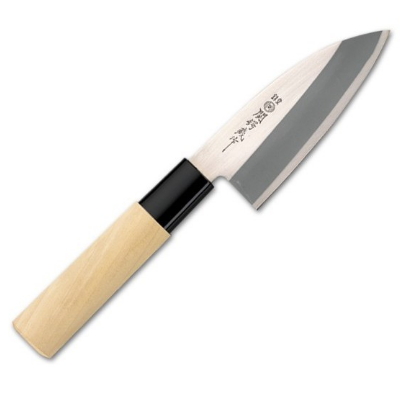
Today, many Western-style Japanese knives have a double bevel, designed with a sharper angle at the front than at the back for a thinner, sharper blade.
Hardness (HRC): The key to edge retention
Japanese knives are made with a harder type of steel than European knives. While a European knife typically has a hardness of 54 to 58 Rockwell (HRC), Japanese knives generally range from 58 to 66 HRC. This high hardness allows for finer sharpening that retains its edge longer and offers less resistance when cutting. However, harder steel also makes the blade more vulnerable to chipping or damage from incorrect movements or cutting bones/very hard foods.
Blade Thickness
Japanese knife blades tend to be thinner than European knife blades. A thinner edge offers less resistance during cutting, which translates into greater efficiency. However, a thinner blade is also more vulnerable.
—
IV. A Knife for Every Purpose: Popular Types of Japanese Knives
Japanese knives have specialized for different uses, reflecting the Japanese belief in having the perfect tool for each task.
Santoku:
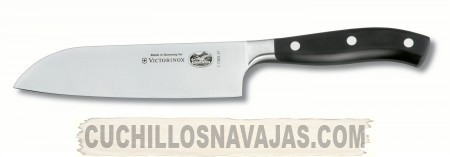
Its name means “3 advantages” or “3 virtues” (meat, fish, and vegetables). It is the traditional Japanese form of a universal knife, similar to the European chef’s knife. It easily chops, slices, and fillets. It is very popular and usually has a double bevel. Its size varies from 14-16 cm. The Santoku knife is a general-purpose kitchen knife, originating from Japan. Its blade is typically between 13 and 20 cm long, and it has a flat edge and a blade that curves at a 60-degree angle. The word Santoku generally translates to “three virtues” or “three uses,” a reference to the knife’s three cutting tasks: slicing, dicing, and mincing. The Santoku blade and handle are designed to work in harmony, and the original Japanese Santoku is considered a well-balanced knife. The design of the Santoku knife is lighter, thinner, and shorter than a traditional Western chef’s knife.
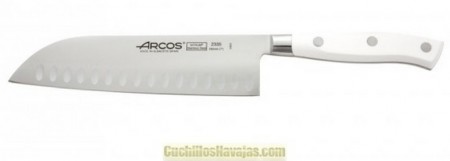
The Santoku knife is sometimes preferred by people with small hands, with modifications, and Santoku-type knives have appeared on television.
Gyuto (Chef’s Knife or Onion Knife):
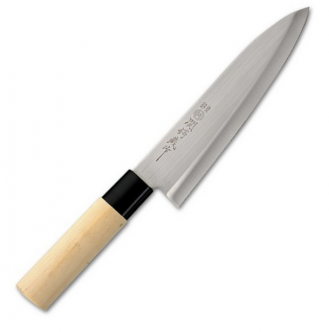
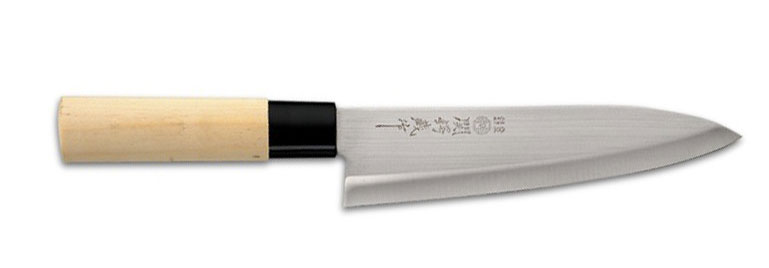
It is the Japanese version of the Western chef’s knife, with a thinner blade. It is a versatile knife for slicing, filleting, and preparing fish, meat, and vegetables. The Santoku is considered, in a way, the double-beveled successor to the traditional single-beveled Gyuto.
Nakiri (Vegetable Chopper):
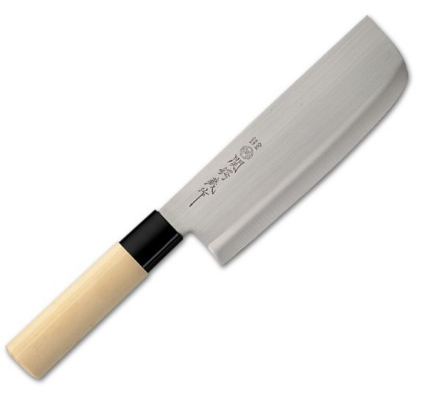
Despite its flat, cleaver-like shape, it is not suitable for cutting bones. It is primarily used for cutting and chopping all kinds of vegetables. Its square tip provides robustness and safety, allowing it to cut dense products all the way to the tip. The size usually varies from 165mm to 180mm.
Yanagiba (Willow Blade / Sashimi):
Meaning “willow blade”. It is a long, thin knife, traditionally used for slicing fish into wafer-thin cuts, typical of sushi and sashimi. It allows for a long, continuous cutting motion for clean, smooth performance. It is used for skinning and, at times, for removing scales and boning certain fish. It generally has a single bevel. Its size usually ranges from 270mm to 330mm.
Deba (Cleaver):
Traditionally used as a cleaver, it is a stable and heavy knife with a wide and strong single-edged blade. The front part is used for cutting and removing fish heads, while the tougher rear part is used for dissecting small bird bones or fish bones. Its size ranges from 120mm to 210mm. Often, it is for cutting fish, but it also serves for poultry and meat.
Petty (Utility):
A small knife, ideal for peeling and carving vegetables, fruits, and other delicate tasks. It is a good complement to larger knives such as the Gyuto or Santoku.
Sujihiki:
It is the Western version of the Yanagiba, a knife for filleting and carving, but with a double bevel.
Usuba:
Vegetable knife with a straight cutting blade for a clean separation on the cutting board. It allows for thin slices. The Usuba knife is the traditional vegetable knife for the professional Japanese cook. These knives are characterized by a flat edge, with little or no curve, and are tall. Usuba literally means “thin blade,” indicating its relative thinness compared to other knives, necessary for cutting vegetables. This knife is particularly popular among Kyoto cooks, who use the Usuba for most of their work.
Kamagata-Usuba:
More common in the Kansai area, also for vegetables, with a tip that allows for delicate tasks.
Bunka / Kiritsuke / Kengata:
Multi-purpose knives that resemble the Santoku, but with a tip that facilitates precise cuts.
—
V. Beyond the Cut: Use, Maintenance, and Essential Care
A quality Japanese knife is a long-term investment, and its lifespan and performance depend on proper use and maintenance.
Professional Japanese cooks generally own their personal set of knives, which are not used by other cooks. Some cooks have two sets of blades, which they alternate every other day. After sharpening a carbon steel knife at night after use, the user normally allows the knife to “rest” for a day to restore its patina and eliminate any metallic odor or taste that might otherwise be transferred to the food.
Grip and Technique: The Chef’s Dance
Holding the knife correctly is fundamental for safety and precision. Japanese chefs use several techniques:
- Pinch Grip / Blade Grip: The most popular. It involves holding the knife with the thumb and index finger directly on the blade, near the bolster and where it joins the handle. The rest of the fingers rest underneath or around the handle, providing support. It allows for the greatest control, wrist flexibility, and is ideal for versatile knives like the Santoku or Gyuto.
- Point Grip: Places the index finger on the spine of the knife to focus on precision, useful for decorative cuts, filleting, and thinly slicing fish. Used with long, thin knives like the Yanagiba.
- Hammer Grip: Where the knife is held completely by the handle, ideal when more force than precision is needed, such as when cutting bones, dense meat, cartilage, or large/hard fruits. Can be dangerous for novices.
- Claw Grip: This is not a way of holding the knife, but the way food is held with the free hand to protect the fingers. The fingertips are curled back towards the palm, and the knuckles act as a guide for the blade, keeping the fingers behind. The thumb should remain tucked behind the food.
Correct Use and Precautions
- Use the right knife for each task.
- Avoid lateral movements, prying, or chopping with your Japanese knife, as these can damage the edge.
- Never cut bones, grates, frozen foods, or hard seeds with these knives; they can chip.
- If you need to apply a lot of force, something is wrong; the Japanese knife should cut smoothly.
- Always use plastic or wooden cutting boards. Marble and glass are too hard and damage the edge.
Cleaning and Storage
- Wash and dry the blade immediately after use, especially carbon steel knives, which are prone to rust.
- Always hand wash. Dishwasher detergent can seriously damage the knife.
- Store your knife safely to avoid contact with other steel objects that could damage the edge. A blade guard, a magnetic strip, or a knife block are excellent options.
- Inform others who may use your knives about their special care and sharpening.
Sharpening: An Art in Itself
A dull knife is dangerous and inefficient. Sharpening a Japanese knife is almost an art and must be done correctly.
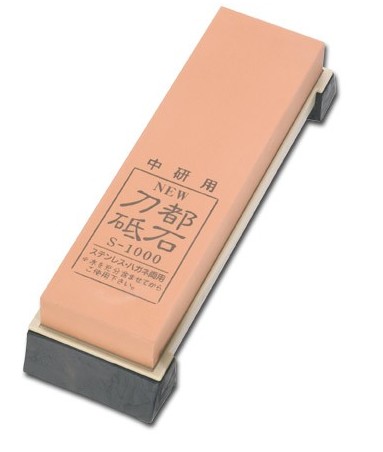
- Japanese Sharpening Stones (Whetstones): These are the preferred method. They offer excellent performance and are easy to use. They should be submerged in water for 5-15 minutes before use so that they release particles and facilitate the process.
- Coarse grit (#220 – #800): For very dull knives or those with damaged edges.
- Medium grit (#1000): Ideal for regular and general sharpening.
- Fine grit (#3000 – #12000): For polishing the blade, removing burrs, setting the edge, and achieving a “mirror-like” finish.
- Sharpening Angle: Hold the knife against the stone at an angle of approximately 15-20 degrees. You can use a sharpening guide to maintain this.
- Movement: Slide the knife over the stone with smooth, even movements, applying moderate pressure, from the heel to the tip. If it has a double bevel, repeat on both sides; if it is single-beveled, only on the sharpened side.
- Do not use steel honing rods: Steel honing rods are ineffective on hard Japanese steel and can damage them. A ceramic honing rod can be used for daily maintenance.
- Edge Verification: Test by cutting a sheet of paper or carefully touching your finger to feel the uniformity of the edge.
Handle Maintenance
Wooden handles, common on Japanese knives, require maintenance. It is advisable to treat them with oil or wax from time to time (Eden Essentials maintenance oil, Ballistol or other mineral oil), avoiding olive oil which can become rancid.
—
VI. The Right Choice: Japanese vs. Western?
Both knife styles have their strengths, and the choice will depend on your culinary needs and preferences.
| Feature | Japanese Knives | Western Knives |
|---|---|---|
| Steel | High hardness (58-66 HRC), often carbon steel or hard alloys | Softer (54-58 HRC), more resilient |
| Edge Angle | Sharper (15-20 total degrees), for precise cuts | Less sharp (20-25 total degrees), for greater durability |
| Blade Thickness | Thinner, less resistance when cutting | Thicker, less vulnerable |
| Precision | Ideal for delicate tasks and fine cuts | Less precise for delicate cuts |
| Durability/Robustness | More fragile, vulnerable to chipping with bones/hard foods | More durable and resistant to damage |
| Maintenance | Requires frequent sharpening and special care, harder to sharpen | Easier to sharpen, less maintenance |
| Versatility | Less suitable for bones or hard foods | Suitable for a wider variety of tasks |
| Manufacturing | Often handmade, high artisanal quality | Usually mass production |
For beginners, a European knife is usually easier to handle due to its robustness and ease of sharpening. However, if you are looking for maximum precision and are willing to give it the care it deserves, a Japanese knife will reward you with unparalleled performance.
—
VII. Featured Brands and Masters: Excellence in Japanese Cutlery
The Japanese knife market offers a vast range of brands, many of them from small workshops that keep the tradition alive.
- Kai: One of the world leaders in high-end knives. Their Shun Premier series (with tsuchime technique and 61 HRC hardness) and Shun Damascus are well-known. They also offer the Wasabi Black series for beginners and Shun Classic. Kai Corporation works with a network of local artisans in Japan.
- Global: Very well-known and preferred by many professional chefs. Their knives are forged in one piece with the characteristic dotted anatomical handle. They use Cromova 18 steel (58 ± 2 HRC), exclusively designed for them.
- Kyocera: Stand out for their ceramic knives, a material that ensures sharpening durability up to 10 times superior to steel, does not transmit odors or flavors, and are very lightweight.
- Samura: Has gained ground in the market with excellent performance products. The Super 5 series uses V-10 steel (enriched with carbon) and is hand-forged, while the Okinawa series uses AUS-8 steel and focuses on functionality for professionals and home users. Although the steel is Japanese and the blades are forged and sharpened in Japan, assembly is done in China for a competitive price.
- Misono: Internationally recognized for their quality and prestige. The UX10 line is their top exponent, made with Swedish steel (59-60 HRC). The 440 series uses “High 16 Chromium and Molybdenum” steel and the Molybdenum series uses “High carbon 13 Chrome Molybdenum.”
- Glestain: Easily recognizable by their design with unique dimples that reduce friction and prevent food from sticking. Made with ACUTO440 stainless steel (58-59 HRC) subjected to multiple heat treatments and with a convex edge invented by Mr. Homma, their founder.
Other notable brands include Hocho, Tamahagane, Kanetsugu, Tojiro, Masamoto, Kotetsu, Rakumo, Muramo, Wave, Akagi, Toku, Hikane, and Exclusive.
Among the master blacksmiths are names such as Yoshihiro, Keijiro Doi (whose workshops in Sakai are examples of traditional knives), Suogo Yamatsuka (master in blade manufacturing), Hirotsugu Tosa (master sharpener), and Keido Suhihara (master in handles). Mr. Homma, founder of Glestain, is known for his innovative approach to knife manufacturing since 1971.
—
The Investment in a Perfect Edge
Japanese knives are the result of centuries of tradition, art, and an tireless pursuit of perfection. Choosing one is not just buying a tool; it’s acquiring a piece with history and the legacy of master artisans. Whether you seek precision for the perfect sushi, versatility for daily use, or simply the pleasure of working with an instrument of beauty and functionality, a Japanese knife is an investment that will transform your kitchen experience and accompany you for years.