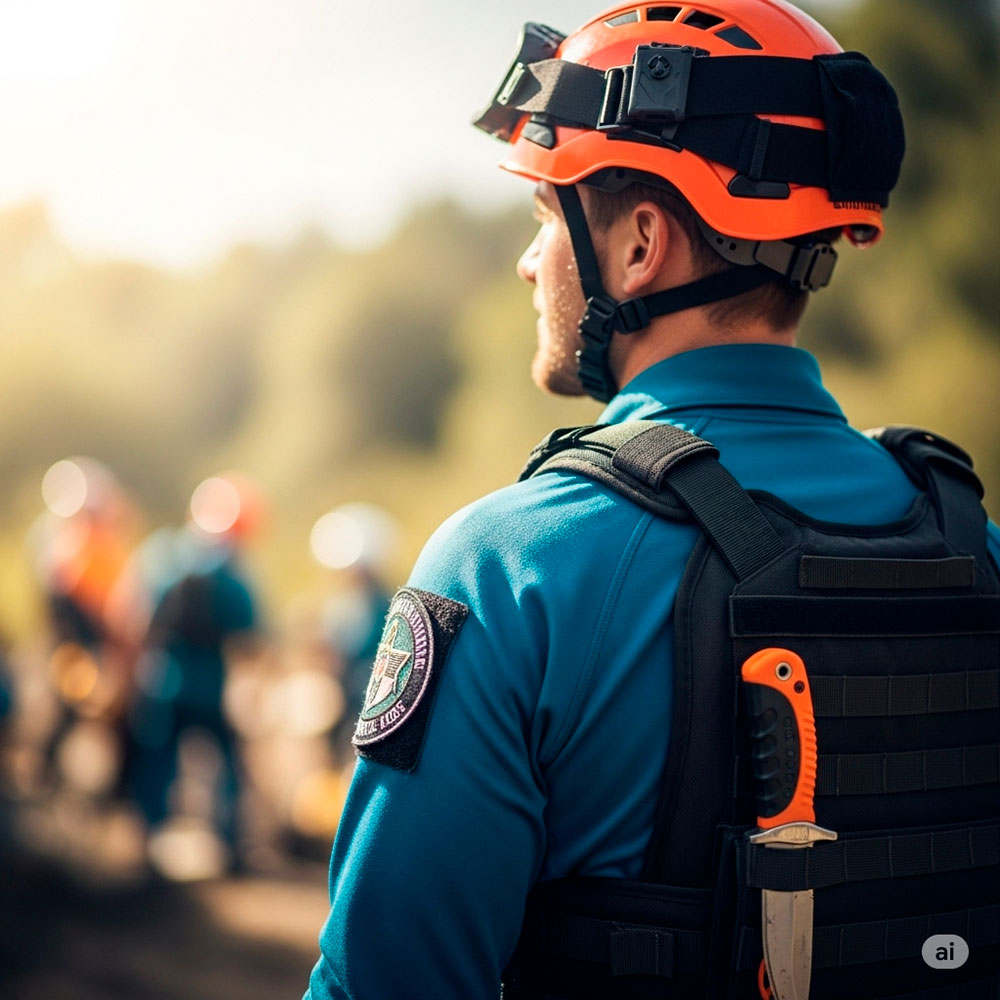
Rescue knives are specialized tools, designed to face emergency situations quickly and safely. Unlike a conventional multi-tool knife, these tools are designed for a very specific purpose: to help in critical moments, whether in a traffic accident, a natural disaster, or any situation where speed and functionality are vital. But what makes them so special? What features should you look for to ensure you have a tool that will truly save you in a pinch?
In this article, we will break down the essential characteristics that define a high-quality rescue knife. It’s not just about the blade, but a combination of elements that make it an indispensable tool for professionals such as firefighters, paramedics, police, or even for anyone who wants to be prepared for the unexpected.
Contents
What is a Rescue Knife and Why is it Different?
A rescue knife is much more than a simple folding blade. It is a compact survival kit, integrated into a single handle. Its main difference lies in its additional functions, which go beyond cutting. These tools are designed to be operated with one hand, often in stressful conditions and low visibility, and to perform specific rescue tasks.
Its key components usually include a seatbelt cutter, a glass breaker, and, of course, a robust and functional blade. Each of these parts is optimized for its purpose, which distinguishes them from everyday knives.
Essential Components and Their Characteristics
Understanding each component will help you choose the right rescue knife. Not all models are the same, and the quality of each part can make the difference between a useful tool and one that fails when you need it most.
1. The Blade
The blade of a rescue knife must be robust and reliable. Here are the most important features:
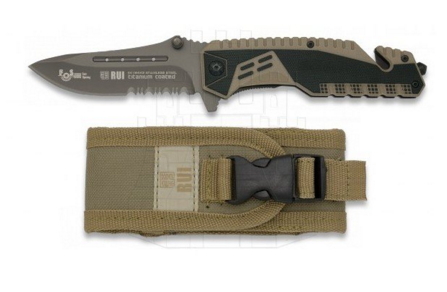
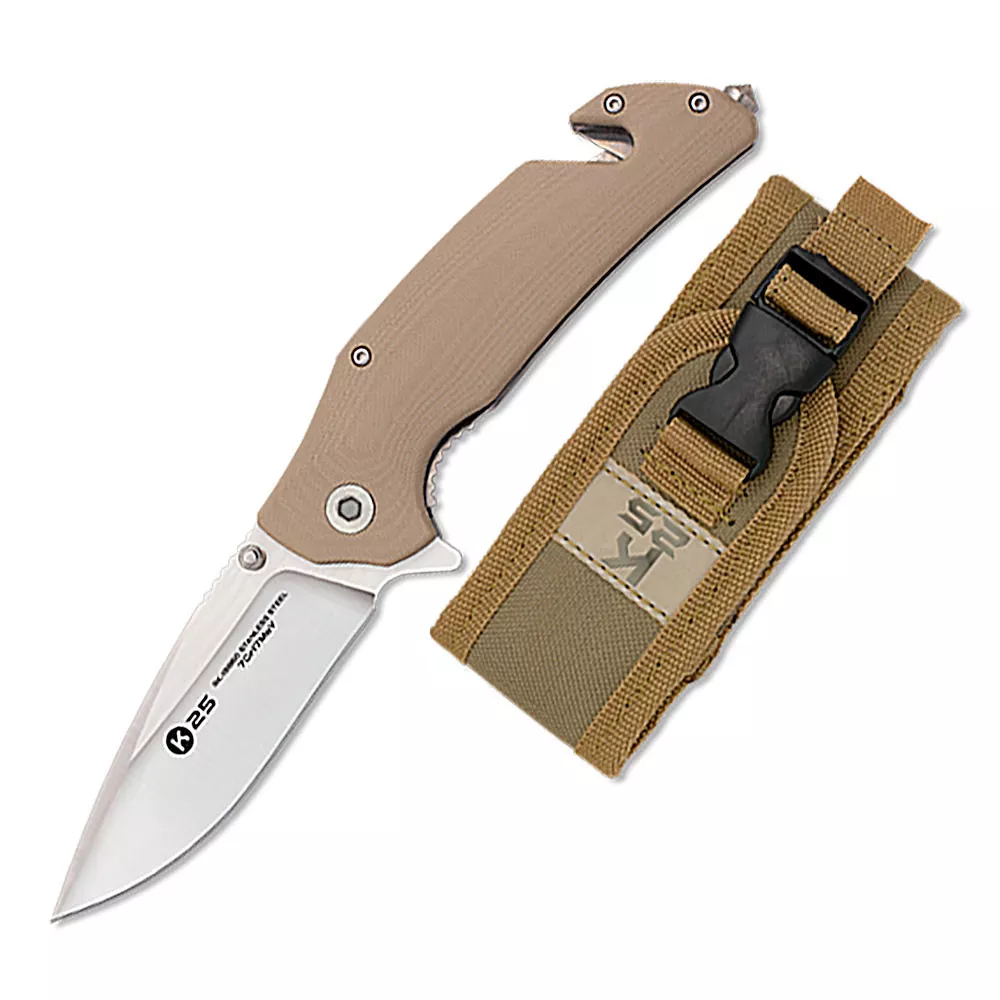
- Blade shape: They often have a drop point or tanto shape, which are strong and versatile. The edge can be straight, but it is common to find it partially serrated. The serrated part is ideal for cutting fibrous materials or thick ropes, while the plain edge is used for more precise cuts.
- Steel material: Stainless steel is the preferred material, as it resists corrosion, which is crucial if the knife will be used in humid environments or in contact with liquids. Steels such as 440C, 8Cr13MoV, or VG-10 are popular choices, as they offer good edge retention and are relatively easy to sharpen.
- Opening mechanism: Speed is vital. Therefore, most rescue knives feature assisted or manual one-hand opening mechanisms. The thumb stud, flipper, or a hole in the blade are the most common systems.
- Blunt Tip: Many models have a blunt tip to prevent accidents when cutting seatbelts or clothing without harming the person being rescued.
2. The Seatbelt Cutter
This is, perhaps, the most characteristic and crucial component. A good seatbelt cutter must be:
- Robust and sharp: It must be able to cut the synthetic material of a seatbelt with a single movement, without getting stuck. It is often integrated into the base of the handle or on the back of the knife.
- Safe: The cutter’s edge must be protected by a hook to prevent accidental cuts to the user or the person being rescued.
- Accessible: It must be easy to use with one hand and without having to open the main blade, allowing quick access in stressful situations.
3. The Glass Breaker
This component, generally a tungsten carbide tip, is located at the end of the handle. Its function is to break vehicle windows safely and controllably. To be effective, it must:
- Be made of a hard material: Tungsten carbide is the industry standard, as its hardness allows it to fracture tempered glass without breaking.
- Be well positioned: It must be a natural extension of the handle, allowing the force of the blow to be concentrated at a small point to maximize its effectiveness.
4. The Handle and Ergonomics
The handle is the basis of everything. A rescue knife should feel secure and comfortable in the hand, even if it is wet, bloody, or if gloves are worn. Look for handles made of materials such as:
- Aluminum: Lightweight, strong, and durable. It often has textures for a better grip.
- G-10 or Micarta: Fiber composites that offer exceptional grip, even when wet, and are extremely durable.
- Carbon Fiber: Offers great strength and lightness, although it is usually more expensive.
In addition to the material, ergonomics are fundamental. A good design must allow for a firm grip in any situation.
5. Other Elements
Some rescue knives include additional features that can be very useful:
- Pocket clip: A robust and reversible clip allows the knife to be carried safely and accessibly.
- Lanyard Hole: Allows a lanyard to be attached for greater security or to carry the knife hanging.
- Additional tools: Some models may include screwdrivers, nut wrenches, or even small saws.
Comparison Table: Rescue Knives vs. Multi-tool Knives
To illustrate the differences, here is a comparison table summarizing the key points:
| Feature | Rescue Knife | Traditional Multi-tool Knife |
|---|---|---|
| Main Purpose | Use in emergency and rescue situations. | General use, leisure, DIY, daily tasks. |
| Specific Functionalities | Seatbelt cutter, glass breaker, one-hand opening. | Openers, scissors, screwdrivers, corkscrews, etc. |
| Blade Design | Robust, often with serrated edge, blunt tip. | Plain edge, sharper tips, simpler design. |
| Handle Material | Ergonomic, with textures for a firm grip (G-10, aluminum). | Plastic, wood, polished metal, not always optimized for grip. |
| Speed of Use | Designed for quick one-hand deployment. | Requires two hands or slower deployment. |
Recommendations According to User Profile
Choosing the right rescue knife depends on your specific needs. Here’s how we can help you decide:
For the Professional (Firefighter, Paramedic, Police)
If your job requires constant use of this tool, you need a model of the highest quality. Look for knives with G-10 or aircraft-grade aluminum handles, high-end steel blades (such as D2 or 154CM), and fast, reliable assisted opening mechanisms. Durability and flawless functionality are the number one priority. Models from brands like CRKT, Böker Plus, or Spyderco are usually an excellent option.
For the Prepared Driver, but be careful …
If you are looking for a tool to carry in your car, a rescue knife with the three basic functions (blade, seatbelt cutter, and glass breaker) will be more than enough. Choose a compact model, easy to access, and with a safely integrated glass breaker. Brands like Kershaw, Gerber, or Muela’s own rescue knives offer very functional and affordable models.
The problem is that in some countries, like Spain, it is not legal to carry a knife with a blade longer than 4 centimeters in the car. We recommend you take a look at the following video (in Spanish) where we explain everything.
For the Outdoor Enthusiast or Adventurer
If you spend time outdoors, a rescue knife can be a smart addition to your gear. Consider models that have a good balance between robustness and weight. A seatbelt cutter can be useful if you are going to drive ATVs, motorcycles, or off-road vehicles, while the serrated blade will be ideal for cutting ropes or branches. Look for models with handles that offer excellent grip in wet conditions.
Rescue knives are not just an accessory, but a safety tool that can make a difference in a critical situation. When choosing one, don’t just be swayed by price or aesthetics. Evaluate each component: the quality of the blade, the effectiveness of the seatbelt cutter, the robustness of the glass breaker, and the ergonomics of the handle. A well-chosen knife is an investment in your safety and that of others.
Explore our selection of rescue knives, designed for professionals and those who want to be prepared. Find the perfect model for your gear and have the peace of mind of carrying a reliable tool in your daily life.