Keeping your knives impeccably sharp is crucial, whether you’re an experienced chef or simply enjoy precision cutting. The honing steel, that often misunderstood utensil, is the key to achieving this. It’s not about sharpening, but about honing the edge, a subtle but fundamental difference that can completely transform the cutting experience. Are you ready to discover all its secrets and become a master in maintaining your cutting tools?
What is a Honing Steel and Why is it Indispensable?
Contents
Before delving into the “how,” it’s essential to understand the “what.” A honing steel is a utensil specifically designed to realign and hone the edge of knives and similar tools. Its use is common in the home, but it is absolutely indispensable for professionals such as butchers, carpenters, and shoemakers, who rely on sharp knives for their daily work. It’s that elongated steel cylinder you see in many kitchens, and its function goes beyond what most people imagine.
The Science Behind Its Functioning
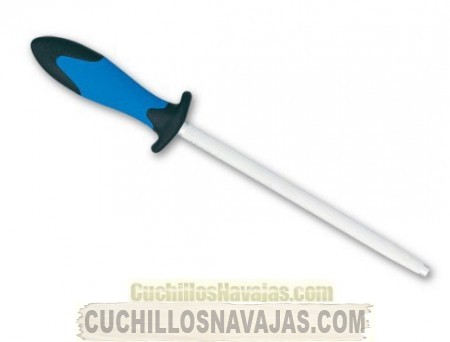
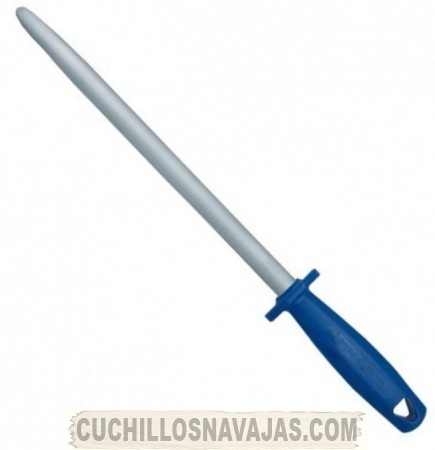
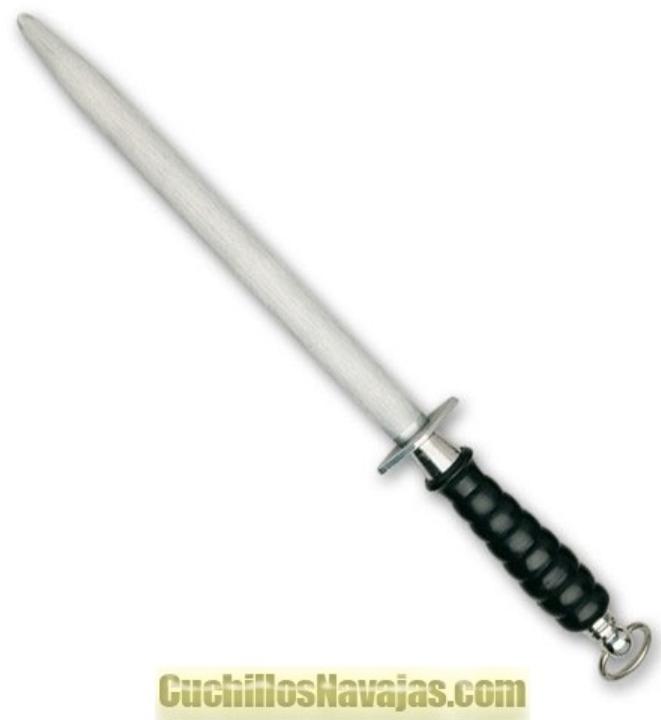
Although it looks like a simple cylinder, its design is ingenious. It is composed of a cylindrical or sometimes oval body, made of high-quality steel, which has longitudinal grooves along its entire surface. These grooves do not sharpen, but act as micro-guides. When the knife’s edge slides over them, the imperceptible deformations in the edge (which cause the loss of sharpness) are realigned, returning to their original position and restoring the knife’s optimal cutting ability. It’s like “combing” the edge so that its microscopic teeth are straight and aligned again. Therefore, understanding how to use a honing steel is not just about technique, but about understanding the physics that makes it so effective.
Types of Honing Steels: Choose the Ideal One for You
Not all honing steels are the same. There are different materials and shapes, each with its own advantages. Knowing the available types will help you choose the most suitable one for your needs and better understand how to use a honing steel to maximize its efficiency.
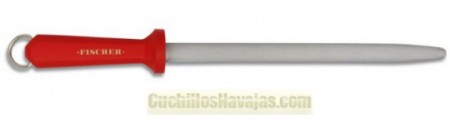
- Steel Honing Steels: These are the most common and versatile. Ideal for daily maintenance of most kitchen knives. Their grooved surface effectively realigns the edge.
- Ceramic Honing Steels: They offer a slightly higher level of abrasion than steel ones, which makes them suitable for recovering edges that have lost a bit more of their sharpness. They are softer than diamond honing steels, but more effective than steel ones in certain cases.
- Diamond Honing Steels: They contain diamond particles embedded in their surface, which makes them the most abrasive. They are used for very dull knives or to give an initial edge to knives that do not have one. They require more careful handling due to their greater abrasive capacity.
- Glass Honing Steels: Although less common, they can be used to polish and refine the edge after using other types of honing steels.
Comparative Table: Popular Honing Steels
| Honing Steel Type | Main Material | Abrasion Level | Recommended Use | Durability |
|---|---|---|---|---|
| Grooved Steel | High-hardness steel | Low to moderate (hones) | Daily edge maintenance. | Very high |
| Ceramic | High-density ceramic | Moderate (recovers) | Slightly dull knives. | High, but more fragile. |
| Diamond | Steel with diamond particles | High (sharpening/grinding) | Very dull knives or for initial sharpening. | Very high |
Mastering the Technique: Detailed Steps on How to Use a Honing Steel Correctly
The key to effectively using a honing steel lies in technique and angle. A common mistake is to think that you have to press hard or that the goal is to “scrape” the knife. Nothing could be further from the truth. The movement should be smooth, fluid, and at a constant angle.
Step 1: Posture is Key
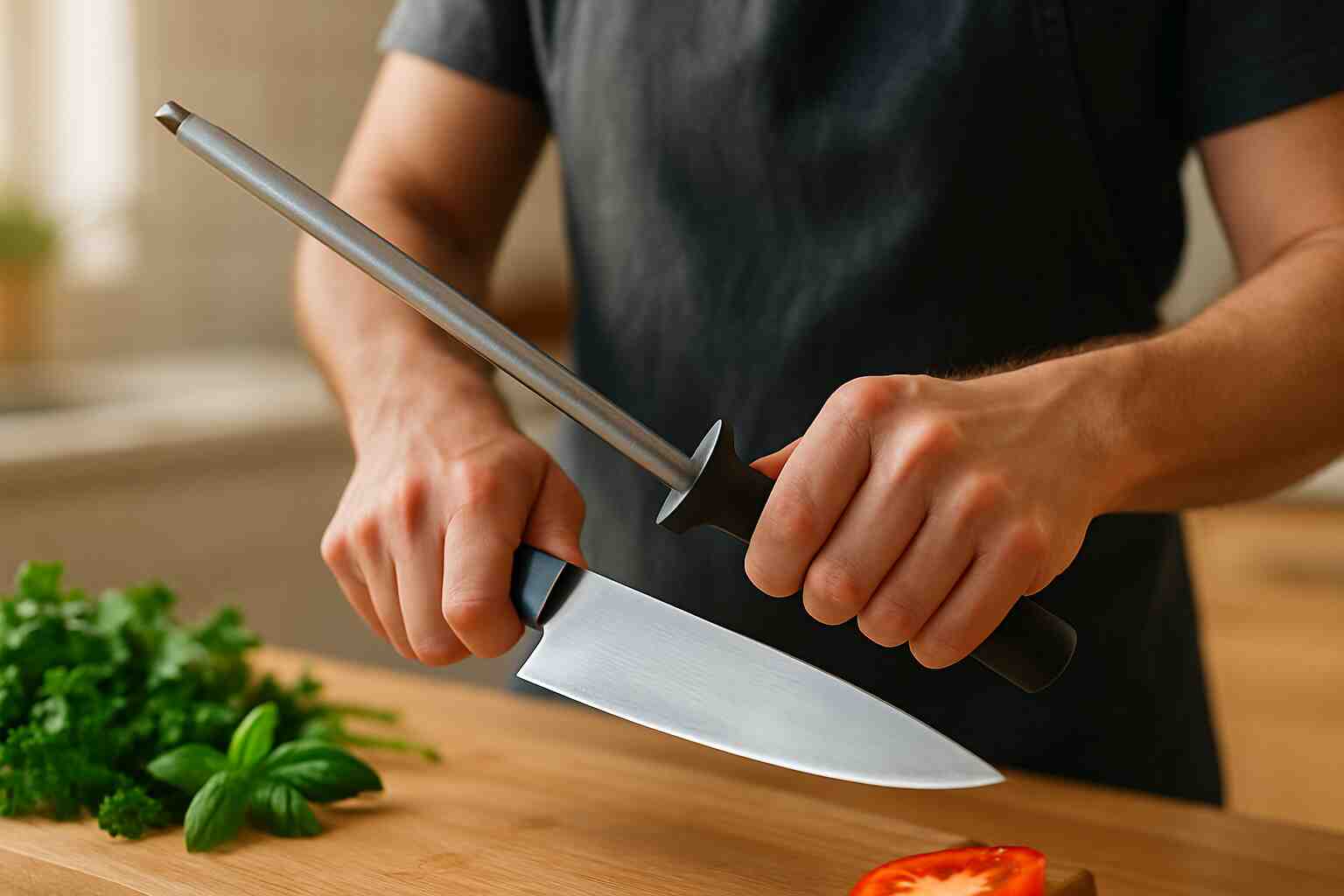
Hold the honing steel firmly with your non-dominant hand, resting the tip on a stable, non-slip surface (such as a cutting board or even the countertop) at an angle of approximately 45 degrees to your body. This will give you stability and allow you to maintain precise control over the knife. If you are not comfortable resting it, you can hold it in the air, but make sure it is far enough away from your body to avoid accidents.
Step 2: The Perfect Angle – Your Best Ally
This is the most critical point for knowing how to use a honing steel. For most Western knives, the ideal angle is 20 degrees. Imagine the spine of the knife is at 90 degrees to the honing steel, and half of that is 45 degrees. Then, half of 45 degrees is approximately 22.5 degrees, almost the angle you need. Practice will help you feel this angle intuitively. Maintaining this constant angle throughout the process is fundamental to realigning the edge uniformly. You can use angle guides if you find it difficult to maintain consistency at first.
Step 3: The Fluid and Diagonal Movement
- For one side of the edge: Gently place the closest edge of the knife blade (near the handle) against the top of the honing steel, maintaining the 20-degree angle.
- As you slide the knife down and away from you, move the blade diagonally along the honing steel, so that when the knife reaches the end of the honing steel, the tip of the knife is the last part to leave the surface of the honing steel.
- The honing steel should remain still; it is the knife that performs the smooth and controlled movement.
Step 4: Repeat on Both Sides
Repeat the same movement on the opposite side of the knife. That is, now the blade will rest on the honing steel on the other side and the movement will be upward or downward, depending on your comfort, but always maintaining the same angle and the same smoothness. It is vital to alternate sides to ensure uniform honing of the edge.
Step 5: The Right Amount of Passes
Generally, five to ten passes on each side are sufficient to hone the edge. There is no need to apply excessive pressure; gravity and smooth sliding are your best allies. Once you feel the knife “grip” the honing steel and hear a soft, uniform sound, you will know that the edge is properly aligned.
Maintenance and Care of Your Honing Steel
One of the great advantages of honing steels, especially good quality steel ones, is that they are extremely durable and require little maintenance. They are designed to withstand constant use and the passage of time.
- Cleaning: After using it, you can clean it with a damp cloth to remove any metal residue that has come off the knife. It is not necessary to wash it with soap or submerge it in water.
- Storage: Store it in a safe place where it will not be hit by other utensils, preferably in a knife block or on a magnetic wall mount. Although they are resistant, a strong blow could damage them, especially ceramic or diamond honing steels.
- Rust: Although high-quality steel is resistant to corrosion, if you live in a very humid environment or if the honing steel gets wet frequently and does not dry well, some rust stains may appear. In that case, you can gently rub it with a fine scouring pad or a specific product to remove rust.
A well-maintained honing steel can last for many years, becoming a long-term investment for the maintenance of your cutting tools.
When the Honing Steel is Not Enough: Is it Time to Sharpen?
It is important to remember that the honing steel does not sharpen the knife, but hones the edge. If your knife is very dull, chipped, or the edge has lost its original shape, a honing steel will not be enough. In those cases, you will need a knife sharpener, which removes a small amount of metal from the blade to create a new edge. A good sign that your knife needs sharpening and not just honing with the honing steel is if it cannot effortlessly cut a ripe tomato or if it slides over the surface without biting into it. If you are unsure or uncomfortable sharpening it yourself, you can always go to a professional to restore your knives’ edge to perfection.
Finding a good honing steel and quality sharpeners is essential. We recommend exploring the options available in our online store, where we have a wide selection of tools for maintaining your knives.