
If you are passionate about cooking and fresh fish is your favorite ingredient, you will know that working with this delicate raw material is an art that requires precision and the right tools. From the tip of the knife to the pan, we are going to immerse ourselves in the fascinating world of fish cuts and the knives that will help you make the most of them in your recipes.
Cutting and preparing fish can seem intimidating at first, but with the right knife, the task is greatly simplified. Get ready to discover how to choose and use these essential tools to transform your culinary experience with fish, achieving professional results in your own kitchen. The correct choice of kitchen utensils contributes directly to enjoyment and efficiency in the kitchen, making every cut a pleasure.

The European Panoply: Robustness and Versatility
Contents
- The European Panoply: Robustness and Versatility
- The World of Japanese Precision: Art and Specialization
- Yanagiba (Sashimi Knife): The Essence of Fine Cutting
- Deba: The Heavy Japanese Butchering Knife
- Sujihiki: The Japanese Double-Edged Filleting Knife
- Maguro Bocho: The Tuna Giants
- Sushikiri: The Perfect Roll Cutter
- Hamokiri: For Fish with Delicate Bones
- Kiritsuke: The Executive Chef’s Knife
- Santoku: The Japanese Three Virtues
- Gyuto: The Japanese Chef’s Knife
- Crucial Technical Aspects: Material and Maintenance
- Comparison of Advantages and Disadvantages: Which is Best for You?
- Purchase and Usage Recommendations by User Profile
European kitchen knives are known for their robustness, durability, and versatility, characteristics that make them indispensable in any kitchen, from domestic to professional. Their design, often forged from a single piece of high-carbon steel or stainless steel, gives them exceptional balance and strength. For fish, some models are truly indispensable, offering practical solutions for each stage of processing.
Filleting Knife: The Master of Butchering
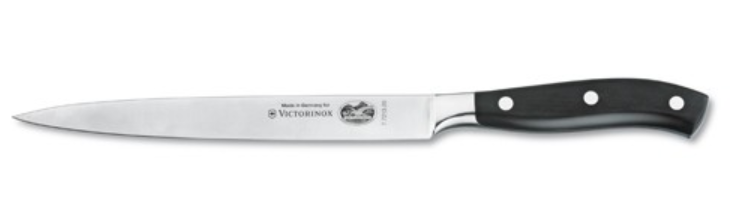
This is, without a doubt, your main ally for butchering fish. Its design is meticulously thought out for the task: a long, narrow, and remarkably flexible or semi-flexible blade. This flexibility is crucial, as it allows the blade to curve and adapt to the shape of the fish, following the line of the backbone to separate the meat with astonishing precision. It is ideal for obtaining clean, uniform, and waste-free fillets, and also for easily removing the skin, sliding between the meat and the skin effortlessly. The length of its blade can vary significantly, generally between 15 and 30 cm, which allows it to adapt to the size of the fish being worked, from small sole to large salmon. A shorter filleting knife is manageable for small fish, while a longer one is efficient for larger species. It requires careful and regular sharpening to maintain its optimal edge, with a typical angle of between 15 and 20 degrees. It is sometimes colloquially known as a “sole knife” due to its effectiveness with this type of flatfish.
Salmon Knife: Elegance in Every Slice
Considered the “aquatic cousin” of the ham knife, this knife is characterized by its very flexible, narrow blade, approximately 30 cm long. Its design is generally straight and blunt, with a rounded tip to avoid damaging the delicate salmon flesh during cutting. Its main purpose is to cut thin, uniform slices of smoked or cured salmon, allowing for impeccable presentation and perfect texture. However, its usefulness extends beyond salmon, also being excellent for preparing fish or meat carpaccio, where the fineness of the cut is paramount. Some models, especially high-end ones, even have a scalloped edge (small indentations or dimples) along the blade. These indentations create air pockets between the blade and the slice, which helps prevent thin portions from sticking to the blade, facilitating a clean and continuous cut. This technical detail is a testament to the engineering behind these specialized knives.
Boning Knife: Precision in Detail
Although its name suggests a primary use for meat and poultry, this boning knife is also surprisingly useful for fish, especially when it comes to tasks requiring extreme precision near the bone. Its fundamental purpose is to remove bones, and its design makes it perfect for this: a narrow blade, slightly curved towards the fine tip and relatively thin. This shape allows the user to maneuver with agility around bones and spines, making precise and clean cuts without wasting meat. Despite its thinness, it is designed to be strong and rigid enough to withstand resistance when cutting around the bone without bending or breaking. Its sharpening angle is usually between 15 and 20 degrees, providing a durable edge for demanding jobs.
Fishmonger’s Cleaver: Strength for Heavy Tasks
For the most robust and demanding tasks in fish processing, the fishmonger’s cleaver is the perfect tool. It is a very heavy and robust knife, with a very wide and stable, almost rectangular blade, often resembling a small axe. It is mainly used for cutting large bones and considerable pieces of fish, as well as for the general butchering of large species. Its great weight and the solidity of its blade give it the necessary force and momentum to cut hard materials with a single blow, such as the head or tail of a large fish, or the most resistant central bones. It is an indispensable tool in fishmongers and for those who work with whole pieces of large fish.
Oyster Shucker: The Mollusk Specialist
This utensil is highly specific for a particular mollusk: the oyster. It has a very short, wide, and exceptionally strong blade, designed to withstand the necessary pressure to open oyster shells without breaking. Its use is restricted to the safe opening of these bivalves, allowing the user to insert the blade into the oyster’s hinge and pry it open. Its design minimizes the risk of damaging the delicate oyster meat or introducing shell fragments inside, ensuring a clean and safe culinary experience.
Chef’s Knife (or Onion Knife) and Utility Knives: The All-Rounders
Although not exclusive to fish, the chef’s knife (or onion knife) and utility knives are tremendously versatile tools that will assist you in various stages of fish butchering, cleaning, and portioning. The chef’s knife, with its wide and slightly curved blade, is a true all-rounder capable of chopping vegetables for a garnish, cutting aromatic herbs, or even making thick cuts of fish. Its versatility makes it a staple in any kitchen. Utility knives, smaller and more manageable, are ideal for smaller precision tasks, such as cleaning small bones or making more detailed cuts. Their presence in the kitchen complements more specialized knives, offering flexibility for various preparations.
A common and highly beneficial technical detail in many knives designed for fish, both European and some Japanese, are the dimples (small indentations or oval hollows along the blade). These dimples create small air pockets between the blade and the cut food, which greatly facilitates the detachment of the cut portion from the blade, avoiding the annoying sticking effect that often occurs with wet fish or thin meats. This feature improves cutting efficiency and fillet cleanliness.
Cooking brings joy and is a source of health, such as fish, so recommended in the Mediterranean diet for its nutritional benefits and culinary versatility.
There are those for filleting and for cutting fish, achieving very desirable results, from thin slices for sashimi to perfect portions for grilling or baking. The key lies in the combination of the right technique and the specific tool for each task.
A fundamental aspect for the durability and performance of your knives is the cutting surface. Fish knives should be used exclusively on a good quality wooden or plastic cutting board. These surfaces are soft enough not to damage the knife’s edge, allowing it to maintain its sharpness for longer. Conversely, under no circumstances should they be used on hard surfaces such as marble, glass, or steel plates, as these surfaces will quickly dull the knife and can even cause nicks in the blade. Board care is as important as knife care.
The World of Japanese Precision: Art and Specialization
Japanese knives, with a millennial tradition inherited directly from the manufacture of legendary katanas, are globally recognized for their unparalleled precision, extreme sharpness, and the craftsmanship that characterizes them. Each piece is the result of centuries of refinement, where master artisans have developed unique and highly specialized tools for almost every imaginable culinary task, especially in the realm of fish. If you seek to take your cuts to a higher level and experience precision that borders on perfection, familiarizing yourself with them is essential. Their design philosophy focuses on specific function, which makes them highly specialized tools.
A key difference in Japanese knives, and a determining factor in their performance, is the type of bevel or edge:
- Kataba Style (Single Bevel): These knives are sharpened on only one side of the blade, which gives them extreme sharpness and an incredibly specific and clean cutting ability. This design allows for superior control for making fine and delicate cuts, such as those for sashimi, where the cutting surface must be impeccable. However, this specialization implies that they require specialized sharpening and are often designed specifically for right-handed or left-handed users, as the beveling directs the cut in a particular way.
- Ryoba Style (Double Bevel): These knives are sharpened on both sides, similar to the Western style. They are more versatile and easier to use for most daily tasks, as they do not require specific adaptation for right-handed or left-handed users. They offer a good balance between sharpness and edge durability.
Here are the most relevant and revered Japanese knives for fish processing:
Yanagiba (Sashimi Knife): The Essence of Fine Cutting
The “sashimi knife” par excellence, whose name poetically translates to “willow blade” due to its slender and elegant shape. It features an exceptionally long, thin, and, crucially, single-beveled (Kataba) blade. It is specifically designed for filleting fish into very thin slices for sashimi or sushi, allowing for clean and precise cuts with minimal force. The length of the blade (which can range from 21 cm for domestic use to 36 cm or more for professionals) is fundamental, as it allows for a continuous and fluid cut in a single motion, without the need for sawing, which preserves the integrity and delicate texture of the fish. There are specialized variations such as the Fuguhiki (even thinner and more flexible, designed for the delicate pufferfish) and the Takohiki (with a square tip, ideal for cutting octopus and tuna). Maintaining a Yanagiba in optimal condition involves cleaning and drying it immediately after each use. For carbon steel models, it is essential to oil them with camellia oil or a food-grade mineral oil to prevent oxidation and maintain the patina.
Deba: The Heavy Japanese Butchering Knife
A robust and heavy knife, with a thick and pointed blade, generally sharpened on one side (Kataba). The Deba is the workhorse of Japanese cuisine when it comes to whole fish. It is ideal for heading, cleaning, and butchering whole fish, and its robustness even allows it to cut thin fish bones, poultry, or meats with small bones, all without losing its edge. However, it is important to note that it is not recommended for very large or extremely hard bones, for which a cleaver would be needed. There are different types of Deba, adapted to different needs: the Hon-Deba (“true deba”) is the heaviest and most robust; the Mioroshi Deba has a slightly thinner and longer blade, which makes it more versatile for filleting after heading; and the Ko-Deba is a smaller version, ideal for smaller fish.
Sujihiki: The Japanese Double-Edged Filleting Knife
This knife is the Japanese equivalent of the European filleting knife, but with a distinctive feature: its double-edged (Ryoba) blade. Although it has a long and narrow blade, designed for making fine and clean cuts, its versatility is greater than that of a Yanagiba. It is widely used for thinly slicing meat, separating tendons and nerves, but can also be used for sushi and sashimi, although it is less specialized and, therefore, less convenient for filleting large pieces of fish with the same precision as a Yanagiba. Its blade is notably thinner than that of European filleting knives, which allows for less cutting resistance and greater delicacy in handling.
Maguro Bocho: The Tuna Giants
These are highly specialized and truly impressive knives, designed exclusively for butchering giant tuna. They are flexible, thin, and, most notably, extremely long. Some models, like the Oroshi hocho, can measure up to a meter and a half in blade length, allowing an entire tuna to be cut in a single continuous stroke. Their length and flexibility are essential for gliding through the tuna meat, separating large loins with extraordinary efficiency and cleanliness. These are tools primarily seen in wholesale fish markets and restaurants specializing in tuna.
Sushikiri: The Perfect Roll Cutter
A knife designed specifically for cutting sushi rolls (maki). It is easily recognizable by its large size, its characteristic square tip, and a symmetrical curved edge. Its design allows sushi rolls to be cut into uniform and clean portions with a single movement, without crushing the roll or damaging the internal ingredients. The shape of the blade helps maintain the integrity of the maki, ensuring that each piece is perfect.
Hamokiri: For Fish with Delicate Bones
This knife is halfway between the Santoku and the Yanagiba, with a distinctive square tip. It is specifically designed to work the bone of anguilliform fish, such as eel or conger, which have a particular and delicate bone structure. Its design allows it to cut through these thin bones without splintering them, keeping the meat intact.
Kiritsuke: The Executive Chef’s Knife
A multifunctional knife with a sharp tip and a profile that combines the precision of a Yanagiba with the versatility of a Gyuto. Traditionally, the Kiritsuke was reserved for executive chefs (Itamae) in Japan, symbolizing their mastery over all facets of Japanese cuisine. Its design allows for both fine sashimi cuts and more general cutting tasks, making it a versatile tool for an experienced chef.
Santoku: The Japanese Three Virtues
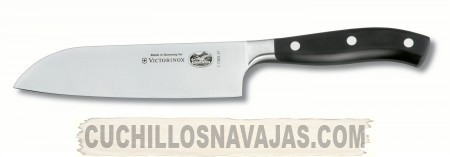
Although it is a multi-purpose knife for meat, fish, and vegetables, the Santoku is so popular and versatile that we cannot fail to mention it in this guide. Its name means “three virtues” or “three uses” (slicing, dicing, and mincing), which reflects its ability to handle a wide range of culinary tasks. With its wide, light blade and a slightly curved or “sheep’s foot” tip, it is an excellent option for daily use in any kitchen, offering exceptional balance and comfort for most users.
Gyuto: The Japanese Chef’s Knife
The Gyuto is the Japanese equivalent of the Western chef’s knife. It is a versatile knife designed for a wide range of tasks, including slicing, chopping, and filleting fish and meat. Its blade is generally thinner and often sharper than that of a Western chef’s knife, making it suitable for delicate work and precise cuts. It is an excellent choice for those looking for a high-quality multi-purpose knife with the precision and edge of Japanese tradition.
Crucial Technical Aspects: Material and Maintenance
Beyond the type and shape of the knife, some technical aspects directly influence its performance, durability, and the care it requires. Understanding these details will help you make informed decisions when buying and maintaining your tools.
Blade Material: The Heart of the Knife
The material the blade is made of is the most important factor determining the edge, edge retention, corrosion resistance, and maintenance of the knife:
- Carbon steel: This type of steel allows for superior sharpening, achieving extreme sharpness and an incredibly fine edge. It is preferred by many professional chefs for its cutting ability. However, it requires more meticulous care, as it is more prone to oxidation and the formation of patina (a dark layer that forms over time and use). It is not dishwasher safe and must be dried immediately after each use.
- Stainless steel: It is the most common option for everyday knives due to its ease of maintenance and high resistance to oxidation. Although it does not achieve the same level of extreme sharpness as carbon steel, it offers excellent edge retention and is much more tolerant of moisture and less rigorous care. It is ideal for daily use in the home kitchen.
- Damascus steel: More than a type of steel, it is a forging technique that combines multiple layers of different steels (often one harder and one softer) to create a blade with a characteristic and aesthetic wavy pattern. Damascus knives are valued for their beauty, durability, and the combination of the properties of the steels used, offering an excellent balance between edge and strength.
- Ceramic: Ceramic knives, made of zirconium oxide, are extremely hard and maintain an exceptional edge for a long time without needing sharpening. They are very light and do not react with food, preventing the transfer of metallic flavors. However, they are fragile and can break or chip if dropped or used to cut hard materials like bones. They are ideal for fine and delicate cuts of boneless fish.
Handle: Comfort and Balance
The material and shape of the handle are crucial for comfort, balance, and safety when using the knife. You can find:
- Traditional Japanese handles (Wa-handle): They are usually made of wood and have octagonal or D-shapes, designed for a light and precise grip. They are very light, which shifts the knife’s balance point towards the blade, facilitating delicate cuts.
- Ergonomic European-style handles (Yo-handle): They are generally made of synthetic materials, wood, or combinations of both, and are designed to fit comfortably in the hand, offering a secure grip and a balance more centered at the junction point between the blade and the handle.
The choice of handle largely depends on your personal comfort and balance preference. A good handle should provide a firm, non-slip grip, even with wet hands, and allow full control over the blade.
Maintenance: The Key to Longevity
Finally, the key to the success and longevity of any knife is proper maintenance, with sharpening being the most critical aspect. A sharp knife not only makes cleaner, more precise, and more aesthetic cuts, but it is also significantly safer. A dull knife requires more force to cut, which increases the risk of slips and accidents. It is essential to sharpen it regularly using appropriate sharpening stones (water stone is preferred for Japanese knives) or a quality honing steel to maintain the edge between sharpenings. In addition, it is essential to clean the knife immediately after each use and dry it completely by hand. Avoid the dishwasher at all costs, as aggressive detergents and high temperatures can damage the edge, handle, and promote oxidation, especially in carbon steel knives.
Comparison of Advantages and Disadvantages: Which is Best for You?
The choice between a European and a Japanese knife, or between different types within each category, will depend on your needs, your level of experience, and the type of fish you plan to prepare. Here is a comparison to help you decide:
European Knives:
- Advantages:
- Robustness: Generally heavier and built to withstand rougher use.
- Versatility: Many models (such as the filleting knife or chef’s knife) are multifunctional.
- Ease of Maintenance: Stainless steel ones are corrosion-resistant and more forgiving with daily care.
- Availability: Widely available and with varied prices.
- Bilateral Edge: Easier to use for both right-handed and left-handed users without distinction.
- Disadvantages:
- Less Precision: Although good, they do not achieve the extreme precision of specialized Japanese sashimi knives.
- Lower Edge Retention: Often require more frequent sharpening than Japanese carbon steel knives.
Japanese Knives:
- Advantages:
- Extreme Precision: Ideal for fine and delicate cuts, especially single-edged ones.
- Superior Edge: Capable of achieving incredible sharpness, which facilitates clean and effortless cuts.
- Specialization: Specific tools for each task, optimizing performance.
- Aesthetics: Often works of art, with unique finishes and patterns.
- Disadvantages:
- More Care: Carbon steel ones require rigorous maintenance to prevent oxidation.
- Fragility: Some models, such as the Yanagiba, can be more delicate and prone to chipping if not used correctly.
- Cost: Generally more expensive, especially artisanal ones.
- Single Edge: Kataba knives can be difficult for left-handed users if designed for right-handed users, and vice versa.


Purchase and Usage Recommendations by User Profile
Choosing the right knife is an investment in your culinary pleasure. Here are some recommendations based on your experience level and cooking habits:
For the Beginner or Occasional Cook:
- Recommendation: A good European stainless steel filleting knife and a versatile chef’s knife.
- Why: They are easy to maintain, robust, and will allow you to perform most fish butchering and preparation tasks without complications. The filleting knife will give you the necessary flexibility for basic cuts, and the chef’s knife will be your all-rounder for other preparations. Do not invest in high-maintenance knives until you master the basic techniques.
- Use: Practice with medium-sized fish such as sea bass or sea bream. Focus on safety and maintaining a basic edge.
For the Enthusiastic Cook or Occasional Adventurer (Intermediate Level):
- Recommendation: In addition to the filleting knife and chef’s knife, consider adding a salmon knife (if you enjoy smoked fish) or a Japanese Deba if you want to start butchering whole fish more efficiently. A Santoku is also an excellent addition for its versatility.
- Why: You are ready to explore more specific cuts and appreciate the advantages of a more specialized tool. The Deba will open the doors to complete butchering, while the salmon knife will improve your presentations. The Santoku is an excellent bridge between Western and Japanese tradition.
- Use: Experiment with different types of fish, including those with more complex bones. Start familiarizing yourself with stone sharpening techniques.
For the Expert or Professional Cook:
- Recommendation: A complete set that includes a Yanagiba (or Fuguhiki/Takohiki, depending on specialty), a robust Deba, a Sujihiki, and, if you work with tuna, even a Maguro Bocho. Consider carbon steel knives for maximum performance.
- Why: Your skill and demands require the most precise and highest-performing tools. The specialization of Japanese knives will allow you to achieve perfection in every cut, from the most delicate sashimi to the butchering of large pieces. Carbon steel will offer you an unparalleled edge, although it will require constant maintenance.
- Use: You will master advanced butchering and filleting techniques. Sharpening with water stones will be a routine part of your preparation.
There you have it, culinary explorer! We have navigated through the different types of fish knives and their exciting uses in the kitchen. From the Japanese Yanagiba for sushi to the versatile European filleting knife, each knife has its own personality and specialization. The next time you think about preparing that fresh fish, you will know exactly which tool is ideal for each cut, and how to care for it so that it accompanies you for many years of exquisite preparations. Investing in a good knife is an investment in your passion for cooking and in the quality of your dishes.