
Montería is a big game hunting modality with a deep heritage in the Spanish hunting tradition. In this practice, hunting dogs play an absolute leading role, being fundamental for its execution. Since the Late Middle Ages, when European royal houses commissioned Hunting Treatises, this activity has evolved, but has maintained elements that define it. For centuries, different types of montería have been known, from those carried out with nets in the northwest of the Iberian Peninsula, to the most common form in Europe, where the bedding of the game piece was sought with the help of a bloodhound.

Over time, the hunter has pursued the game, on foot or on horseback, to catch the piece. However, despite technological advances such as modern firearms, there is an element that has remained an irreplaceable symbol of this ancestral tradition: the montería knife.
The Essence of a Tradition: More Than a Tool
Contents
The montería knife is much more than a tool. It is an iconic element in the hunter’s equipment, and its importance is magnified when talking about its main use: the “remate” (finishing) of big game pieces. This practice has been maintained throughout the centuries, reflecting a unique relationship between the hunter, nature, and their tools.
The Purpose of the Finishing Knife: Beyond Hunting
The name of these knives already indicates it: they are the definitive instrument to end the life of a big game prey. Generally, this occurs after the animal has been wounded by a firearm, seeking to quickly end its suffering and avoid the risks that a wounded animal can present.
The finishing knife is also crucial when a piece is immobilized by a group of dogs (“agarre” or hold). In this situation, the use of a rifle or shotgun could endanger the dogs, making the knife the only safe and ethical option. There is even a hunting modality that is practiced exclusively with dogs and a knife, without firearms, especially for wild boars. This underlines that the finishing knife is a piece designed for a very specific purpose and is not a multi-purpose knife.
Keys to Choosing the Perfect Montería Knife
The choice of a montería knife should not be taken lightly, as robustness and safety are required in potentially delicate situations. Consider the following aspects to ensure you choose the best tool for your needs.
The Quality of the Steel and Construction: Full Tang vs. Stick Tang
The quality of the steel is fundamental for the reliability of the blade. A good finishing knife must offer the best possible quality. Regarding its construction, the blades can be “stick tang”, where the blade is hidden inside the handle, or “full tang”, where the blade structure extends from the tip to the pommel. Many hunters prefer the greater robustness of full tang blades for this task.
It is important to remember that, although stainless steels are more resistant to oxidation, no steel is immune, and those with a higher carbon content usually offer a superior edge.
Blade Dimensions: Size Does Matter
To reach the vital organs of a big game piece (lungs and heart), the blade should not measure less than 20 cm in length. The width is also very important, as a wider blade will affect more blood vessels and tissues, increasing its effectiveness. A blade that is around 7 cm wide and between 23 and 25 cm long is considered more than sufficient for an effective finish.
Blade Shapes and Types: From Higüela to Bowie
There is a wide variety of designs for montería knives, always with the need for a very sharp point and cutting edges. Some of the common types include:
- Higüela: Characterized by an isosceles triangle-shaped blade, often short for mobility in the mountains, but with a disproportionate width (“much death”) for its specific use.
- Cow Tongue or Lanceolate: Similar to the higüela but with less pronounced shapes.
- Bayonet: Straight blades reminiscent of military bayonets.
- With Raised False Edge: Like some ancient sabers.
- Bowie: A classic design, although its Spanish origin precedes the famous North American hero. It is advisable to hold them with the concave false edge downwards for a precise thrust.
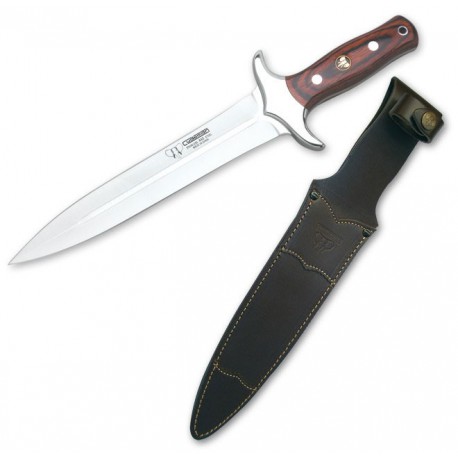
- Double Edge (Daggers): Many hunters prefer double-edged knives to finish the job more quickly. The blade must be very sharp to penetrate well and have a thickness of at least 5 or 6 millimeters to prevent breakage.
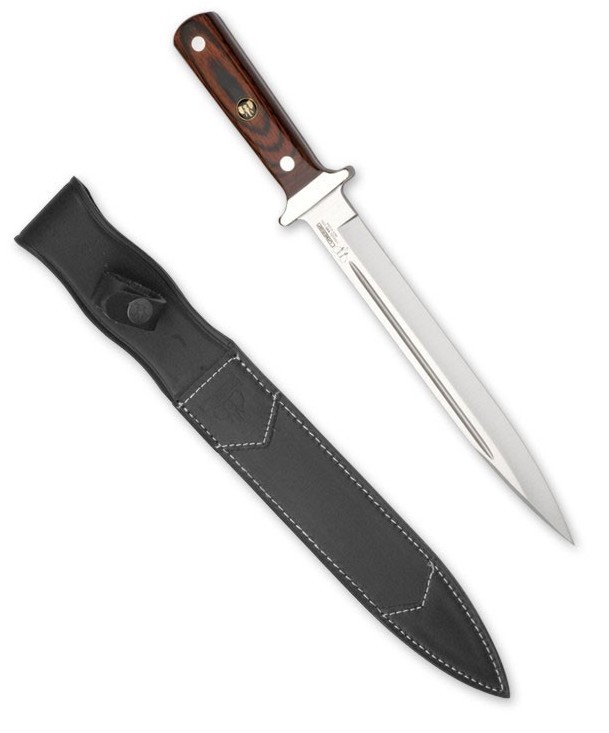
The Handle and Guard: Safety and Comfort
The handle is the anchor point with our hand and must be comfortable and secure, adapting perfectly to it. It can be made of natural materials such as noble woods or deer antler, or modern polymers that offer advantages such as stability and resistance. It is vital that it does not slip, especially with blood. The guard, for its part, is indispensable to protect the hand from the edges and prevent the blade from sinking more than necessary into the animal.
Mastering the Finish: Technique and Caution
Finishing with a knife is a skill that requires knowledge and practice. The finish must be performed with the knife as an extension of the arm, and the thumb must guide the thrust, seeking precision in the vital area. It is not a simple “stab”, but a rapid succession of thrusts without completely withdrawing the weapon, varying the angle to achieve a lethal and definitive action as quickly as possible.


Prudence and experience are fundamental. One should never attempt to finish a wounded animal if there is no certainty that the dogs have it truly immobilized. The game can unexpectedly break free, even when feeling the knife wound, and the risk of serious accidents is real. Therefore, it is recommended to learn from experienced hunters and dog handlers before attempting a finish on your own.
Finally, knife care is essential: the blood-stained blade should never be sheathed, as vital fluid is very corrosive, and the sheath must be of sufficient design and quality to keep the weapon safe and prevent accidents. The montería knife is a symbol of a genuinely Spanish hunting tradition that endures, and its enjoyment is a way to preserve and enrich a cultural legacy that combines passion, respect, and skill in the field.