
Kitchen knives are made for specific tasks: cutting, peeling, chopping, boning, skinning and much more. Their durability and performance depend directly on the quality of the materials and the manufacturing process. In this article you will discover why Samura knives have earned a place among demanding professionals and enthusiasts, what to expect from their different ranges, how to choose the right model and best practices for care and sharpening.
Why choose a Samura knife?
Contents
- Why choose a Samura knife?
- Materials, hardness and edge geometry
- Main series and models: what they offer
- Types of Samura knives and recommended uses
- How to choose the right Samura knife for you
- Maintenance and sharpening to maximize lifespan
- Resistance to moisture and heat: myths and realities
- Usage tips to keep the edge longer
- Where to buy and warranties
Choosing a knife is not just a matter of aesthetics: it means choosing precision, comfort and consistency in cutting. The Samura brand selects its steels from renowned Japanese foundries and combines tradition and technology in each blade. The result is a piece with precise edges, excellent edge retention and a balance designed to work for hours without fatigue.
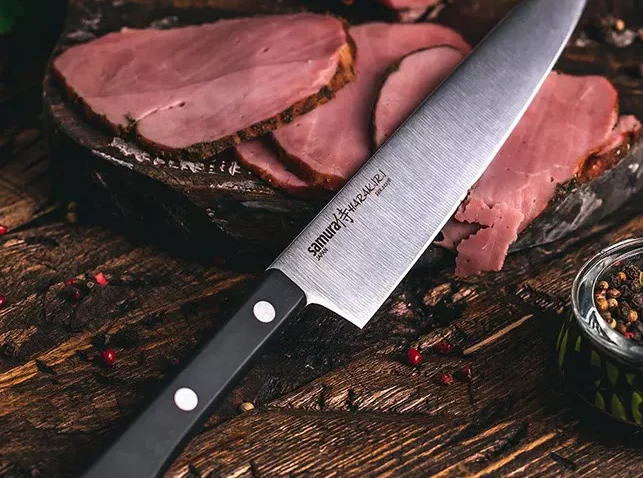
Samura produces lines aimed both at professional chefs and home users who value design and performance. Their knives combine Japanese aesthetics with modern ergonomic solutions, allowing precise and comfortable cuts, from thin slices to more demanding tasks.
Materials, hardness and edge geometry
One of the pillars of the quality of Samura knives is the choice of steel. They use high-quality Japanese and Swedish steels subjected to heat treatments that reach between 58 and 61 HRC. This hardness ensures good edge retention without sacrificing resistance to moderate impacts.
The shape of the blade follows the Japanese tradition: slim lines and a grind that starts near the spine of the blade. Samura’s typical edge angle is around 17 degrees, which provides an ideal combination of sharpness and durability.
Advantages of Samura’s approach:
- Greater edge retention thanks to properly hardened steels.
- Optimized edge geometry for clean, precise cuts at 17 degrees.
- Resistance to daily use due to the combination of materials and heat treatment.
Main series and models: what they offer
Samura offers several series, each designed for a different audience and use. Knowing the differences helps you choose better.
Damascus Series
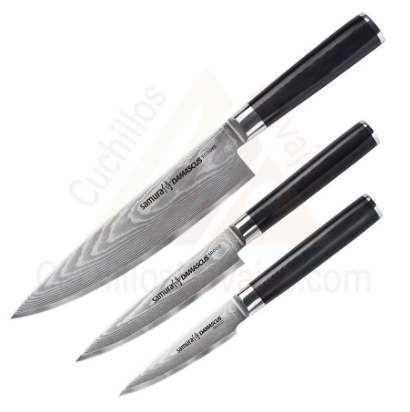
The Damascus ranges stand out for their aesthetics and multilayer construction. Damascus-finished blades are not only attractive, they also add strength and a surface that reduces food sticking. They are ideal for those looking for a piece that combines design and performance.
Blacksmith Series
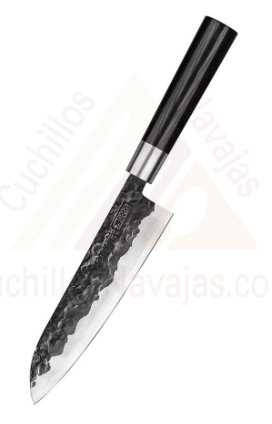
The Blacksmith series usually offers knives with robust lines, aimed at those who want a more traditional style and the feel of a professional tool in hand. They are excellent for intensive kitchen use.
INCA Series (ceramic)
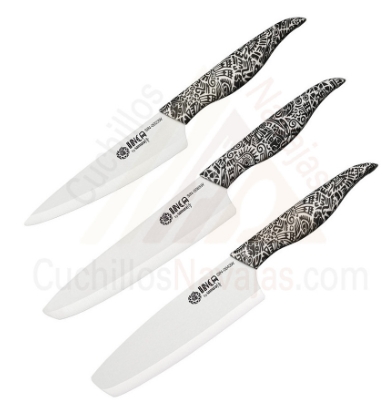
Samura also works with ceramic knives, such as the INCA series. Ceramic offers a very sharp edge and stable longevity, as well as being lightweight and corrosion-resistant. They are ideal for fine work, like cutting fruits and vegetables, although they should be avoided on bone or hard surfaces.
Types of Samura knives and recommended uses
Knowing the types of knives and their purpose makes kitchen work much easier. Here are the most common and how to get the most from them.
- Gyuto (Japanese kitchen equivalent to the chef’s knife): versatile, used for meat, fish and vegetables. It is the workhorse knife in many kitchens.
- Santoku: shorter, wider blade, excellent for chopping, slicing and filleting vegetables and proteins. Very popular for its comfort.
- Petty: small precision knife, ideal for peeling and fine tasks.
- Bread knife: serrated blade for slicing without crushing breads and doughs.
- Boning knife: thin, flexible blade for separating meat from bone with control.
- Ceramic knife: keeps its edge for a long time and is perfect for fruits and vegetables.
How to choose the right Samura knife for you
The choice depends on how you cook, ergonomic preferences and budget. Here is a practical guide:
- Assess the use: Do you cook a lot with vegetables? The Santoku or a Gyuto will be excellent choices. Need precision? Add a Petty.
- Consider the balance: the knife should feel comfortable in the hand, neither too light nor too heavy. Good balance reduces fatigue.
- Think about maintenance: if you want fewer frequent sharpenings, a steel with higher edge retention (high HRC) is preferable.
- Handle materials: look for ergonomic, non-slip handles for safe work.
Practical tip
If you hesitate between two models, try holding both and simulating cuts. The feel at the wrist and control often decide the purchase more than the technical specifications on paper.
Maintenance and sharpening to maximize lifespan
A good knife that is poorly cared for quickly loses its advantage. Here are clear steps to keep a Samura knife in optimal condition:
- Cleaning: wash by hand with warm water and soap. Avoid the dishwasher; heat and aggressive detergents can damage the edge and handle.
- Drying: dry immediately to prevent stains or corrosion on steels that are susceptible.
- Storage: store in a wooden block, magnetic strip or protective sheath. Avoid leaving it loose in a drawer.
- Use of cutting boards: use wooden or polyethylene boards; glass or stone boards wear the edge faster.
- Sharpening: respect the factory angle (approx. 17 degrees). For Samura knives, a sharpening stone from medium to fine grit and then fine yields the best results. Alternatively, a professional sharpener ensures precise edge recovery.
Sharpening step by step
- Soak the stone and place the knife at the correct angle (17°).
- Slide the blade from the heel to the tip, maintaining the same angle and applying moderate pressure.
- Repeat on both sides until the edge regains its cutting ability.
- Finish with a finishing stone or leather to polish the bevel.
Resistance to moisture and heat: myths and realities
Samura designs knives that are resistant for domestic and professional use. Although many models withstand moisture and moderate heat well, they are not indestructible. Avoid subjecting them to sudden thermal changes, baking them or exposing them to saline environments for prolonged periods without proper cleaning. Hardened steel offers resistance, but maintenance remains key.
Usage tips to keep the edge longer
- Do not use ceramic knives on bones or frozen foods.
- Avoid twisting the blade when cutting; make clean, straight cuts.
- Grind and polish the edge periodically according to use.
- Protect the tip; many levering or lateral pressure tasks damage it.
Where to buy and warranties
Buying from authorized dealers guarantees authenticity, warranties and proper after-sales service. Samura knives usually include care information and, depending on the dealer, limited warranties against manufacturing defects. Always check the seller’s policy and shipping conditions.
If you are looking for a specific piece, check the technical specifications: steel used, HRC hardness, blade length and handle type. These data will allow you to compare models objectively.
A good starting point is to focus on the combination of steel composition, heat treatment and edge finish. Together they determine the feel when cutting and the knife’s durability.