
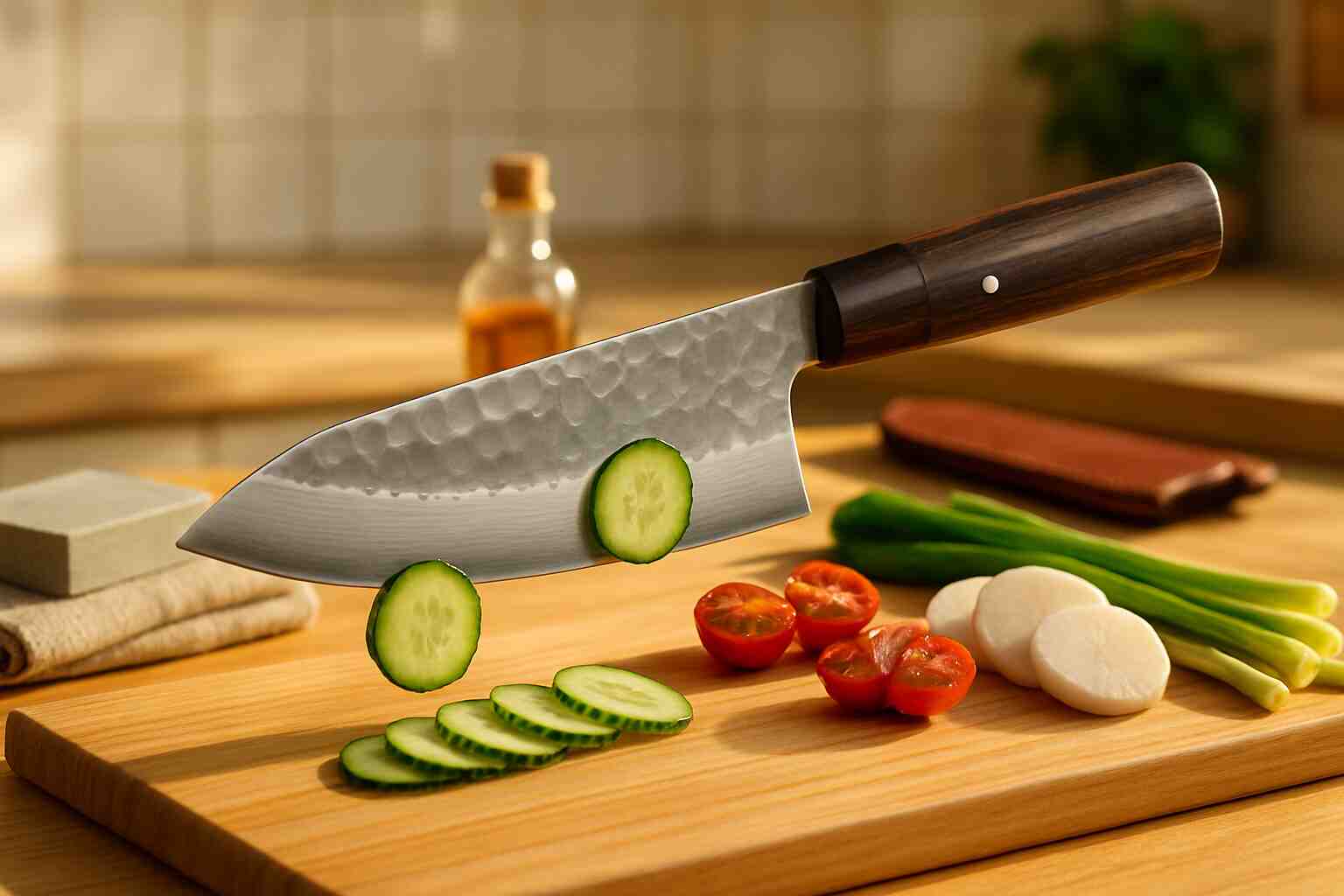
The Santoku Knife is the multipurpose knife used by Japanese cooks and the equivalent of the Western chef’s knife. Its name means it fulfills three virtues: cutting, chopping and slicing. Its versatility has made it a favorite in both home and professional kitchens, where it is also used for crushing, carving and preparing ingredients with precision.
What exactly is a Santoku knife and why is it so popular?
Contents
- What exactly is a Santoku knife and why is it so popular?
- Main blade characteristics
- Recommended uses and techniques for the Santoku
- Practical comparison: Santoku vs Western chef’s knife vs Nakiri
- How to choose your Santoku: detailed buying guide
- Practical tips and common mistakes
- Maintenance and sharpening: steps for a long-lasting edge
- Benefits of hollows and why they matter
- Usage recommendations by cuisine type
The Santoku knife comes from Japanese culinary tradition adapted to modern needs: a versatile blade with a flat base and a rounded tip that facilitates short, controlled motions. Unlike some Western knives with a pronounced curve for rocking cuts, the Santoku favors an up-and-down motion, ideal for chopping and slicing quickly. Chefs appreciate it for its precision, lightness and safety when working with vegetables, fish and boneless meats.
Main blade characteristics
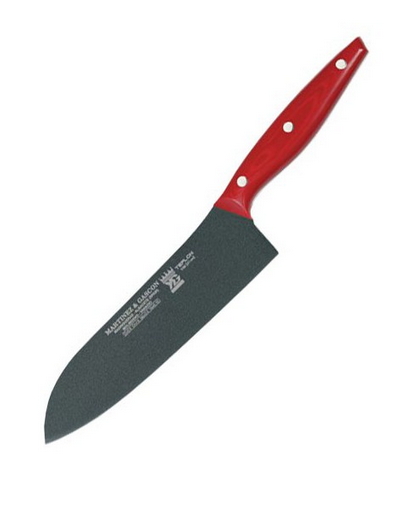
A typical Santoku features a high-quality forged blade, well balanced, with lengths that usually range between 12 and 20 cm. Its flat base and rounded tip allow use of the full blade length without wide sweeping motions. Many models include the characteristic hollows (also called cavities or air pockets) that help prevent food from sticking to the blade, especially useful when cutting vegetables or thin slices of fish.


Edge construction varies: some Santoku knives have a symmetrical grind, others a subtle bevel that improves slicing. Common materials range from high-performance stainless steels to carbon steels or damascus blends in premium ranges. The handle may be traditional Japanese wood (wa style) or ergonomic synthetic materials designed for everyday use.
Recommended uses and techniques for the Santoku
The Santoku Knife is used for cutting all kinds of boneless foods: lean meats, fish, vegetables, fruit and for precision tasks like filleting small pieces or thinly slicing ingredients. Its design also allows efficient chopping by placing the palm on the spine of the blade when a firm, controlled press is needed.

In the following image we see popular chef Karlos Arguiñano cutting pieces of meat with a Santoku, a clear demonstration of its usefulness in real kitchens, both professional and domestic.

Practical comparison: Santoku vs Western chef’s knife vs Nakiri
Although all are used in food preparation, each has specific advantages depending on technique and the type of dish you prepare. The comparison table below will help you understand the differences and choose according to your needs.
| Feature | Santoku | Chef’s knife (Western) | Nakiri |
|---|---|---|---|
| Blade shape | Flat base, rounded tip | Pronounced curve, pointed tip | Straight, square tip |
| Ideal movement | Up-and-down, chopping | Rocking and long cuts | Vertical cuts and chopping |
| Best for | Vegetables, fish, boneless meats | Meats, steaks, general use | Vegetables and sliced produce |
| Hollows | Common (prevent sticking) | Less common | Rare |
| Typical length | 12–20 cm | 18–30 cm | 16–18 cm |
Practical example
If you mainly prepare vegetables and thinly sliced fish, a Santoku or a Nakiri will be superior options. If you often cut large pieces of meat or need to slice long loaves or fillets, a Western chef’s knife with a longer blade will be more efficient.
How to choose your Santoku: detailed buying guide
Choosing a good Santoku involves weighing several factors: blade length, steel material, edge type, presence of hollows and handle ergonomics. Here is a practical checklist to consider before buying:
- Length: If you cook in tight spaces or prefer control, choose 12–16 cm. For more versatility and cutting larger pieces, 18–20 cm.
- Material: Stainless steel for low maintenance; carbon steels for better edge retention (require care to prevent rust).
- Edge: Look for a sharp, well-finished edge. A symmetrical grind is easier to maintain, while more specialized Japanese edges can offer finer cuts.
- Hollows: Useful for vegetables and thin slices; they reduce friction and sticking.
- Handle: Test the grip: a well-balanced handle prevents fatigue and improves safety.
- Construction: Forged or stamped. Forged knives typically offer better balance and durability.
Quick comparison table of models and sizes
| Model | Blade length | Hollows | Recommended use |
|---|---|---|---|
| Compact Santoku | 12 cm | No | Small home kitchens, control |
| Standard Santoku | 17 cm | Yes | General use, vegetables and fish |
| Professional Santoku | 20 cm | Yes | Professional kitchens, larger pieces |
Practical tips and common mistakes
To get the most from your Santoku follow these simple recommendations: keep a stable, sturdy cutting board; do not use the Santoku to cut bones or frozen foods; sharpen with a whetstone or a proper honing rod; wash by hand and dry immediately if your knife is carbon steel. Avoid the dishwasher to preserve the edge and the handle.
Common mistakes
- Not resting the palm on the spine when chopping when extra control is needed.
- Using the Santoku for tasks it is not designed for, such as splitting bones.
- Leaving the knife wet or storing it loose in a drawer, which can cause knocks and edge damage.
- Not sharpening often enough: a dull edge forces you to use more force and increases risk.
Maintenance and sharpening: steps for a long-lasting edge
Proper maintenance extends the life of any quality knife. Here is a practical, easy-to-follow routine:
- Daily cleaning: Wash by hand with warm water and mild soap; dry with a soft cloth.
- Storage: Use a wooden block, wall magnet or protective sheath to avoid knocks.
- Sharpening: A medium-fine whetstone (1000/3000) is ideal for maintaining the edge; for more aggressive sharpening you can start with a 400–600 grit.
- Honing rod or quick touch-up: Use a honing rod only to realign the edge; it does not replace sharpening on a stone.
- Handle protection: If it is wood, apply mineral oil occasionally to prevent drying.
Quick guide to sharpening on a stone
1) Wet the stone and place the knife at an approximate angle of 15–20° depending on the edge profile. 2) Slide the blade from heel to tip maintaining a constant angle. 3) Repeat on both sides until you obtain a uniform edge. 4) Finish with a fine grit to polish, then clean and dry the knife.
Benefits of hollows and why they matter
Hollows reduce friction and create small air pockets between the blade and the food. This prevents thin slices and vegetables from sticking, allowing cleaner cuts and preventing ingredients from tearing. For those who prepare sushi, carpaccio or thin vegetable slices, hollows are a great plus.
Usage recommendations by cuisine type
– Oriental and Japanese cuisine: Santoku and Nakiri are ideal for their precision and control. – Mediterranean cuisine: the Santoku works very well for vegetables, fish and quick sauce preparation. – Professional kitchens: a 20 cm Santoku with good edge retention is versatile for various quick preparations.
Chef’s tip
If you’re unsure between sizes, choose a medium one (17 cm). It offers control and enough blade for diverse tasks. Always test the grip before buying: comfort in the hand prevents injuries and improves technique.
SEE MORE JAPANESE KNIVES | SEE OTHER KITCHEN KNIVES
As with all high-quality knives, proper use and adequate maintenance guarantee a long service life. It’s worth learning the handling and practicing to gain skill with this professional multipurpose knife. If you choose your Santoku well and take care of it, it will become a central tool in your kitchen and accompany you for many years.