
Choosing the perfect knife involves not only considering its design or size, but also the material of its blade. Among the most common options, stainless steel and carbon steel stand out for their unique properties. Do you know which one is right for you? In this article, we will break down the characteristics of each so you can make the best decision and turn your knife into a durable and efficient tool.
Understanding the Fundamental Differences: Chemistry and Performance
Contents
- Understanding the Fundamental Differences: Chemistry and Performance
- Factors to Consider When Choosing Your Knife’s Steel
- Comparison Table: Stainless Steel vs. Carbon Steel
- Myths and Realities About Knife Steel
- Specific Applications of Each Steel Type
- Proper Maintenance for Each Steel Type
- The Final Choice: A Personal Decision
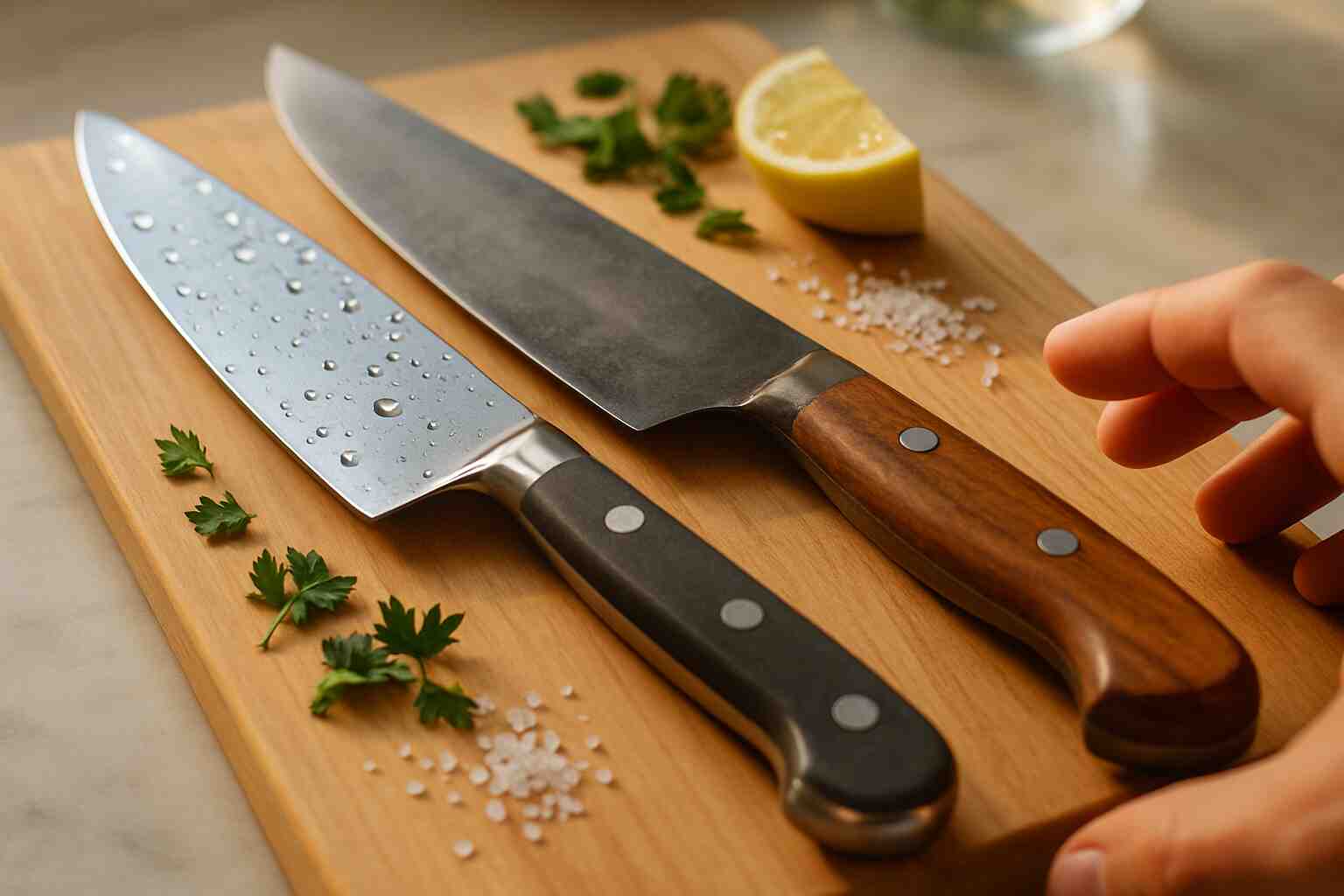
The key to understanding the differences between stainless steel and carbon steel lies in their chemical composition. These variations dictate how they behave when exposed to elements such as moisture, their ease of sharpening, and the durability of their edge.
Stainless Steel: Guaranteed Oxidation Resistance
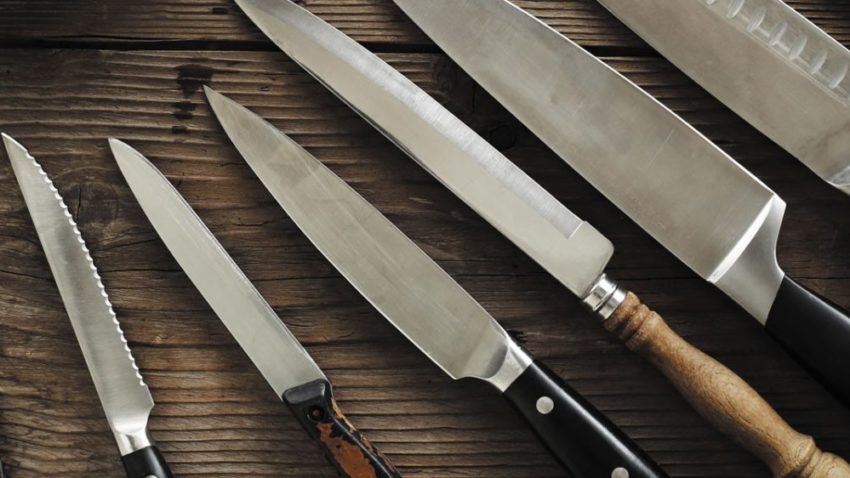
Stainless steel is an alloy of iron, carbon, and, crucially, chromium. It is this last component, present in a minimum proportion of 10.5%, that gives stainless steel its remarkable corrosion resistance. Chromium reacts with oxygen in the air, forming a thin passive and protective layer on the metal surface. This layer prevents oxygen from reaching the iron, thus preventing oxidation and rust.
In addition to its corrosion resistance, stainless steel tends to be easier to maintain, as it does not require such meticulous care against moisture. However, its hardness can be slightly lower than that of carbon steel, which could result in an edge that needs to be re-sharpened more frequently, although the process is generally simpler.
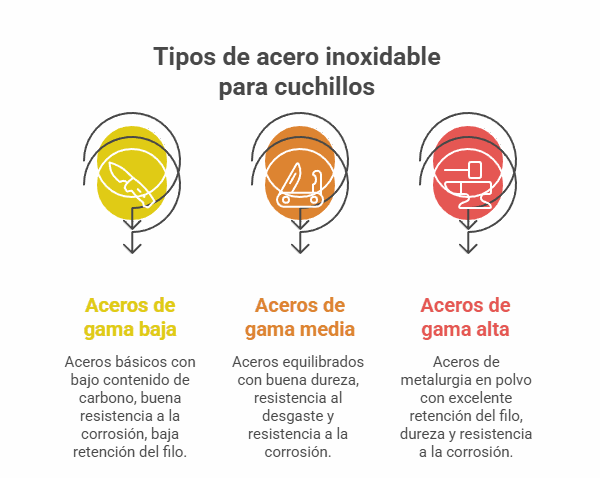
Low-End Steels (Economical)
-
420 and 420J2: These are basic steels with low carbon content. They are often used in economical kitchen knives and multi-tools. They offer excellent corrosion resistance, but their edge retention is low.
-
8Cr13MoV: This is a very popular Chinese steel. It is affordable, has good corrosion resistance, and is relatively easy to sharpen. It is commonly used in EDC (Everyday Carry) knives and mid-to-low-end pocket knives.
Mid-Range Steels
-
440C: Historically, it has been an industry standard. It is a steel with a good balance between hardness, wear resistance, and corrosion resistance. It is easy to find and is used in a wide variety of quality knives.
-
AUS-8: A Japanese steel known for its balance of corrosion resistance, durability, and ease of sharpening. It is a solid option for everyday use knives.
-
12C27 Sandvik: Swedish steel highly valued for its purity and good performance. It is common in Nordic and kitchen knives. It offers good edge retention and is easy to sharpen.
-
VG-10: This is a high-quality Japanese steel with an excellent reputation. It contains vanadium and cobalt, which give it great hardness and edge retention. It is very popular for high-end kitchen knives and pocket knives.
-
N690Co Böhler: An Austrian steel that is considered similar to VG-10. It contains cobalt, which improves edge retention and wear resistance. It is highly valued in European cutlery.
High-End Steels (Premium)
-
CPM-S30V / CPM-S35VN: These powder metallurgy (PM) steels are highly valued for their excellent balance of properties. They offer exceptional edge retention, good hardness, and great corrosion resistance. They are difficult to sharpen, but maintain their edge for a long time. S35VN is an improved version of S30V, with greater toughness.
-
M390 Böhler / CPM-20CV / CTS-204P: These are powder metallurgy steels with very high wear resistance. They are considered “superior” steels for their ability to maintain an incredibly good edge. They are expensive and very difficult to sharpen, but their performance is among the best available.
-
CPM MagnaCut: A modern and very advanced steel that seeks to balance the three key properties: edge retention, toughness, and corrosion resistance. It has quickly gained great popularity for its exceptional performance and for being easier to sharpen than other high-end steels.
-
ZDP-189: A Japanese steel with a very high carbon content (around 3%). This gives it extreme hardness and edge retention, but makes it more susceptible to corrosion and very difficult to sharpen. It is used in ultra-high-end kitchen knives.
Carbon Steel: Hardness, Flexibility, and Durable Edge
Unlike stainless steel, carbon steel is composed primarily of iron and carbon, without the significant addition of chromium or other elements that provide oxidation resistance. This simpler composition gives carbon steel greater hardness and, surprisingly, outstanding flexibility.
The high hardness of carbon steel translates into an exceptional edge and a superior ability to maintain that edge for prolonged periods of use. While it is more difficult to sharpen initially, once sharpened, its ability to retain its cutting edge is enviable for many knife enthusiasts. The trade-off is its susceptibility to oxidation and patina formation if not properly maintained. However, this patina, which some consider a distinctive character, can also offer a natural protective layer over time.
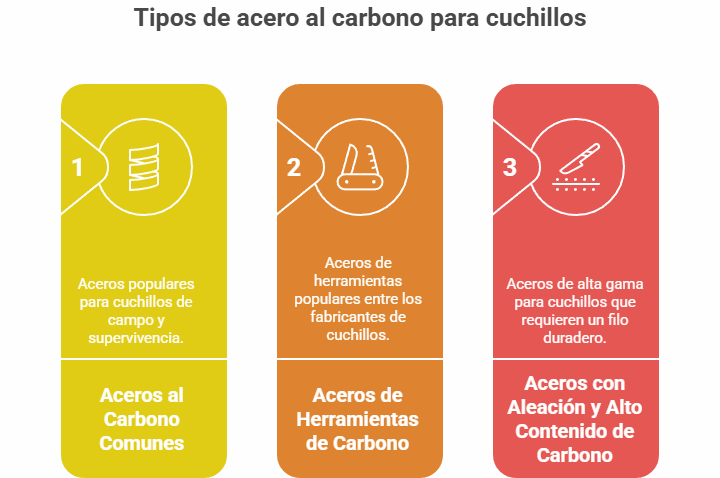
Common Carbon Steels
-
1095: This is one of the most popular carbon steels for field knives, machetes, and survival knives. It has a high carbon content, which gives it excellent edge retention. It is a hard steel but susceptible to corrosion if not properly cared for.
-
1084: This steel is highly valued by blacksmiths and knife makers for its ease of heat treatment. It offers a good balance between edge retention and toughness (resistance to breaking or chipping). It is an excellent starting point for those new to knife making.
-
1075: Similar to 1084, but with a slightly lower carbon content, which makes it a bit tougher at the expense of less edge retention. It is ideal for knives that need to withstand rough use, such as camp knives.
-
1050: With an even lower carbon content, this steel is very tough and impact resistant. It does not hold an edge as well as higher carbon steels, but it is an excellent choice for tools that require hardness and strength, such as swords or large knives.
Carbon Tool Steels
-
O1: This is a popular tool steel among knife makers for its good edge retention and ease of forging. It is a high-carbon steel with alloys that improve its hardness and wear resistance, although it is less corrosion resistant than stainless steel.
-
W2: Known for its ability to achieve a “hamon” (a visible line on the blade resulting from differential heat treatment), this steel is very hard and retains a sharp edge for a long time. It is commonly used in high-end kitchen knives and Japanese-style knives.
Alloyed and High Carbon Steels
-
52100: Originally designed for ball bearings, this steel is a high-end option for knives. It contains chromium, which increases wear resistance, toughness, and edge retention. It is excellent for hunting and kitchen knives that require a very durable edge.
-
Cru-Wear: This powder metallurgy steel has a high carbon, chromium, vanadium, and tungsten content. It offers superior edge retention and very high toughness, making it ideal for tactical and heavy-duty knives.
Factors to Consider When Choosing Your Knife’s Steel
The choice between stainless steel and carbon steel is not a matter of “better” or “worse,” but rather “more suitable” for your needs. Here are some key factors to consider:
1. Maintenance and Care
This is perhaps the most determining factor. Stainless steel knives are notably more tolerant of occasional neglect. If you are someone who doesn’t have time or doesn’t want to dedicate extra effort to tool maintenance, stainless steel is your ally. Simply clean them after each use and store them in a dry place. Carbon steel knives, on the other hand, demand more rigorous care. You should clean and dry them immediately after each use and consider applying a thin layer of mineral oil to protect the blade from moisture. If you enjoy the ritual of knife care and value authenticity, carbon steel will provide a gratifying experience.

2. Usage Environment
Where do you plan to use your knife? If you live in a humid environment, such as coastal or tropical areas, or if your knife will frequently be exposed to moisture, such as when fishing or camping, stainless steel is the most practical option to prevent corrosion. For dry environments or for more controlled indoor use, carbon steel can be an excellent choice, provided maintenance guidelines are followed.
3. Type of Use
Professional chefs often prefer carbon steel for its superior edge and ability to slice with extreme precision. For tasks requiring constant and demanding cutting, an edge that stays sharp longer is an undeniable advantage. For daily home use or less intensive recreational activities, a stainless steel knife may be more than sufficient and more convenient.
4. Ease of Sharpening vs. Edge Retention
As we mentioned, stainless steel is generally easier to sharpen. This is an advantage if you don’t have much experience with sharpening or if you prefer a quick process. However, you may need to sharpen it more frequently. Carbon steel, although more difficult to sharpen initially, rewards the effort with superior edge retention, meaning it will maintain its sharpness longer between sharpenings.
5. Aesthetics and Evolution
Stainless steel maintains its shine and original appearance over time. On the other hand, carbon steel develops a unique patina with use, a discoloration that some find attractive and that tells the knife’s story. If you value a tool that acquires character over time, carbon steel might be your choice.

Comparison Table: Stainless Steel vs. Carbon Steel
To simplify your decision, we have prepared a detailed comparison table with the key characteristics of each type of steel:
| Characteristic | Stainless Steel | Carbon Steel |
|---|---|---|
| Corrosion Resistance | High (thanks to chromium) | Low (prone to oxidation and patina) |
| Edge Retention | Good | Excellent (holds edge longer) |
| Ease of Sharpening | Easy | More difficult (experience recommended) |
| Hardness | Good | Very high |
| Maintenance Required | Low (clean and dry) | High (immediate cleaning, drying, and oiling) |
| Appearance Over Time | Maintains shine | Develops patina (unique character) |
| Flexibility | Good | Excellent |
| Cost | Variable (depends on alloy) | Variable (depends on alloy) |
Myths and Realities About Knife Steel
Does Stainless Steel Never Rust?
A common misconception is to assume that stainless steel is completely immune to rust. Although its resistance is exceptional, it is not totally stainless. In extremely adverse conditions, such as prolonged exposure to corrosive liquids or poor maintenance, stainless steel can stain or, in extreme cases, rust. However, its risk is significantly lower than that of carbon steel.
Is Carbon Steel Too Fragile?
Contrary to what some may think, carbon steel is not inherently fragile. In fact, its combination of hardness and flexibility makes it extremely strong and capable of withstanding impacts and twisting without breaking, an attribute highly valued in heavy-duty knives.
Patina on Carbon Steel: A Flaw or a Feature?
Patina is a natural layer of oxidation that forms on carbon steel and can vary in color, from gray to blue or brown tones. Far from being a defect, many collectors and users value this patina for its ability to protect the steel from more severe corrosion and for the unique character it gives the knife. It is a sign of use and of the knife’s history.
Specific Applications of Each Steel Type
Kitchen Knives and Professional Chefs
In the culinary field, the choice can vary. Many professional chefs lean towards carbon steel knives due to their ability to achieve an extremely sharp edge that allows for clean and precise cuts, essential for preparing delicate foods. However, the convenience and corrosion resistance of stainless steel make it indispensable for general-use knives in kitchens where hygiene and ease of cleaning are valued.
Hunting and Survival Knives
For outdoor activities such as hunting or survival, durability and strength are paramount. Carbon steel knives are highly valued for their robustness and ability to maintain an edge even in demanding conditions. Their ease of producing sparks with a flint also makes them valuable in survival situations. However, stainless steel offers greater peace of mind in humid environments, reducing concerns about rust.
EDC (Every Day Carry) Knives
For an everyday carry (EDC) knife, the balance usually tips towards stainless steel due to its low maintenance and corrosion resistance. An EDC knife is exposed to various conditions, and it’s not always possible to clean and dry it immediately, so rust resistance is a significant advantage.
Proper Maintenance for Each Steel Type
Stainless Steel Care
- Cleaning: Wash the knife with warm water and soap immediately after use.
- Drying: Dry it completely with a soft cloth to prevent water spots.
- Storage: Store the knife in a dry place, preferably in a knife block, sheath, or magnetic strip.
- Avoid: Do not leave the knife submerged in water or wash it in the dishwasher, as harsh detergents and high temperatures can damage the edge and handle.
Carbon Steel Care
- Immediate Cleaning: It is crucial to clean the knife immediately after each use. Do not allow food residues, especially acidic ones, to remain on the blade.
- Thorough Drying: Dry the blade thoroughly with a clean, dry cloth. Moisture is carbon steel’s number one enemy.
- Regular Oiling: Apply a thin layer of food-grade mineral oil (or a specific knife oil) to the blade after each cleaning, especially before storing it for extended periods.
- Patina Development: Allow patina to form naturally, as this additional layer offers some protection. Avoid polishing off the patina unless you truly wish to remove it.
- Avoid: Never leave the knife wet. Do not wash it in the dishwasher. Avoid prolonged contact with acidic substances like citrus or vinegar.
The Final Choice: A Personal Decision
As you’ve seen, both stainless steel and carbon steel offer distinct advantages. The ideal choice depends on your priorities: Do you value ease of maintenance and rust resistance above all else? Opt for stainless steel. Do you prefer an edge that stays sharp longer and don’t mind dedicating a little more time to maintenance? Carbon steel will win you over.
Consider your lifestyle, the intended use of the knife, and your willingness to maintain it. Ultimately, the best knife is the one that perfectly fits your hands and your needs, and that will faithfully serve you for many years, regardless of the steel type.
VIEW KNIVES IN DIFFERENT STEELS | VIEW POCKET KNIVES IN DIFFERENT STEELS