
If you have ever seen a professional sushi chef in action, you will have noticed the incredible skill with which they handle their spectacular knives. These are not common kitchen knives; they are specialized tools designed for the precision and delicacy that the art of sushi demands. From filleting fish to cutting vegetables or the final roll of a maki, a good sushi knife makes all the difference. But what makes them so special and why should you consider having one at home? Read on to find out.

What Makes a Sushi Knife So Special?
Contents
Traditional sushi knives, designed by Japanese artisans, are distinguished by several key features that guarantee superior cutting performance:
- Extreme Edge and Length: They are incredibly sharp and often very long (generally at least 30 cm). This length allows for clean and precise cuts in a single pass, without damaging the delicate texture of the fish or ingredients.
- Unique Bevel (Kataba): Most traditional Japanese knives have a single bevel, meaning they are flat on one side and have an edge only on the other. This allows for extremely precise and fine cuts, although it requires specific versions for right-handed and left-handed users. Although it may seem flat, the sharpening on the flat side is done at an almost imperceptible angle, creating a very subtle “V”-shaped edge.
- High Quality Material: They are frequently made with carbon steel, known for its ability to achieve an extremely sharp edge and its ease of sharpening. Although they require more maintenance to prevent oxidation, the result is a superior edge. There are also options in stainless steel for greater corrosion resistance and less maintenance, or composite blades that seek to combine the best of both worlds.
- Lightweight Handle: The handles are usually made of unvarnished wood, with a simple “D” shape, designed to be lightweight. This ensures that the weight is concentrated on the blade, facilitating a balanced and precise cut.

Types of Japanese Knives for Sushi
Japanese cuisine uses a variety of knives, each designed for specific tasks. Knowing them will help you choose the right tool for your needs:
- Yanagiba: Considered the essential knife for sushi and sashimi. Its long, thin, single-bevel blade is ideal for filleting raw fish and creating thin slices without damaging the fibers. Typical length varies between 210 mm and 300 mm. Similar knives include the Takobiki (with a rectangular blade, popular in the Kansai region) and the Fugubiki (a thinner version for fugu pufferfish).
- Deba: A robust and heavy knife, with a single bevel, designed for more forceful tasks such as deboning and filleting fish, especially for cutting through bones and cartilage. It is not used for the final cuts of sushi, but it is indispensable for the initial preparation of the fish. There are several types of Deba, such as the Hon-deba (the thickest and heaviest) or the Miroshi-deba (thinner for filleting).
- Usuba: It is the ideal knife for cutting vegetables with exceptional precision. Its wide, straight blade, with a single bevel, allows for extremely thin and uniform cuts, crucial for the aesthetics of sushi and garnishes.
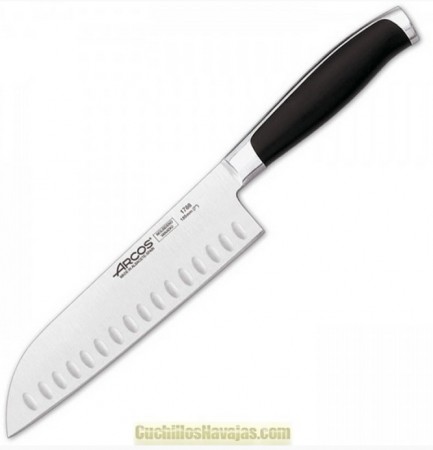
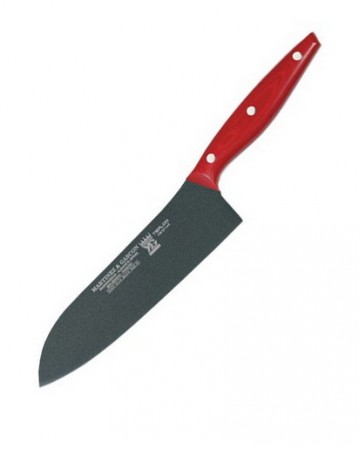
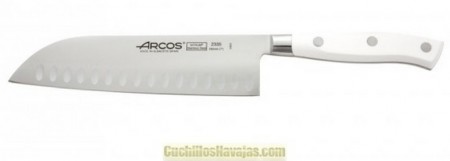
- Santoku: Means “three virtues” and is a very versatile multi-purpose knife. It is an excellent option for those looking for a tool to cut fish, meat, and vegetables with great precision. It is ideal for amateur cooks who need a knife for various tasks in Japanese cuisine.
- Sujihiki: A versatile double-bevel knife similar to the Yanagiba in length, but thinner, perfect for filleting fish, sushi, and sashimi, and also useful for cutting meats.
- Kiritsuke: A versatile double-bevel knife that combines characteristics of the Gyuto and the Usuba, being useful for both cutting vegetables and preparing sashimi.
How to Choose the Perfect Sushi Knife
Choosing a Japanese knife is personal and should be based on your cooking style and experience level. Consider these key factors:
Blade Material:
- Carbon steel: Offers a very durable and easy-to-sharpen edge, but requires constant maintenance to prevent oxidation.
- Stainless steel: More resistant to corrosion and easy to maintain, although its edge may not be as durable as that of carbon steel.
- Composite blades (Damascus): Combine the advantages of both, offering a sharp edge and some resistance to oxidation, with an aesthetic design.
Blade Bevel:
- Single bevel: Allows for extremely precise cuts, but is specific for right-handed or left-handed users and requires more skill in use and sharpening. It is the traditional Japanese design.
- Double bevel: Easier to use and sharpen, suitable for both types of users and more versatile for different tasks.
Handle Type:
- Western Handle: Ergonomic and familiar, it offers more weight in the handle due to its full tang design.
- Japanese Handle (Wa-Handle): Lighter due to a partial tang, which provides a balance preferred by many sushi chefs.
Blade Length and Weight:
- The length should adjust to your comfort and skill. A blade that is too short can make it difficult to make a clean cut in a single motion.
- Heavier knives (like the Deba) are for tasks that require force, while lighter ones (like the Yanagiba) are for delicate cuts.
Maintenance and Care of Your Japanese Knives
A Japanese knife is an investment that requires attention and love to maintain its optimal performance.
- Immediate Cleaning: Always rinse your knife with warm water and mild soap immediately after use. Never leave it soaking! Use a soft cloth or sponge, avoiding abrasive scourers. Always clean from the back of the blade towards the edge, being careful not to cut yourself.
- Thorough Drying: Make sure to dry the knife completely with a soft cloth after each use, as minimal moisture can cause oxidation, especially in carbon steel.
- Avoid the Dishwasher: The high temperatures and aggressive detergents of the dishwasher are disastrous for the blade and handle of any Japanese knife.
- Rust Prevention: The golden rule is to dry immediately. Occasionally, you can apply a layer of food-grade mineral oil to the blade for additional protection. If some rust appears, you can try to remove it with a rust eraser or fine sandpaper.
- Safe Storage: Store your knives in a knife block, a magnetic strip, a protective sheath, or a knife roll. Never leave them loose in a drawer, as this can damage the edge and is dangerous.
- Regular Sharpening: A dull knife not only makes work difficult, but can also ruin the texture of food. Regular sharpening with a sharpening stone (water stones are the most recommended) is recommended. Maintain a constant angle (generally between 15 and 20 degrees) and use coarse grit stones to repair damage and fine grit stones to polish. The ideal granularity for a perfect edge is between 1000 and 6000 grits.
- Handle Care: Wooden handles require regular oiling with food-grade mineral oil to prevent dehydration and should avoid prolonged contact with water.
- Proper Use: Always use wooden or plastic cutting boards, as hard surfaces like glass quickly dull the knife. Avoid using your knife for tough tasks like cutting bones or frozen foods, or as a prying or scraping tool.
Tips for Cutting Sushi Like a Pro
Sushi is a Japanese dish consisting of vinegared cooked rice, combined with other ingredients. The composition varies according to the type and prescription. Sushi is served in small pieces that have an attractive appearance. In recent decades, sushi has become a popular food in Western countries. Depending on the specific type of sushi you want to cook, whether it’s sushi maki or rolls, sashimi, temaki, etc., it will be necessary to cut the fish differently.
 For the characteristic sushi rolls, called sushi maki, the fish should be cut into elongated and thick rectangles, of the maximum length of the loin. This is because the roll should be made around it.
If what we want to create are nigiri sushi, that is, a ball of rice with fish on top, or sashimi, simply fish, without rice, we must take the best part of the loin and cut slices of the fish, always cutting with the knife perpendicular to the fat veins of the fish. Always against the grain.
Japanese cuisine has a wide variety of knives, and each one is designed for a specific task and for a certain type of ingredients. Here are some examples. The hamo-giri bocho (36 cm long blade; for cutting fish with many small bones); the yanagi-ba bocho (for sashimi; the long blade is pulled towards oneself when cutting so as not to crush the fish fibers); the maguro-hiki bocho (for cutting fish with little fiber; it is cut straight forward); the fugu-hiki bocho (for very thin cuts); the deba bocho (thick and heavy blade for filleting large fish); and the usuba bocho (especially for chopping vegetables into small pieces).
A sushi chef’s knife is as valuable to him as a sword is to a Samurai. These knives must be handled carefully to keep their edge sharp, they must be sharpened by hand with a wet sharpening stone, never with a metal sharpener or a wheel.
Owning and maintaining a Japanese sushi knife is a significant step in mastering the art of Japanese culinary. Investing in a quality tool and dedicating time to its care and sharpening not only improves the precision and aesthetics of your culinary creations, but is also a form of respect for the craftsmanship and the food you prepare. With the right tool and proper care, you will be ready to make perfect cuts and fully enjoy preparing sushi.
Do you want to discover the best sushi knives? Explore our selection of knives for preparing sushi