Tactical knives, with their unparalleled versatility, robust design, and multifunctional utility, have cemented their position as an indispensable element in the vast and fascinating universe of cutlery. Although their origin is rooted in the need for reliable tools for high-demand situations, these pieces have transcended their initial purpose to become essential equipment. Today, they are not only valued by professionals in the military, police, and private security fields, but are also inseparable companions for adventure enthusiasts, campers, hikers, and anyone looking for a compact and effective tool to face the challenges of their daily lives. Their growing popularity has transformed them from mere utilities into coveted collector’s items, appreciated for both their functionality and their aesthetic and artisanal value.

A Historical Journey: From Survival to Modern Recognition
Contents
- A Historical Journey: From Survival to Modern Recognition
- The Engineering Behind Efficiency: Materials and Design
- Practical Uses and Typologies
- Military/Combat Knives: Dual-Function Tools
- Survival Knives: Indispensable Companions in Nature
- Rescue Knives: Designed for Emergency
- Everyday Carry (EDC) or Pocket Knives: Everyday Utility
- Sports Knives: Allies in Outdoor Adventure
- Marine Knives: Resistance in the Aquatic Environment
- Fishing Knives: Precision for the Angler
- Tactical Knives in Society and Culture
- Legal Aspects: Knowing and Respecting Regulations
- Caring for Your Tactical Companion: Essential Maintenance
- The Future of Tactical Knives
The concept underlying a tactical knife has roots that extend centuries into the past. The first iterations of these tools emerged as rudimentary survival instruments, used by soldiers, explorers, and hunters in hostile environments. Initially manufactured with basic materials and simple techniques, these blades served fundamental purposes such as personal defense, subsistence hunting, and a variety of general uses in outdoor life. The adjective “tactical” in its modern denomination directly alludes to the strategic application of actions to achieve specific objectives, in this context, survival in adverse conditions and self-defense.
It was not until the dawn of the 20th century that the first designs that we could consider truly tactical began to emerge, significantly influenced by the rigorous military demands of the time. These knives typically featured fixed blades, handles designed for a secure and robust grip, and were often complemented by sheaths that allowed quick and efficient access. After the end of World War I and World War II, public interest in tactical knives experienced a notable increase, which prompted manufacturers to refine and diversify their designs, incorporating innovations in materials and mechanisms that would make them even more efficient and reliable. This period marked the beginning of the evolution that would lead them to be the sophisticated tools we know today.
The Engineering Behind Efficiency: Materials and Design
Identifying a superior quality tactical knife goes far beyond evaluating the sharpness of its edge. It implies a deep understanding of the complexities and subtleties of its engineering, elements that provide it with the reliability and suitability necessary to operate effectively in the most challenging and demanding conditions.
High-Quality Materials: The Foundation of Durability
The inherent durability of a tactical knife invariably begins with the selection of its materials. The blades, the heart of any knife, must be forged from advanced steels, meticulously selected for their ability to maintain an exceptionally sharp edge even after intensive and prolonged use, as well as for their inherent resistance to corrosion and wear. Among the most valued steels in the manufacture of tactical blades are:
Stainless Steel: Widely used for its excellent corrosion resistance, making it ideal for humid or marine environments.
VG-10: A Japanese steel known for its impressive edge retention and its ability to be sharpened to an extreme keenness.
CPM-S30V and CPM S110V: High-performance powder steels that offer a superior combination of edge retention, wear resistance, and toughness, although they can be more difficult to sharpen.
Handles, for their part, are not mere aesthetic elements; they must guarantee outstanding structural strength and, crucially, provide a secure and non-slip grip under any conditions. Preferred materials for handles include:
G-10: A fiberglass and epoxy resin laminate, extremely lightweight, durable, and with a texture that improves grip.
Titanium: Offers an exceptional strength-to-weight ratio and excellent corrosion resistance, although it is a more expensive material.
Advanced Alloys: Metallic compositions designed to optimize strength and lightness.
Synthetic Materials: Such as Zytel or FRN (Fiberglass Reinforced Nylon), which are lightweight, strong, and economical.
Natural Materials: Such as rubber and leather, which offer a comfortable grip and a classic aesthetic, although they may require more maintenance.
It is of vital importance that all materials used are intrinsically resistant to impacts, prolonged exposure to rain, chemical or saline corrosion, and extreme temperatures. Simultaneously, the knife must maintain a light weight and a balance that facilitates its handling and manipulation with precision.
Ergonomic Design: The Extension of the Hand
A well-designed tactical knife should feel like a natural extension of the user’s hand. Its ergonomics are fundamental: it must be comfortable to hold and manipulate, even during prolonged periods of use or in adverse conditions, such as with wet, sweaty, or gloved hands. A properly contoured and textured handle minimizes fatigue and maximizes control, which is critical in situations where precision and safety are paramount.

Opening and Closing Mechanisms: Speed and Security
The speed of deployment and the security of blade lock are key attributes for the tactical functionality of any folding knife. Quick-opening systems allow the user to access the blade with one hand and in fractions of a second, which is vital in emergency or self-defense situations. Closing mechanisms, for their part, must ensure that the blade remains firmly locked in the open position during use, preventing accidental closures that could cause injuries. Among the most reliable and popular mechanisms are:
Axis Lock: A robust and ambidextrous system that uses a cylindrical pin to lock the blade.
Back Lock: A classic and very secure mechanism, which employs a pivoting bar on the back of the handle.
Liner Lock: A simple and effective system where a metal liner moves to lock the blade.
Frame Lock: Similar to the liner lock, but uses a part of the handle’s own frame for locking, offering greater robustness.
Some military tactical knives incorporate specific features such as a thumb hole (popularized by Spyderco) that facilitates quick opening, and advanced locking mechanisms that eliminate any oscillation or play in the blade once deployed.
Blade and Edge Types: Adaptability to the Task
The shape and type of blade edge are determining factors in the functionality of a tactical knife, adapting it to specific tasks:
Blade Types:
Straight (Drop Point): Characterized by a curved design on the spine that descends towards the tip, offering a robust and fine point. It is a versatile design, ideal for controlled perforations and general use, combining strength and precision.
Clip Point or Bowie: Features a very fine and sharp tip, formed by a “clip” or cut on the spine of the blade. This design is exceptionally precise for piercing and detailed tasks.
Dagger: A pointed blade with a double edge, primarily designed for penetration. Although extremely effective for this purpose, its design makes it less suitable for general cutting tasks.
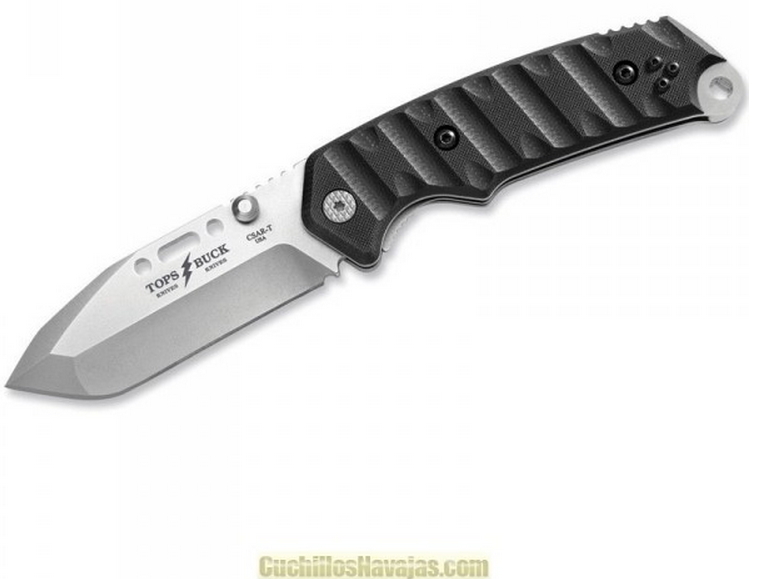
Tanto: Inspired by Japanese swords, with a very strong and geometric tip, ideal for heavy piercing tasks and for maintaining edge integrity in demanding jobs.
Edge Types:
Plain Edge: Requires more frequent sharpening to maintain maximum efficiency, but is notably easier to clean and sharpen than a serrated edge. It offers clean and precise cuts.
Partially Serrated Edge: Combines a plain edge section with a serrated one. The serrated part is exceptionally useful for cutting fibrous materials such as ropes, webbing, or tendons, where a plain edge might slip.
Double Edge: Desirable in combat knives, as it facilitates penetration and allows cuts in both directions, increasing effectiveness in self-defense situations.
Handle and Pommel: Control and Additional Functionality
The handle of a tactical knife must be inherently grippy, ensuring a firm and secure hold even when wet, greasy, or covered in blood. Aggressive textures and ergonomic contours are crucial to prevent slipping. A metal pommel, located at the end of the handle, can serve as an improvised impact tool, useful for breaking glass, striking, or applying force in emergency situations.
Practical Uses and Typologies
Tactical knives are, by definition, instruments of astonishing versatility. Their range of application spans from the simplest and most everyday tasks, such as cutting ropes, opening packages, or peeling fruit, to considerably more complex and critical tasks, such as preparing a shelter in a wild environment, creating improvised tools, or even, in extreme situations, serving as a personal defense tool. This breadth of uses has given rise to diverse typologies, each optimized for specific scenarios:
Military/Combat Knives: Dual-Function Tools
Designed to be dual-purpose tools, military or combat knives are both an effective weapon in risky situations and an indispensable tool in the field. Their primary military application is the neutralization of the enemy in hand-to-hand combat or the silencing of a sentry. In hostile survival scenarios, their utility is unquestionable for tasks such as building shelters, preparing food, or opening cans. An ideal military knife must have a robust blade, with a plain edge for clean cuts and ease of sharpening, and often a saw on the back for cutting ropes or branches. Durability and reliability are their most outstanding attributes.
Survival Knives: Indispensable Companions in Nature
These knives are distinguished by their highly solid blade and remarkable resistance to oxidation, essential characteristics for withstanding the inclemencies of nature. Their design usually incorporates a plain edge part and a saw part, which allows them to adapt to a wide range of situations, from cutting wood to preparing food. Frequently, survival knives include additional tools integrated into the handle or sheath, such as fire starters, emergency whistles, blade sharpeners, or compasses, turning them into compact survival kits. They are the preferred equipment for adventurers, hikers, hunters, and anyone venturing into wild environments.
Rescue Knives: Designed for Emergency
Specifically designed for versatility in emergency situations, rescue knives feature ergonomic handles that allow safe and efficient use even with gloves. They often incorporate specialized functions that are critical in rescue scenarios, such as glass breakers (for fracturing vehicle windows) and seatbelt cutters (for freeing trapped people). They are essential tools for firefighters, paramedics, rescue teams, and first aid personnel, where every second counts.
Everyday Carry (EDC) or Pocket Knives: Everyday Utility
Compact, portable, and discreet, everyday carry (EDC) or pocket knives are perfect for a multitude of everyday tasks. From opening packages and envelopes, cutting loose threads, performing small repairs, or even serving as a discreet personal protection tool. Within this category, multi-tools, such as the iconic Leatherman, are undisputed leaders. They stand out for their high construction quality, resistance, and the impressive variety of tools they integrate (screwdrivers, scissors, wire cutters, can openers, etc.), offering unparalleled functionality in a compact format.
Sports Knives: Allies in Outdoor Adventure
Specifically designed to complement the practice of outdoor sports, these knives are highly useful and versatile for activities such as cycling, skating, mountain biking (MTB), golf, mountaineering, or climbing. They are usually lightweight, resistant, and often incorporate features that adapt to the specific needs of each sport, such as tools for adjusting equipment or cutting specific materials.
Marine Knives: Resistance in the Aquatic Environment
Created to withstand the rigorous conditions of the marine environment, marine knives are characterized by their highly corrosion-resistant steel blades (generally high-quality stainless steel) and non-slip handles that ensure a secure grip even in extreme humidity conditions. They may include specific functions for the nautical field, such as rope cutters (for cutting thick ropes and lines) or shackle openers.
Fishing Knives: Precision for the Angler
These knives are equipped with thin and exceptionally sharp blades, designed for precise tasks such as cleaning and filleting fish with ease. In addition, they often incorporate additional tools that are very useful for fishermen, such as hook removers, descalers, or even small pliers, making the fishing experience more efficient and enjoyable.

Tactical Knives in Society and Culture
Beyond their undeniable functionality, tactical knives have transcended their role as mere tools to become reliable companions and, in many cases, true symbols. Their appeal goes beyond the purely utilitarian, delving into the social and cultural realm, where they have forged their own identity.
Cultural Symbol: Presence in Popular Culture
Tactical knives have deeply permeated popular culture, making recurring appearances in films, television series, video games, and literature. This constant presence has contributed to consolidating their status as symbols of strength, resilience, self-sufficiency, and robustness. This media representation has amplified their appeal, not only among those seeking a functional tool, but also among collectors and occasional users who are attracted by the image and meaning that these pieces project. They have become an archetype of the hero or adventurer, reinforcing their mysticism and desirability.
The growing popularity of tactical knives has catalyzed the emergence of a vibrant and robust community of enthusiasts. This community manifests itself on a variety of platforms: from specialized online forums and active social media groups, to local gatherings and fairs where fans can share their experiences, exchange maintenance tips, and proudly display their collections. The passion for collecting is a key driver of innovation in design and manufacturing. Many collectors seek limited edition pieces, unique specimens, or handmade knives by artisans, valuing precision, material quality, and functionality. Engraved knives, in particular, often transform into cherished heirlooms, passed down from generation to generation as tangible reminders of personal stories, achievements, and the artisanal mastery that created them, adding deep sentimental value to their already inherent utility.
Legal Aspects: Knowing and Respecting Regulations
The popularity and versatility of tactical knives are accompanied by a legal landscape that, at times, can be complex and vary significantly from one jurisdiction to another. It is of vital importance that any owner or user of a tactical knife knows and fully understands the regulations in force in their area to avoid infringements and the consequent penalties. Ignorance of the law does not exempt from compliance.
Legality in Spain: Key Design and Dimensions
In Spain, the portability and use of knives are strictly regulated by arms legislation, which considers several factors related to their design and dimensions. It is crucial to pay attention to the following points:
Opening System: The law states that only knives with manual opening mechanisms are legal. Knives that incorporate automatic opening systems, such as spring-assisted or inertia-deployed knives, are prohibited and considered prohibited weapons.
Blade Shape: Blades with an extremely sharp point and aggressive shapes (such as double-edged blades or those designed exclusively for penetration, dagger type) are discouraged and, in many cases, prohibited. Generally, only a cutting edge on one side of the blade is allowed.
Blade Length: This is one of the most important criteria. In general, the blade length of a knife that can be carried in public cannot exceed 11 centimeters. This measurement is taken from the end of the handle to the tip of the blade.
Exceptions: Knives with blades longer than 11 cm are not illegal per se, but their portability is restricted. They are legal if kept exclusively at the owner’s home for decorative purposes, collection, or for use in specific activities (such as hunting, provided they are transported and used under the relevant license conditions and only during the activity).
Types of Permitted Knives (meeting requirements): As long as they comply with the opening system, shape, and blade length requirements, survival knives, Swiss knives, multi-tools, tactical knives, and pocket knives are permitted. The key lies in compliance with the technical characteristics and not in their commercial designation.
Consequences of Non-Compliance: Legal Sanctions
Carrying or using a knife that is not in conformity with current regulations can lead to serious legal consequences, ranging from significant administrative fines to prison sentences, depending on the seriousness of the infringement and the specific circumstances.
Minor Infractions: Actions such as not cooperating with authorities when requested, or the mere possession of knives that, although not prohibited weapons, do not comply with current regulations for their portability (for example, a knife longer than 11 cm outside the home without justification) are considered minor infractions. Penalties for these infractions can amount to up to 300.52 euros.
Serious Infractions: These include carrying knives in public places or recreational areas where their presence could generate risk, or the negligent or dangerous use of the knife (such as brandishing it threateningly, displaying it without justification, or using it in a way that endangers third parties). Fines for serious infractions range from 300.52 to 30,050.61 euros.
Very Serious Infractions: In specific cases and under aggravating circumstances (for example, using the knife in a violent crime, or repeatedly carrying prohibited weapons or in large quantities), penalties can be extremely severe, reaching over 600,000 euros, in addition to possible prison sentences.
Transport Regulations: Precautions When Traveling
The transport of knives is also subject to specific regulations, especially when using vehicles or public transport.
In Vehicles: Carrying prohibited knives (for example, automatic or excessively long-bladed without justification) in the car or in a backpack inside the vehicle is considered a minor infraction. This can lead to fines, vehicle immobilization, and even confiscation of the knife. It is recommended to transport any legal knife in a safe and not immediately accessible place, such as the trunk, and always with a clear justification for its use (for example, for a sports or work activity).
On Public Transport (Train/Plane):
Train: Generally, railway regulations do not allow the transport of blades exceeding 6 centimeters in hand luggage. An exception may be made for newly acquired knives if the purchase invoice is presented and they are properly packaged.
Plane: Knives, regardless of their size, are completely prohibited in hand luggage due to strict air security regulations. To transport a knife, it must be carried in checked luggage (in the plane’s hold), and even then, it may be subject to specific conditions of the airline and the airport authorities of the country of origin and destination. It is always advisable to consult the specific regulations of the airline and customs regulations before traveling.
In summary, the responsibility lies with the knife owner to ensure that they comply with all local and national laws, and that they carry or transport it legally and safely.
Caring for Your Tactical Companion: Essential Maintenance
Even the highest quality tactical product will lose its properties and efficiency if it is not subjected to proper and regular maintenance and cleaning. A tactical knife, if properly cared for, will not only maintain its optimal performance, but can become a faithful companion that will last you a lifetime, and even be passed down to future generations.
Blade Cleaning: The Basis of Maintenance
After each use, it is essential to clean the knife blade. Use a damp cloth, preferably microfiber, to remove any residue. It is crucial to avoid using strong detergents, abrasive products, or harsh chemicals, as they can damage the blade finish or handle material. For stubborn stains that cannot be removed with water, a gentle mixture of lemon juice and baking soda can be effective: apply the paste, let it sit for about 5 minutes, and then gently remove it with the damp cloth, making sure to rinse well to remove any acidic residue.
Rust Prevention and Treatment: Silent Enemy
Rust is the number one enemy of any steel blade. The best strategy is prevention: never leave the tool wet, especially after using it in humid environments or with liquids. If, despite precautions, rust appears, an effective home solution is to submerge the affected part of the blade in apple cider vinegar overnight. The next day, the rust should have softened enough to be removed with a soft-bristled brush or a non-abrasive scourer that will not scratch the metal. For more ingrained rust, there are specific products on the market.
Oil: Protection and Lubrication
The periodic application of a thin layer of lubricating oil specifically for knives on the blade and exposed metal parts is an excellent preventive measure against rust and helps eliminate small stains. In humid, coastal climates or if the knife is going to be exposed to the elements, the frequency of application should be increased. If you plan to store the knife for a prolonged period, be sure to apply a generous layer of oil before storing it. Use food-grade mineral or synthetic oils if the knife will be used for food preparation.
Lubricating Joints (Folding Knives): Smooth Opening
Folding tactical knives can stiffen or become more difficult to open and close with continued use, due to dirt accumulation or friction. Periodically lubricating the joints and blade pivot with a drop of suitable lubricating oil (such as sewing machine oil or specific cutlery oils) prevents this stiffness and ensures smooth and fluid operation of the opening and closing mechanism.
General Preventive Maintenance: Comprehensive Care
External agents such as sand, salt, mud, or corrosive products can cause significant damage to the tool. If the knife comes into contact with any of these elements, it is imperative to wash and dry it quickly and thoroughly. Meticulous drying is as important as cleaning.
Locking and Closing Functions: Safety First
It is vital to frequently check the operation of the blade locking and closing mechanisms. Make sure the blade locks firmly in the open position and that the closing mechanism works smoothly. In the case of multi-tools, also check the correct functioning of all integrated additional tools; lack of use or improper storage can cause problems in their mechanisms.
Sharpening: Maintaining the Edge
Sharpening the knife periodically is essential to maintain its cutting performance. Always use tools specifically designed for this, such as sharpening stones, ceramic sharpeners, or guided sharpening systems. Avoid using the knife on materials for which it is not designed, as this can damage or dull the edge quickly. Plain edges usually require more frequent sharpening than serrated edges, although the latter can be more complex to sharpen correctly. A well-maintained edge is not only more efficient but also safer to use.
The Future of Tactical Knives
The evolutionary journey of tactical knives is far from over. As technology advances by leaps and bounds, it is foreseeable that these tools will continue to transform, adapting to new needs and capabilities. Technological advances, such as the integration of augmented reality for specific uses or the concept of “smart knives” equipped with sensors or connectivity, could drastically reconfigure the tactical cutlery industry.
Manufacturers are actively exploring new cutting-edge materials, such as high-carbon steels with exotic alloys that promise unprecedented edge retention and corrosion resistance, or the development of advanced ceramic blades that offer exceptional hardness and weight. These innovations will not only improve the functional performance of knives but will also give them a renewed aesthetic appeal. The integration of digital features, such as GPS tracking capabilities for lost tools, or smart maintenance reminders based on use, could significantly increase their appeal and utility for the modern user.
The unbreakable passion for collecting will continue to be a fundamental driver of innovation in design. Artisans and designers from all over the world will dedicate countless hours to perfecting their creations, seeking the ideal combination of form, function, and beauty. This will ensure that every tactical knife, whether a mass-produced piece or a handcrafted work of art, embodies the precision, superior quality, and functionality that have made it an indispensable tool.
In short, tactical knives represent a fascinating fusion of practicality, art, and a deep community spirit. Whether one is attracted by their rich history, the mastery of their craftsmanship, the adventure they symbolize, or their unparalleled utility in everyday life, their importance in contemporary life is undeniable. If you are looking for a reliable companion that combines robustness, versatility, and intelligent design for your adventures or your daily routine, we invite you to explore the wide selection of high-quality tactical knives available in our online store. Discover the perfect piece that suits your needs and accompanies you in every challenge.
View all available Tactical Knives