Hello, meat lovers and fine cuisine enthusiasts! Have you ever wondered why some cuts of meat look so perfect or how butchers achieve such impeccable precision? The answer lies in a combination of skill and, above all, in choosing the right tool: the knife. In this article, we are going to immerse ourselves in the fascinating world of knives for meat and butchers, exploring their history, technical aspects, practical uses, and the social importance they have on our tables and in the industry. Get ready to sharpen your knowledge!

A Look at the Past and Present of the Craft
Contents
Since time immemorial, the act of preparing meat has been fundamental to human sustenance, and the knife, its inseparable companion. The butcher, with his sharp tools, is not just a merchant, but an artisan who transforms large pieces into perfect cuts for our enjoyment.
In the day-to-day life of a butcher shop, knives are an extension of the professional’s hand. An experienced butcher knows that a good knife not only makes the job easier and more efficient, but also protects their own joints and wrists from injuries, especially at a high work pace. There is a popular “myth” that a well-sharpened knife can be used for days without needing to be re-sharpened. However, the reality of butchery is that, when cutting on Teflon or wooden boards, the edge wears constantly, requiring almost continuous maintenance. The hygiene and proper display of the counters, along with customer service, are the “face” of the butcher, and precision in cuts is key for excellent presentation.
Butcher knives are essential; they must be of the best quality, always well-sharpened, and very clean.
The Science Behind the Edge: Materials and Design
The quality of a knife begins with the materials of its blade and the engineering of its design. Choosing the right one is crucial for durability, corrosion resistance, and, of course, the sharpness.
Blade Material:
- High-Carbon Stainless Steel: It is the most recommended material for its durability, corrosion resistance, and ability to maintain its edge. Stainless steel is popular because it does not rust easily, is easy to maintain, and is durable.
- Carbon Steel: It is renowned for its ability to achieve and maintain an extremely sharp edge for longer than stainless steel. However, it requires greater care to prevent corrosion, needing to be dried immediately after each use and, occasionally, oiled. High-carbon knives develop a protective patina over time, a surface layer that is not rust, but a sign of their composition and which makes them less sensitive once formed.
- Ceramic: Lightweight and with a very durable edge, ceramic knives do not rust. However, they are fragile and can chip or break if dropped or used for tasks they are not designed for, such as cutting bones.
- Damascus Steel: Famous for its wavy and attractive pattern, this multi-layered steel offers a combination of hardness and flexibility that results in a durable and exceptional edge. Its manufacturing is more complex, making them more expensive.
Steel Hardness:
Hardness is measured in HRC (Rockwell scale). Harder steels, such as those used in many Japanese knives (61+ HRC), allow for thinner blades and more durable edges. Comparatively, German or French knives usually have lower hardness (54-58 HRC).
Blade Design:
The length and shape of the blade are adapted to specific tasks.
- Length: Varies from 3-1/4″ to 12″ in brands like KASCO, or even longer, from 12 to 35 centimeters in other types.
- Shape: Can be wide for heavy tasks or thin for precision work. A curved blade is ideal for rocking cuts, while a narrow and pointed one is key for precision in detailed cuts.
- Flexibility: Blades vary from flexible to rigid, with flexibility being essential for jobs requiring maneuverability and control, such as precision boning, and rigidity for heavy cuts that demand strength and stability.
Handle Design and Balance:
A well-designed handle is as important as the blade. FIBROX handles can be sterilized at 150° C.
- A textured and non-slip handle is fundamental for superior control, especially during prolonged use and in busy kitchen environments where it must withstand high temperatures.
- The comfort of the handle reduces fatigue and allows for precise control, adapting well to the hand.
- The tang, the unsharpened extension of the blade that goes into the handle, is an indicator of quality. A full tang knife (which extends to the end of the handle) is more resistant and durable.
- A well-balanced knife facilitates cutting and reduces effort, with an ideal balance point where the blade and the handle meet.
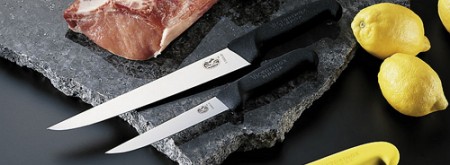
These are professional knives for specific use, such as for chops with a polyoxymethylene (POM) handle, stainless steel blade, and blister packaging.
Tools for Every Task: Types of Knives
Each knife is designed for a specific purpose, and knowing them will allow you to make more precise, efficient, and safer cuts. There is a wide variety of butcher and kitchen knife types, each adapted to a specific need.
- Chef’s Knife (or French Knife): The most versatile and common tool in the kitchen, with a wide, curved blade of 20-30 cm. Ideal for chopping, mincing, and slicing large pieces of meat, as well as for precise cuts.
- Boning Knife: Essential for separating meat from bones. Its blade is narrow and pointed, with a length of 12-17 cm. It can be rigid for tougher jobs (like poultry or beef) or flexible for precision around small bones or tendons.
- Fillet Knife: Designed to obtain thin and precise cuts, especially with fish and delicate meats. Its blade is long (15-28 cm), thin, and very flexible, allowing it to follow the contours of bones and create clean fillets.
- Butcher Knife (or Scimitar): A robust and heavy knife, generally 25-35 cm. Its blade is thicker for cutting bones and cartilage. The scimitar has a rigid, upwardly curved blade, 15 to 35 cm, used for cutting large pieces of meat into smaller portions.
- Carving Knife: Used for cutting cooked and roasted meats into thin, uniform slices, with a long, thin blade of 20-30 cm.
- Butcher’s Cleaver (or Machete): A powerful and almost rectangular tool, 15-20 cm, used for splitting large bones and cartilage. Its design is “off-balance” to add inertia to the blow.
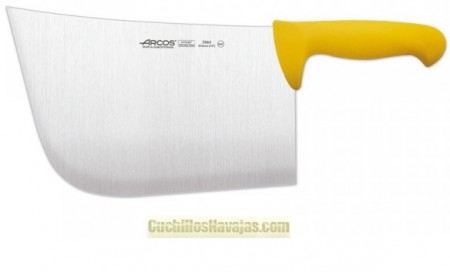
There are knives for poultry and small animals, steak knives, skinning knives, acute-point knives, round-point knives, breaking knives. There are also butcher cleavers or kitchen cleavers.
- Santoku Knife: Of Japanese origin, similar to the chef’s knife but with a shorter blade (12-18 cm) and a straight edge, ideal for fine and precise cuts on lean meats and poultry.
- Steak Knife: With a wide and robust blade, specific for cutting beef, pork, and lamb, it is heavier for powerful cutting.
- Skinning Knife: Curved and rigid blade for removing skin from meat, requiring a good edge so as not to damage the meat.
- Cornering Knife: Long and narrow blade with curvature for uniform and precise cuts.
- Utility Knife: A versatile knife with a shorter blade for general cutting tasks.
- Chinese Cleaver (Kitchen Cleaver): A thin blade and round handle, light to medium weight. For boning chicken, with a shorter and stiffer blade than the boning knife, useful for separating meat from small bones.
- Ham Knife: A very long, thin, and flexible blade, essential for cutting thin and uniform slices of ham or pork shoulders without breaking the fibers.
The Secret to a Lasting Edge: Maintenance
A sharp knife is not only more effective but also safer. Proper maintenance of your knives will extend their lifespan and ensure optimal performance.
Regular Sharpening:
- Frequency: For home cooks, once a month is a good estimate; for professional chefs, weekly. The key sign is when you feel the knife slipping or requiring more force to cut. Sharpening regularly is easier and removes less material from the blade.
- Tools:
- Honing Steel (Sharpening Steel): Contrary to popular belief, the honing steel does not sharpen, but microscopically straightens the edge, realigning deformations. Using it regularly (about 10 seconds) can maintain the edge up to 10 times longer. For soft steels (up to 58 HRC), a fine-cut steel honing steel is used; for harder steels, a ceramic or diamond-coated one.
- Sharpening Stone (Whetstone or Oilstone): For deeper sharpening. Wet the stone and pass the blade at a constant 20-degree angle, alternating sides until the desired edge is obtained.
- Electric Sharpeners: They are practical and fast, but always follow the manufacturer’s instructions.
- Important: Always sharpen from the heel of the blade to the tip to prevent gaps from forming in the edge profile.
Cleaning Techniques:
- Manual Washing: Forget the dishwasher! Harsh detergents, hot water, and clanking against other utensils can damage the edge and handle. Wash your knives by hand with warm water and soap.
- Immediate Drying: Dry your knives immediately after washing to prevent stains and corrosion, especially on high-carbon steels.
- Lubrication: If the knife is high-carbon steel, you can gently lubricate it with maintenance oil or refined edible oil (like sunflower) before storing it, especially when new and the patina has not yet formed.
- Disinfection: Occasionally, clean them with a solution of water and vinegar to disinfect.
Safe Storage:
- Never store knives loosely in a drawer with other utensils, as this damages the delicate edge and is dangerous.
- Magnetic Strips: Keep knives safe, accessible, and prevent contact between them, protecting the edge.
- Knife Blocks: Protect the blades and keep them organized. Make sure the slots do not damage the edge and that the block is clean and dry.
- Protective Sheaths (Sayas): Ideal for transporting knives or storing them safely in drawers, preventing accidental cuts and damage to the edge.
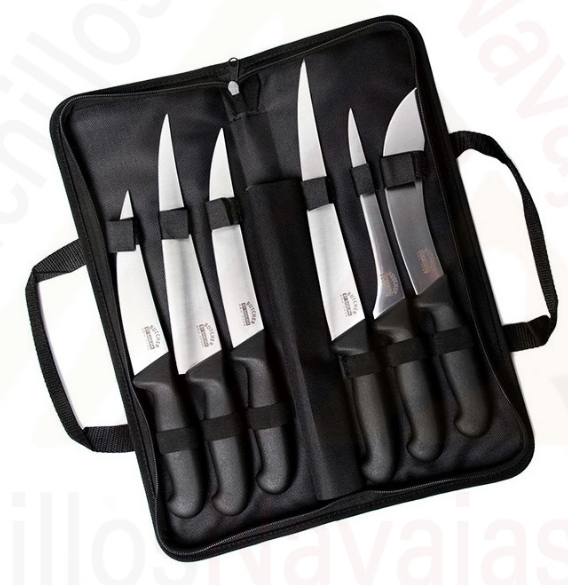
- Knife Bags or Rolls: Perfect if you have a set and transport them frequently.
- Drawers with Dividers: Offer safe and organized storage within the drawer.
Proper Use:
- Cutting Boards: Avoid hard surfaces like marble, glass, or ceramic, which can dull or chip blades. Use professional wooden or synthetic cutting boards. Ideally, have at least two: one for raw meats and fish, and another for vegetables and fruits.
- Minimum Force: A sharp knife does not need much force; the blade’s own weight is usually sufficient for many ingredients, which reduces food damage and improves precision.
- Do Not Scrape with the Edge: To move food from the board, flip the knife over and use the spine (the back) instead of the edge, which is very thin and sensitive to transversal force.
- Care with Delicate Knives: Japanese knives, made of very hard steel, are very sharp but also more sensitive. They should not be used for cutting bones, cheese, crunchy bread (especially carbon-burnt crust), coconuts, or as tools (openers, screwdrivers, hammers), as they can chip.

Trust and Quality: Featured Brands
Choosing a reputable brand is an investment that guarantees quality and long-term durability.
As we have seen, the knife, whether for the professional butcher or the kitchen enthusiast, is much more than a simple tool: it is an extension of skill and precision. Understanding the different types of knives, their materials, designs, and above all, how to keep them sharp and safe, is fundamental to achieving excellent and lasting results.
Investing in quality knives and dedicating time to their maintenance not only improves your efficiency in the kitchen but also transforms the experience of preparing meat into a true art. Remember that a well-maintained knife chosen for the correct task is key to impeccable cuts and safe work. To find the perfect tool that suits your needs, we invite you to explore our wide selection.