Hello, precision and throwing art enthusiasts! Have you ever been fascinated by the image of a knife flying through the air, sticking with impeccable accuracy into its target? Beyond what we see in movies, knife throwing is a fascinating sport discipline that combines concentration, technique, and a good dose of patience. Get ready to delve into the exciting world of throwing knives, from their ancient origins to modern competitions and the secrets to mastering them.

A Look at the Past: The History of Knife Throwing
Contents
- A Look at the Past: The History of Knife Throwing
- What Are Throwing Knives Really? Features and Design
- Types of Throwing Knives: Which One is Ideal for You?
- Mastering the Technique: Throwing Methods and Tricks
- Purpose and Modern Applications
- Tips for Beginners and Improving Your Accuracy
- Safety First: Crucial for a Fun Throwing Experience!
- Maintenance of Your Throwing Knives
- Trusted Brands in the World of Throwing Knives
Knife throwing is nothing new, not at all! It’s a millenary technique that has accompanied humanity for centuries. Initially, its purpose was vital: a crucial skill for survival, used for hunting and combat.
- Ancient Origins: Warrior tribes in Africa used throwing knives for hunting and defense, designed to fly with precision and cause maximum damage upon impact. In Asia, especially in Japan, samurais and ninjas employed throwing weapons like shuriken, which, although not knives themselves, followed the same principle of throwing sharp objects with great dexterity.
- Middle Ages and Transformation: In Europe, during the Middle Ages, hunters and soldiers also perfected this technique. However, over time, its relevance in war and hunting diminished.
- From War to Spectacle: By the 19th century, knife throwing began to transform into a spectacle. Cowboys and circus performers amazed audiences with their precision in vaudeville shows and circuses. Artists like David Adamovich, known as “The Great Throwdini”, and Jack Dagger have taken this practice to another level, demonstrating exceptional speed and accuracy, and even training contestants. Adamovich, considered the world’s best circus thrower, states: “if you are not sure you will hit a million times in a million tries, you are not ready yet.”
- Current Sport and Recreation: Today, it is a globally practiced sport discipline, where skill and ability are rewarded. Anyone can participate, from beginners to experts, as it depends more on technique and practice than on strength.
What Are Throwing Knives Really? Features and Design
A throwing knife is a fascinating and highly specialized tool, designed specifically to be thrown with precision towards a target and have its point firmly embed in the objective. Unlike kitchen knives or general-purpose knives, they are not used for cutting. In fact, it’s not necessary for the blade to have a cutting edge, as its main purpose is to pierce.
These knives possess unique design characteristics that optimize their effective and precise throwing capability:
- Spear-Point Blade Design: Allows for a straighter throw, reducing deviations and ensuring the point effectively sticks. The aerodynamic design is crucial for a stable trajectory. Some models have more prominent and sharper points.
- Ergonomic Handle: Designed for a secure and comfortable grip, minimizing accidental slippage during throwing. Handles are usually made of metal and can be wrapped in cord or textured to improve grip.
- Weight and Balance: A fundamental aspect is the balance between the handle and the blade. Proper balance ensures stability in flight and improves accuracy. Heavier knives offer steadfastness over long distances, while lighter ones are fast and agile for close-range throws.
- Solid Construction: It is crucial to observe the knife’s construction. A more solid and uniform build is preferable, as very thin parts can break upon impact. Throwing knives have thicker edges than regular knives.
- Material: The quality of the blade material is key.
- Stainless Steel: It is rust-resistant and shiny, but can be more fragile and less suitable for strong impacts on very hard surfaces.
- Carbon Steel: Resistant and durable, but requires more care to prevent oxidation. It allows for piercing concrete, brick, or metal targets.

Types of Throwing Knives: Which One is Ideal for You?
There are various models and sets of throwing knives, adapted to different skill levels and preferences. The choice of knife is subjective; some prefer exotic designs, while others opt for simpler projectiles.
Here are the main categories and criteria for choosing yours:
By Balance:
- Balanced Knives (Center): The “all-rounders”, ideal for beginners and very versatile, allowing throws from both the handle and the blade. They are the best option for beginners, with an even weight distribution.
- Heavy Blade Knives: Optimal for throws with a handle grip.
- Heavy Handle Knives: Designed for a blade grip.
By Construction:
- Tang Throwing Knife: Blade that extends into a wooden or rubber handle, offering a pleasant throw but with possible vibrations.
- Monobloc Throwing Knife with Handle: Composed of a single piece with an added handle for a better grip.
- Simple Monobloc Throwing Knife: Made from a single piece, it is the most resistant and sometimes includes an adjustment screw to guide the trajectory at a distance.
By Flexibility:
- Fixed Blade Knives: Solid structure without moving parts, offering greater durability and control. Ideal for beginners and experts due to their impact resistance.
- Flexible Blade Knives: With some flexibility in the blade, they allow for a more dynamic throw and interesting rotation techniques. These are for advanced throwers due to their greater handling difficulty.
By Size and Weight:
- Long and Heavy Knives: Offer more stability in flight, are easier to control on long throws, and maintain a predictable trajectory.
- Small and Lightweight Knives: Compact and easy to transport, they are agile and fast for dynamic throws. They require greater precision and technique, recommended for experienced throwers.
Popular Styles:
- Kunai Knives: Japanese inspired, versatile, and aesthetically appealing.
- Straight Knives: The choice of professionals; they are simple, predictable, and reliable.
- Military Style Knives: Robust and heavier, not for the faint of heart.
For beginners: It is recommended to start with equally balanced knives, which facilitate handling and technique development. Knives 10 to 12 cm long and weighing between 7 and 9 grams are ideal.
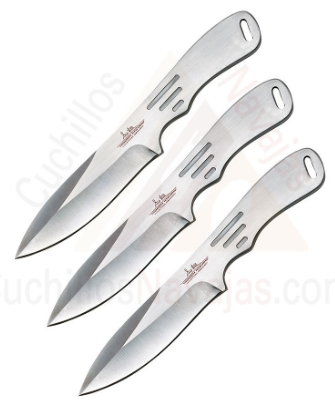
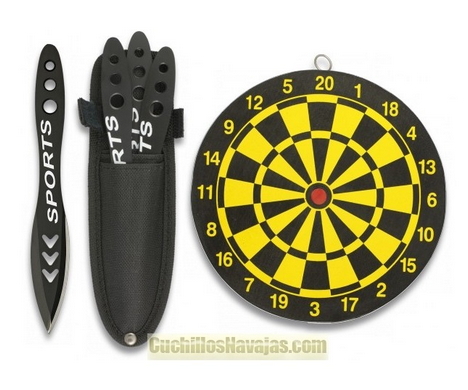
Some examples of popular sets include the White Dragon 3-Piece Thrower Set (with dragon design and nylon sheath) and the Black Steel 3-Piece Thrower Set with Counterweight (with counterweight for improved precision and also with sheath). Other notable models are the Third H7120, Martinez Albainox sets, and the Joker “Botero” knife.
Mastering the Technique: Throwing Methods and Tricks
Knife throwing has a great technique behind it. It’s not just about strength, but about position, distance, precision, body positioning, and the number of knife revolutions.
Fundamental Grips:
You can throw a knife by gripping it by the handle or the blade. Experiment to find the grip that is most comfortable and effective for you. If the handle is the heavy part, grip the blade. If the blade is heavy, grip the handle.
Throwing Methods: With Spin or No Spin?
The choice of method depends on the distance to the target and the desired rotation.
- Spin Throwing: The knife rotates one or more times before impacting the target.
- Half-Spin: The knife makes a single rotation. Ideal for medium distances.
- Full-Spin: The knife rotates completely, sometimes more than once. Useful for longer throws, as rotation adds force to the impact.
Normally, the knife is gripped by the blade, keeping the fist vertical at 45 degrees, and released by pushing the fist downwards.
- No-Spin Throwing (Direct Throw): Also known as “no-spin”, the knife does not spin at all. It requires a firm wrist and constant control. It is ideal for close targets and pinpoint accuracy, but it is complex and versatile for unpredictable distances. It is usually performed by holding the knife by the handle and throwing from the shoulder with a pushing motion.
- Instinctive Throwing: It is based on intuition and constant practice to determine distance and angle, adjusting the throw naturally without thinking about technical details.
Throwing Angles:
The angle influences the knife’s movement, spin, and landing.
- Vertical (Overhead): Tends to maintain stability and control, ideal for short and medium distances.
- Horizontal (Arm at Side): Popular for flashy tricks, it adds effect and curve to the flight.
Adjustments in wrist movement and arm follow-through can be key for the blade to stick and not bounce off.
Purpose and Modern Applications
While it was once a survival skill, today knife throwing has adapted and has multiple applications:
- Sport and Aiming: Its main purpose is the practice of aiming at targets or tree trunks. It improves hand-eye coordination and throwing technique. There are worldwide competitions where precision and skill are rewarded in various modalities, including throws with or without rotation and at distances varying between 2.40 and 6.30 meters.
- Survival and Defense Skill: Although not the most common today, in extreme situations, a throwing knife can be valuable for procuring food or as a long-range defensive option. Consistent training can include dynamic combat exercises, where throwing a knife can be a supporting tool to gain time or incapacitate an attacker, especially in scenarios where a firearm is not viable or fails.
Important: Due to their specific design, throwing knives are not the most suitable for hunting or survival in the traditional sense, as they lack a cutting edge and it is difficult to hit moving targets. However, practice will provide you with an additional skill.
Tips for Beginners and Improving Your Accuracy
If you’re starting out in this fascinating sport, here are some key tips!
- Start with the Basics: Begin your training at short distances, 2.5 to 3 meters (8 to 10 feet), and with little force. This will allow you to develop your technique and understand the knife’s rotation. As you gain experience, gradually increase the distance.
- Posture Matters: Stand with your feet shoulder-width apart, with your dominant foot slightly forward, and stay aligned with your target. A stable posture is crucial.
- Muscle Memory: To improve, you must instill the same movement in your muscles until it becomes natural. The way you grip the knife, stand, swing your arm, and release it must be consistent. Repetitive practice is fundamental.
- Nail the Basics: Hold the knife firmly, but without squeezing too tightly. The throw should feel smooth and like a single motion.
- Correct Errors: Are you gripping too tightly? Are you moving your wrist excessively? These are common mistakes. Take a breath, reset, and focus on doing the basics well.
Safety First: Crucial for a Fun Throwing Experience!
Flying knives carry risks, so a safe setup is non-negotiable.
Establish a Safe Throwing Area:
- Choose a wide and clear area, away from people, animals, and objects that could be damaged.
- Delimit the throwing zone so everyone knows where to keep clear.
- Keep the area tidy, free of obstacles that could cause trips or distractions.
Choose the Right Target:
- Softwoods (pine, fir) are excellent, as they are gentle on the blade and make it easier to stick.
- Straw bales are economical and easy to set up, ideal for beginners.
- End-grain wood or rubber throwing boards are designed to absorb impact without damaging your knives.
- Avoid hard wood or metal targets, as they can cause dangerous ricochets and dull the blade.
- Ensure your target is firmly secured and does not move during practice.
Use Personal Protective Equipment:
- Safety glasses: Essential to protect your eyes from possible splinters or fragments.
- Gloves: Consider wearing them to protect your hands.
- Closed-toe shoes: Are mandatory for your safety.
- Avoid loose clothing.

Check Your Equipment:
- Before each session, inspect the knives to ensure they are not damaged or worn. A knife in poor condition can break when thrown.
- Only use knives specifically designed for throwing, as they are balanced to fly straight.
Attention and Concentration:
- Always keep your attention on your surroundings and the people around you. Never throw a knife if someone is near the target.
- Don’t rush; make sure you have the necessary focus and confidence before throwing.
Training and Supervision:
- If you are new, consider getting instruction from an expert or joining a group.
- If you practice with friends, make sure everyone knows the safety rules and supervises each other. In Mexico, it’s crucial to ask instructors about their experience, certifications, and proof (photos, videos) before attending a course, as there has been a “boom” of uncertified instructors.
Responsible Handling:
- Treat knives with respect and do not play with them outside of practice.
- Store them in a safe place, out of reach of children or untrained individuals.
Maintenance of Your Throwing Knives
Maintaining your knives in good condition is fundamental for their durability and your safety.
- Cleaning and Drying: After using them, clean them well to remove dirt and moisture. Dry them completely to prevent oxidation.
- Oiling: Occasionally, apply a light coat of metal-compatible oil to keep them smooth and protected.
- Sharpening: Don’t overdo it. What you’re looking for is a balanced blade for sticking, not one that cuts like a razor.
- Storage: Store them in a suitable sheath or case to protect them and prevent accidents.
- Avoid Hard Impacts: Do not throw them against overly hard objects, as this can chip or bend the edges.
- Regular Inspection: Periodically check your knives for cracks, dents, or any anomalies. It’s best to detect problems early.
Trusted Brands in the World of Throwing Knives
If you are looking to acquire your first set or upgrade your equipment, it is useful to know the leading manufacturers in the field. Some of the most recognized brands by experts include: SOG Knives, Boker, Whetstone, United Cutlery, Smith & Wesson, and Cold Steel.
Let the Throwing Begin!
Knife throwing is an activity that will challenge you and reward you with improved coordination, concentration, and patience. With the right equipment and necessary precautions, you’ll be ready to enjoy this unique and gratifying experience in the world of sport and entertainment! So, what are you waiting for? Choose your knife, find your target, and start practicing! And remember, the key is practice, consistency, and safety. If you’re ready to start or want to expand your collection, explore our wide range of high-quality throwing knives and accessories in our online store. We look forward to helping you stick every throw!
Want to get the best Throwing Knives NOW?