Hello, kitchen lovers and tools that make life easier! Today we are going to unravel the mystery of an utensil that, although often underestimated, is absolutely essential to keep your knives in their best shape: The Honing Steel. Get ready to discover everything you need to know about this indispensable ally in your kitchen, from its true function to how to choose the perfect one for you. Let’s get to it!
What is a Honing Steel and why is it not what you (perhaps) think?
Contents
- What is a Honing Steel and why is it not what you (perhaps) think?
- Why should you incorporate the Honing Steel into your routine? Key benefits
- Types of Honing Steels: Find your ideal companion
- How to use a Honing Steel like a Professional Chef: The perfect technique
- Common Mistakes when Using a Honing Steel (and how to avoid them!)
- Maintenance and Care of your Honing Steel: A durable ally
- Where to buy and what to look for when choosing your Honing Steel?
- Conclusion: An impeccable edge, an easier life
A honing steel is a fundamental tool, an elongated rod (generally cylindrical or also flat) that, contrary to popular belief, does not sharpen a knife in the traditional sense. It is crucial to understand this: its main purpose is to realign and straighten the blade’s edge, which tends to deviate or “bend” with regular use. Think of the microscopic “teeth” of the edge: the honing steel straightens them, it doesn’t create them or remove material.
This realignment is what allows for precise and safe cuts. It is a daily maintenance tool, not a repair tool for a very dull knife, for which you would need a sharpening stone or a more aggressive sharpener. For butchers, the metallic sound of the honing steel before each cut is a routine that ensures the best performance.

Why should you incorporate the Honing Steel into your routine? Key benefits
A knife well-maintained with a honing steel offers multiple advantages:
- Greater Safety: A sharp knife with the correct edge is safer. It requires less force to cut, reducing the risk of slips and accidents.
- Superior Cutting Performance: Allows for precise and clean cuts on all types of food, facilitating preparation and achieving more professional results.
- Extends the Lifespan of your Knives: By regularly realigning the edge, you prevent excessive wear and the need for more aggressive sharpenings that remove material, which extends the life of your valuable tools.
- Time Optimization: An efficient knife speeds up cutting tasks, increasing your productivity in the kitchen.
- Control and Precision: A set edge gives you exceptional control over the cut, improving the quality of your work.
Types of Honing Steels: Find your ideal companion
The choice of the right honing steel depends on your needs and the type of knives you use. They are mainly classified by their material and, to a lesser extent, by their shape and length. The honing steel must always be made of a harder material than the knife blade to correct the edge angle.
By Material:
Steel Honing Steels:
- Characteristics: These are the most traditional and common, made of chrome-plated stainless steel or carbon steel. They feature grooves that quickly set and true the blade.
- Advantages: Robust, corrosion-resistant, durable, and effective for daily maintenance. They are ideal for Western knives (traditional steel). The honing steel does not require special treatment as it is manufactured from high-quality and hard steel that makes it resistant for many years.
- Disadvantages: Not recommended for high-end Japanese knives with extremely high hardness steel, as the knife might be harder than the honing steel. They do not remove material, so they do not sharpen very dull knives. They work better with slightly softer knives.
- When to use them? For regular maintenance and to straighten the edge. Many professional chefs prefer them for daily maintenance. The honing steel is used exclusively to set the edge.
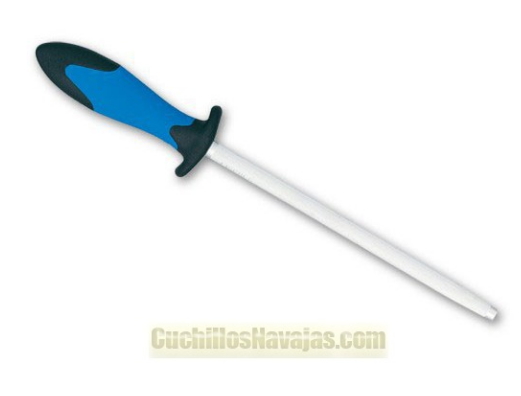
Ceramic Honing Steels:
- Characteristics: They offer a smooth and very careful sharpening. They are more modern and are usually made with fine grit (similar to a 1000 grit sharpening stone). They can sharpen and correct the edge angle at the same time.
- Advantages: Provide a very fine and superior finish. They are more durable and maintain the edge better than steel ones. They can be used with Japanese knives (of high hardness) as their hardness is greater than any steel. Less aggressive than diamond ones, resulting in less knife wear.
- Disadvantages: Very delicate, sensitive to bumps and drops. Not suitable for ceramic knives. They tend to be shorter, ideal for medium knives (up to 20cm).
- When to use them? When you are looking for maximum precision and detail, for high-quality knives, and to obtain a smooth sharpening.
Diamond Honing Steels:
- Characteristics: Coated with diamond particles, nature’s hardest stone. They are extremely hard and can sharpen any type of material, even the hardest.
- Advantages: Achieve a particularly fine and fast sharpening result. They are very efficient, even with very worn edges. They do not break easily when dropped.
- Disadvantages: Considered more of a sharpener than a honing steel, as they remove a lot of material and can be aggressive with the blade. The diamond layer can wear off over time, shortening its average lifespan. It is recommended not to use them daily to avoid removing too much material.
- When to use them? For emergency situations, when you need a super-fast edge, or when the knife has lost a lot of its edge. Complementary to steel or ceramic ones.
Tungsten Carbide Honing Steels:
- Characteristics: They have a tungsten carbide coated blade.
- Advantages: Durable and suitable for all knives.
There are honing steels made of stone of different grits that do allow sharpening and, being also made of steel, provide more rigidity to the stone, thus preventing its possible breakage; they are usually used wet with water and there are several types, for thinning, sharpening and honing.

By Shape and Length:
- Round: The most common shape, facilitates uniform knife sliding.
- Oval: Offers a larger contact surface, which can improve efficiency.
- Flat or Square: Less common, but preferred by some users.
- Length: The length of the honing steel should always be greater than that of the knife blade. Lengths vary, but between 25 and 30 centimeters is ideal for precise and safe sharpening, allowing the entire length of the knife to be covered in a single motion. A longer honing steel facilitates correct movements.
How to use a Honing Steel like a Professional Chef: The perfect technique
Mastering the honing steel technique requires practice, but once you have it, it’s fast and effective. Here we show you the recommended method to start, considered the safest:
- Safe Position: Place the honing steel with the tip down on a flat, non-slip surface (like your kitchen counter, perhaps with a damp cloth underneath). You can also hold it in the air with your non-dominant hand, firmly. For more safety, perform the movement away from your body.
- Grip and Angle: If you are right-handed, hold the honing steel by the handle with your left hand and the knife with your right. The knife’s edge should point downwards. The most important thing is to maintain a consistent angle between the knife and the honing steel. For most knives, an angle of approximately 20 degrees is recommended (between 15 and 20 degrees). For Japanese knives, 15 degrees is common. It’s more a matter of “feel” than exact mathematics. If the angle is too large, you can damage the edge; if it’s too small, it will have no effect.
- Harmonious Movement: Slide the knife progressively from the last part of the edge (near the handle) towards the tip, covering the entire length of the blade along the honing steel. The movement should be in an arc and fluid.
- Pressure and Repetition: Apply moderate and constant pressure, without too much force, as it is not about removing material. Repeat this movement five to ten times on each side of the knife, alternating the faces of the blade with each pass. Speed does not affect sharpening; you can start slowly until you gain confidence.
- Verification: After a few passes, check the edge. You can gently run your finger over it (with great care to avoid cuts!) to feel if it is smooth and without rough spots.
The honing steel is passed over the edge by sliding the blade from one end to the other and from top to bottom in a rubbing action of the edge along the length of the honing steel each time the edge diminishes.
Common Mistakes when Using a Honing Steel (and how to avoid them!)
To ensure effective sharpening and protect your knives and honing steel, avoid these mistakes:
- Incomplete Movements: Not sliding the knife along the entire length of the honing steel can leave parts unset. A trick for beginners is to paint the edge with a water-based marker: if the ink erases, you have covered the entire length.
- Incorrect Angle: Not maintaining the correct angle (too acute or too obtuse) makes sharpening ineffective or damages the edge.
- Too Much Pressure: The honing steel realigns, it does not remove material. Too much force can damage the knife’s edge or the honing steel.
- Improper Cleaning: The rough part of scouring pads (the green side) can remove the sharpness from a knife in a couple of passes. Always use the smooth part or a damp cloth to clean your knife after use and the honing steel after each use.
- Incorrect Knife Storage: Storing knives with other utensils causes rubbing that quickly dulls them. Store them in a safe and protected place.
Maintenance and Care of your Honing Steel: A durable ally
To ensure the effectiveness and prolong the lifespan of your honing steel, good maintenance is key.
- Regular Cleaning: After each use, clean your honing steel to remove metallic residues that adhere to its surface. You can use a soft-bristled brush or a microfiber cloth. For a deep clean, use warm water and mild soap, making sure to dry it completely to prevent oxidation. Avoid abrasive chemicals or metallic scouring pads.
- Proper Storage: Store the honing steel in a dry and safe place, away from excessive humidity, extreme heat, and sudden temperature changes. If it comes with a sheath, use it. Store it vertically or at an angle, and separate from other tools to prevent bumps and damage.
- Periodic Inspection: Regularly check your honing steel for signs of wear or damage, which could affect its effectiveness.
Where to buy and what to look for when choosing your Honing Steel?
When buying, consider the material, length, and handle quality. Some renowned brands offer excellent options:
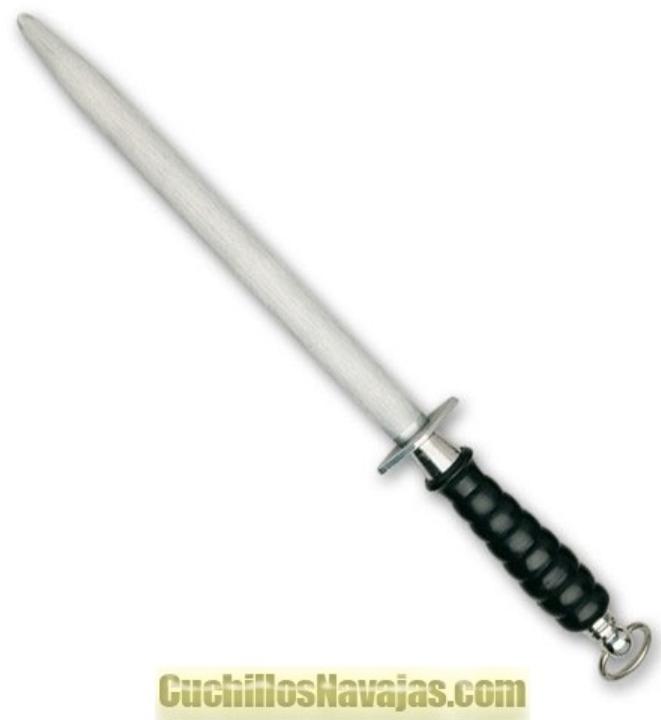
- Wüsthof: Offer quality stainless steel honing steels. The Wüsthof 4468 of 26 cm is an economical and highly chosen option to start. They also have the Wüsthof forged of 26 cm, of maximum quality in steel.
- Kyocera: Stand out for their ceramic honing steels, ideal for sharpening and correcting the edge simultaneously. The Kyocera CSW 18 of 18 cm is a professional option.
- Arcos: Offer several models of honing steels, including chrome-plated carbon steel, with a resistant handle, and some with diamond reinforcement.
- Nirosta: Have stainless steel honing steels, including one for ham knives.
- Smith: A Smith diamond honing steel is very effective for getting a quick edge in emergency situations.
Remember that, as you gain confidence, you will be able to use the honing steel without support, maintaining the correct angle intuitively.
Conclusion: An impeccable edge, an easier life
In summary, the honing steel is an indispensable tool in any kitchen or workshop where cutting tools are used. It is not just a simple sharpener, but the best ally to keep the edge of your knives set and ready for action, prolonging their lifespan and ensuring your safety and efficiency in every cut.
Incorporate it into your routine before each use or each workday, with a few passes on each side, and you will see the difference. Your culinary (or work) experience will be much more pleasant and safe!