

Maintaining an optimal edge on your cutting tools is crucial, whether you work in the kitchen, workshop, or venture into the wild. A knife sharpening kit is the ultimate investment that ensures your pocket knives, artisan knives, and other tools maintain their exceptional performance, prolonging their lifespan and ensuring precise, safe cuts. Mastering the art of sharpening is not just a practical skill, but a way to honour the quality of your instruments.
This comprehensive kit is not just a collection of accessories, but the key to unlocking the true potential of your blade collection, transforming dull tools into precision instruments once again. We will explore its components, techniques, and the science behind the edge, so that every cut is a masterly experience.
Why a sharpening kit is the ultimate investment for your cutting tools
Contents
- Why a sharpening kit is the ultimate investment for your cutting tools
- Essential kit components: unravelling each tool for perfect sharpening
- The science of the edge: types of abrasives and their application in artisan knives
- Practical guide: sharpening techniques for beginners and experts, step by step
- Beyond sharpening: preventive maintenance to prolong the life of your kit and tools
- Customising your kit: selecting the right tools for each type of knife and use
- Discover our selection of The Knife Sharpening Kit: Essential Tools for a Lasting Edge
- Doubts about the edge? Answering your most burning questions

A sharpening kit is not a mere accessory, but a necessity for any enthusiast or professional who values the performance of their tools. A well-sharpened knife is safer than a dull one, as it requires less force to cut, reducing the risk of slips and accidents. The precision offered by a keen edge transforms everyday and complex tasks into rewarding experiences.
Furthermore, regular sharpening prevents premature wear of the edge, extending the lifespan of your treasured tools. In the case of artisan knives and collector’s knives, this proper maintenance preserves their value and intrinsic beauty over the years. It is a form of respect for the craftsman and the quality of the material.
The initial investment in a good sharpening kit quickly pays for itself by avoiding the constant replacement of worn or damaged tools. It offers unparalleled control over the angle and sharpness of the edge, allowing you to customise sharpening according to the type of blade and its specific use. It is the cornerstone for durable maintenance.
Essential kit components: unravelling each tool for perfect sharpening
A complete knife sharpening kit typically includes a variety of tools, each with a specific function to restore and maintain the edge. Understanding each component is key to using them effectively and achieving optimal results on your tools.
- Whetstones: These are the foundation of any kit. They come in different grits, ranging from very coarse (for repairing damaged edges) to extra-fine (for polishing and honing the edge). They usually require water or oil to lubricate and remove metal particles.
- Leather Sharpening Strops: Used after finer stones to remove the microscopic burr and polish the edge to extreme sharpness. Often used with abrasive polishing compounds for a mirror finish.
- Angle Guides: These accessories ensure you maintain a consistent angle during sharpening, which is fundamental for obtaining a uniform and effective edge. They are especially useful for beginners or for maintaining specific angles on delicate blades.
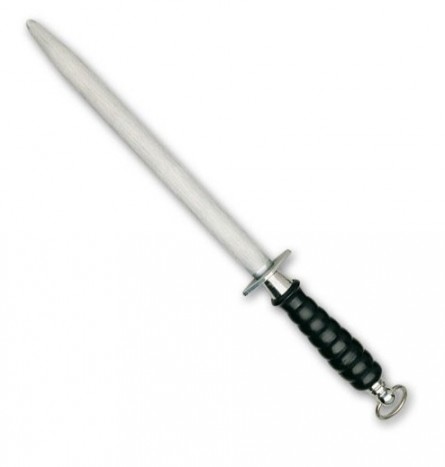
- Honing Rods or Steels: These don’t actually sharpen, but realign the micro-deformations of the edge that occur with use. They are frequent maintenance tools to prolong sharpness between deeper sharpening with stones.
In addition to these fundamental elements, some kits may include other accessories such as non-slip bases for stones, cleaners to remove metal residue, or microfibre cloths for final maintenance. Each component plays a vital role in the sharpening process, contributing to the durability and effectiveness of the edge.
The science of the edge: types of abrasives and their application in artisan knives
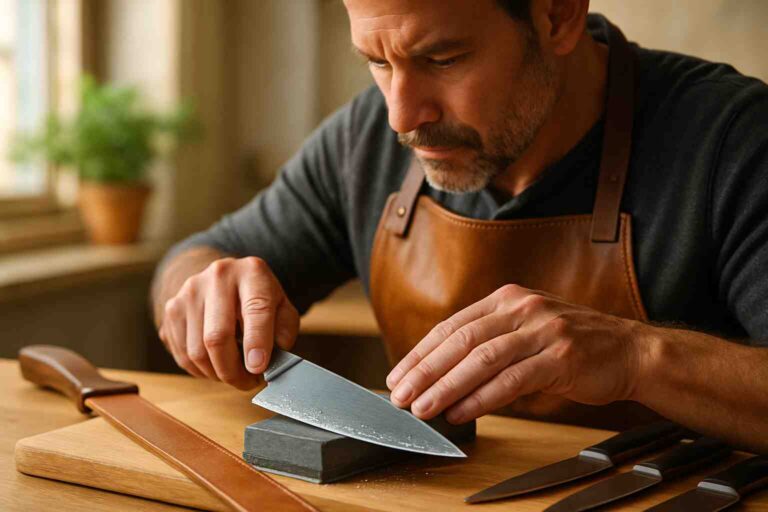
The heart of any sharpening kit lies in its abrasives. These materials, with their ability to wear down metal, are responsible for creating and refining the edge of your knives. Choosing the right abrasive is crucial for the type of tool and the sharpening objective.
Whetstone grits: a detailed guide
Whetstones are classified by their “grit,” a number that indicates the size of the abrasive particles. The lower the number, the coarser the particles and the greater their grinding capacity. The higher the number, the finer the particles and the greater their polishing capacity.
- Coarse grits (120-400): Ideal for repairing badly damaged edges, removing nicks, or changing the bevel angle. They are very aggressive and remove material quickly.
- Medium grits (600-1000): The starting point for dull knives without major damage. They create a decent working edge and prepare the blade for finer grits.
- Fine grits (1500-3000): Refine the edge created by medium grits, preparing it for polishing. They improve cutting ability and reduce friction.
- Extra-fine grits (4000-12000+): For polishing the edge to exceptional sharpness, leaving it ready for stropping. They provide a mirror finish and an extremely clean cut.
The most common abrasives include aluminium oxide (corundum), silicon carbide (carborundum), and diamond. Aluminium oxide is versatile and effective, often found in waterstones. Silicon carbide, being harder, is excellent for very hard steels and is used in combination stones. Diamond, the hardest material, is ideal for exotic steels, ceramics, and for fast and very effective sharpening, especially in fine grits for polishing.
The selection of abrasive depends on the type of steel in your artisan knife. Carbon and low-alloy steels respond well to a wide range of waterstones. High-alloy stainless steels or more modern powder steels can benefit from diamond abrasives for more efficient and precise sharpening, ensuring the edge is not only sharp but also durable.
Practical guide: sharpening techniques for beginners and experts, step by step
Mastering knife sharpening is a skill that improves with practice. Here’s a step-by-step guide, from the basics for beginners to tips for honing the edge like an expert.
1. Preparation and angle: the foundation of success
Begin by preparing your whetstone, either by soaking it in water or applying oil, depending on the type. Identify the bevel angle of your knife; for most kitchen knives, it’s usually between 15 and 20 degrees per side, while for tactical pocket knives, it can be 20 to 25 degrees. Use an angle guide if you are inexperienced.
2. Sharpening with coarse grit stones: repairing the edge
If your knife is very dull or has nicks, start with the coarsest grit stone. Place the knife on the stone, maintaining a constant angle. Push (or pull, depending on the chosen technique) the edge along the stone, applying even pressure. Make consistent passes until you feel a small “burr” on the opposite side of the edge.
3. Progression to medium and fine grits: refining the sharpness
Move to the medium grit stone. Repeat the process, maintaining the same angle and number of passes on each side. The goal is to remove the coarse grit marks and continue to refine the edge. Then, repeat with the fine grit stone for further refinement, making lighter passes to polish the surface and further reduce the burr.
4. Stropping and testing: the finishing touch
Finally, use a leather strop to remove any residual burr and polish the edge to extreme sharpness. Make about 10-20 very light passes on each side. Test the edge by cutting paper; if it cuts cleanly without tearing, you have achieved an excellent sharpen. If the sharpening does not meet your expectations, review the angle and pressure.
Beyond sharpening: preventive maintenance to prolong the life of your kit and tools
Sharpening is only part of the equation for keeping your cutting tools in optimal condition. Proper preventive maintenance for both your knives and your knife sharpening kit is crucial to ensure their long-term durability and performance.
Care of cutting tools:
- Immediate cleaning: Wash your knives and pocket knives immediately after use. Food residues, especially acids, can corrode steel over time. Use warm water and mild soap.
- Thorough drying: Completely dry all tools after washing. Moisture is the number one enemy of steels, causing rust and stains. A microfibre cloth is ideal to avoid leaving residue.
- Proper storage: Store knives in a wooden block, a protective sheath, or on a magnetic strip to prevent the edge from striking other surfaces or tools. This prevents nicks and accidental damage.
- Protective oils: For carbon steel or high-collection knives, apply a thin layer of mineral oil or a specific knife oil after cleaning and drying. This creates a barrier against oxidation and environmental deterioration.
Maintenance of the sharpening kit:
- Stone cleaning: After each use, clean your whetstones to remove metal residue (sludge or slurry) with a brush and water. This prevents pores from clogging and maintains their effectiveness.
- Stone drying: Allow whetstones to air dry completely before storing, especially waterstones. This prevents the proliferation of mould and bacteria.
- Stone flattening: With use, stones can develop irregularities on their surface. Use a flattening stone or coarse grit sandpaper on a flat surface (such as glass or granite) to keep them uniform and ensure consistent sharpening.
- Strop care: Store the leather strop in a dry place. Polishing compounds are applied sporadically and renewed when their abrasive capacity decreases.

Adopting these maintenance practices will not only prolong the life of your tools but will also ensure that your sharpening kit is always ready and functioning correctly when you need it, thus guaranteeing a perfect edge at all times.
Customising your kit: selecting the right tools for each type of knife and use
There is no “one-size-fits-all” sharpening kit. Customising your knife sharpening kit is essential to adapt to the different materials and geometries of your tools. A chef’s knife does not require the same process as a pocket knife or a bush machete.
For everyday stainless steel kitchen knives, a basic system of two or three waterstones (medium and fine grits, and an extra-fine one) will be sufficient to maintain the edge. If you work with high-carbon artisan knives or exotic steels, consider adding diamond or ceramic stones, which offer greater wear resistance and superior cutting ability on harder materials.
| Knife Type/Use | Recommended Abrasives | Additional Accessories | Key Considerations |
|---|---|---|---|
| Chef’s Knife (Kitchen) | Waterstones (Grits 1000, 3000, 6000) | Angle guide, Leather strop | Fine edge for precise food cuts, 15-20° angle |
| Pocket Knife (EDC) | Diamond stones (fine and extra-fine), Ceramic rod | Portable sharpening system, Small strop | Harder steel, robust edge for mixed use, 20-25° angle |
| Hunting/Survival Knife | Silicon Carbide combination stones (coarse/medium), Travel kit | Ceramic rod, Protective pouch for stones | Robust edge, field repair capability, 25-30° angle |
| Carving/Woodworking Tools | Fine Arkansas stones, Profile strops | Profile strops (for gouges), Jeweller’s microscope | Ultra-precise, highly polished edge, specific and constant angles |
Guided sharpening systems are excellent for beginners or for ensuring millimetre-perfect consistency in the angle, which is vital for carving tools or knives with complex bevels. For outdoor use, a compact field sharpener or a set of portable diamond stones becomes an indispensable item, allowing the edge to be maintained in any situation.
Discover our selection of The Knife Sharpening Kit: Essential Tools for a Lasting Edge
Doubts about the edge? Answering your most burning questions
How often should I sharpen my knives?
The frequency of sharpening depends on how often you use your knives. An everyday kitchen knife may need a full sharpening every 1-3 months, while a collector’s pocket knife used occasionally might only require it once a year. However, “honing” with a rod or strop should be done much more frequently, even before each use, to maintain the edge between deeper sharpenings and prolong its sharpness.
What’s the difference between sharpening and honing?
Sharpening involves removing material from the edge to create a new one, using abrasive stones of different grits. It’s a process of grinding and refining. Honing, on the other hand, doesn’t remove significant material; its purpose is to straighten and realign the microscopic deformations that the edge suffers with use, and to remove the small burr left after sharpening. It is done with