Cinema, with its power to shape our perceptions, often transforms everyday objects into unforgettable symbols. Few examples are as impactful as the machete. This tool, essential in the rural life of many cultures, has transcended its original purpose to become a lethal weapon in fiction and, tragically, in reality. But what makes the machete so fascinating and unsettling at the same time? Join us on this journey through its history, construction, and its starring role in the cinematic universe.

Ancestral Origins of a Universal Tool
Contents
- Ancestral Origins of a Universal Tool
- Construction and Variety: The Essence of an Adaptable Design
- Machete vs. Axe: A Matter of Versatility and Purpose
- An Arsenal of Shapes and Functions: Types of Machetes Around the World
- The Machete in the Real World: A Testament to History and Survival
- Care and Maintenance: Preserving the Edge and Safety
- Choosing the Right Machete: A Guide for Every User Profile
- The Machete in Horror Cinema: The Birth of a Macabre Legend
- Beyond the Cliché: Machetes and Feminism in Horror
- A Double-Edged Blade: The Duality of the Machete
The history of the machete is as deep as its edge. Its simple design and wide global distribution make it difficult to pinpoint a single origin, but historians of bladed weapons agree that its development was influenced by two key predecessors:
- The Hocino: A European agricultural tool, smaller than a sickle, used for cutting shrubs and small branches. Its use spread throughout Europe and was introduced by settlers in America, South Africa, and Australia, where it quickly proved its effectiveness in adapting to new agricultural and forest environments.
- The Bracamarte: A short medieval single-edged sword, often curved near the tip, widely used by infantry. Although popular in its time for its robustness and cutting ability, few have survived to this day, as they were institutional weapons of the troops and their metal was destroyed or recycled upon completion of service. Its influence lies in the idea of a wide and blunt blade for close combat.
When European powers established agricultural colonies in the 16th century, especially in tropical and subtropical regions with dense vegetation, the machete became indispensable. Not only did it serve for clearing land and cutting sugarcane, but it also functioned as a versatile field knife, a small axe for firewood, and, occasionally, as a weapon for defense or attack. Its etymology is simple and direct: “machete” is a diminutive of “macho” in Spanish, suggesting a robust and powerful tool. The need for a tool that could cut through the dense vegetation of the new lands, combined with the influence of European designs, culminated in the form and function of the machete as we know it today, adapting and evolving in each region where it took root.
Construction and Variety: The Essence of an Adaptable Design
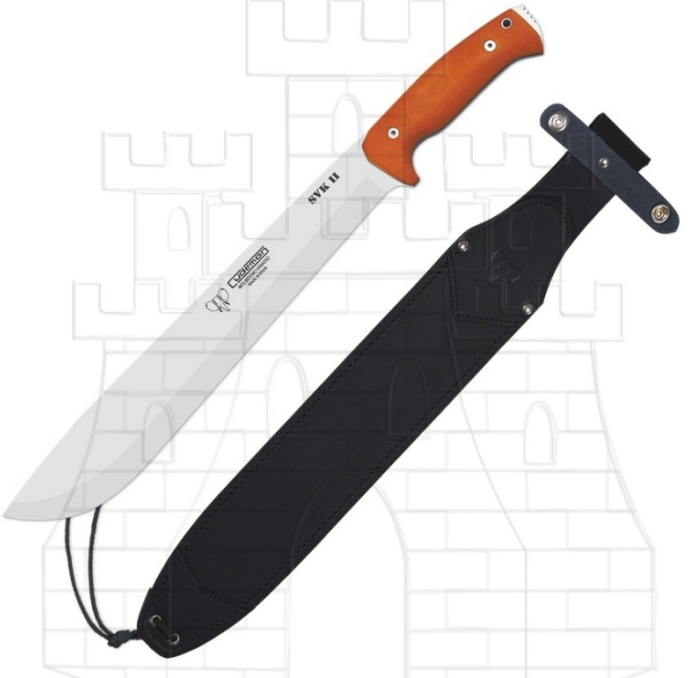
A machete is, in essence, a wide-bladed cutting tool, designed for tasks that require more power than a field knife, but with greater agility than an axe. Its length typically varies between 254 mm (10 inches) and 610 mm (24 inches), although shorter variants exist for specific jobs and some longer ones for intensive clearing. The blade can be straight or curved, with different thicknesses and profiles, adapting to the vegetation and intended use. A fundamental characteristic is that most quality machetes are full tang, meaning the blade extends along the entire handle, providing superior strength and durability to the assembly.
The blade is primarily made of carbon steel (grades 1050 to 1095), a preferred choice due to its ease of sharpening and its remarkable resistance to intensive impacts and flexing without fracturing. The high carbon content allows the edge to maintain its sharpness even after prolonged use. A softer temper than that of other large knives is common, which gives it greater toughness and ability to absorb blows without chipping. Pure stainless steel is avoided, unless a significant percentage of carbon is added to it, as it is too brittle for typical machete uses, where impact resistance is crucial. However, some high-quality stainless steel alloys, with proper heat treatment, can offer a good combination of corrosion resistance and toughness.
The handle can be made of a variety of materials, including wood, plastic (such as polypropylene), rubber, or composite materials like micarta or G-10. The choice of handle material influences grip, weight, and weather resistance. A good handle should be ergonomic, offer a secure grip even with wet or sweaty hands, and be resistant to abrasion and moisture. The sheath is a vital component for user safety and to protect the blade’s edge. It is commonly made of leather, rigid plastics, or synthetic polymers, and must allow quick and safe access to the machete, as well as comfortable transport.
Geographically, Colombia is the world’s leading exporter of machetes, reflecting its cultural roots and large-scale production. However, the United States, China, and Nepal are also major producers, each with their own specialties and designs that reflect local needs and traditions.
Machete vs. Axe: A Matter of Versatility and Purpose
Often, the machete is compared to the axe, but it is fundamental to understand that, while both are cutting tools, they are designed for slightly different purposes and offer distinct advantages. The axe, which relies on its concentrated weight in the head and the force of gravity, is excellent for cutting solid and firmly held objects, such as tree trunks or large branches. Its design allows for deep penetration and efficient splitting of wood with each blow.
On the other hand, the machete is significantly lighter and focuses on cutting speed and versatility. Its thinner blade and lighter weight allow the user to make quick, repetitive movements with less fatigue. While an axe is superior for felling trees or splitting firewood, the machete excels at tasks such as clearing dense vegetation, cutting sugarcane, opening paths in the jungle, pruning thin branches, or even preparing food in the field. Although it may take longer for specific tasks like cutting thick logs, the machete is much more versatile and can perform most axe functions acceptably, plus many others that an axe could not. For example, trying to clear a field with an axe would be inefficient and exhausting, while with a machete it is a routine task. Ergonomics also play a role: the machete allows for a wider and less restrictive range of motion, making it ideal for prolonged work in vegetated environments.
An Arsenal of Shapes and Functions: Types of Machetes Around the World
Local adaptation to the specific needs of each region has resulted in an astonishing variety of machete designs, each optimized for its environment and particular use.
The Panga or Tapanga: Africa’s Powerful Cutter
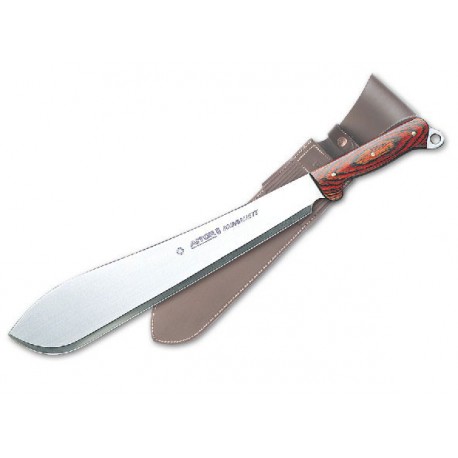
Popular in southern and eastern Africa, the Panga is distinguished by its wide, curved blade that widens towards the tip, giving it great cutting power and excellent inertia for cutting through dense, woody vegetation. Its robust design makes it ideal for heavy clearing and agricultural work in the savanna and jungle. Historically, it has been a protagonist in revolts and genocides in Africa, which underscores its dual nature as a vital tool and a devastating weapon. Its weight and balance are designed to maximize the force of the blow, making each cut effective.
The Bolo: The Philippine Heritage in the Field and Combat
Originating in the Philippines, the Bolo is a rural tool with a very particular design: the blade thickens before the tip, shifting the balance point forward. This feature gives it a “sweet spot” or “impact point” that maximizes cutting efficiency, especially for fibrous vegetation and bamboo. The Bolo is the work machete par excellence in the Philippines, used for agriculture, construction, and jungle survival. The ITAK, a longer and more pointed variant, was used in combat during the Philippine Revolution and the Philippine-American War, demonstrating its lethality on the battlefield. There is even a Filipino martial art, Arnis or Eskrima, which bases much of its training on the handling of the bolo and other bladed weapons, highlighting the sophistication of its use in combat. It is said that the effectiveness of the bolo in hand-to-hand combat against American troops directly influenced the development of the pistol and the .45 ACP caliber, seeking ammunition with greater stopping power.
The Parang and the Golok: Masters of the Southeast Asian Jungle
The Kukri or Khukuri: The Curved Edge of the Gurkhas
The Kukri is a curved knife-machete originating from Nepal, famous for being the standard issue weapon of the feared Gurkhas, Nepalese soldiers known for their ferocity and brutality in hand-to-hand combat. With a blade length of around 300 mm and a thick spine, its unique design with a pronounced forward curve gives it exceptional cutting power, concentrating energy at the point of impact. The Kukri is not just a weapon; it is a versatile survival tool in the Himalayas, used for cutting wood, skinning animals, preparing food, and an infinity of daily tasks. Its blade is conceptually divided into three sections: the tip for stabbing, the belly for chopping, and the section near the handle for carving or fine work. The legend of the Gurkhas and their Kukri has transcended borders, making it a symbol of bravery and martial skill.
Regional Machetes of Latin America: Adaptation to Each Terrain
Latin America has developed a rich diversity of machetes, each adapted to specific geographical and agricultural conditions. In Mexico, for example, we find models such as the ranchero machete, a generalist and versatile design; those with a straight tip, ideal for cutting palms and coconuts; the caballaño machete, with a wider and heavier blade; the acapulqueño, more pointed and lighter; and the imposing bellota machete, large in size, designed specifically for cutting sugarcane. The standard Mexican machete is highly valued for its lightness and versatility, being the ideal tool for clearing paths, cleaning land, and performing various field activities.
Brands like Collins, Gavilán, and Torito are highly valued for their quality, durability, and the balance of their blades, often outperforming more economical but widely available options like those from Truper, which, although functional, may not offer the same longevity or performance in intensive work. It is important to note that some “survival” machetes sold with saws on the spine, can openers, or excessively complex designs, may seem useful in theory, but often turn out to be impractical, fragile, and expensive. Their overloaded design compromises the machete’s main function: efficient cutting and durability. Similarly, very thick and heavy machetes, like those from some expensive brands, can be extremely resistant, but are also uncomfortable and exhausting for prolonged work, being more suitable for occasional felling tasks than for continuous clearing. Practicality, balance, and a good quality-price ratio are usually preferable for everyday tasks and general use.
In other regions of Latin America, we find variants such as the cane machete in the Caribbean and Brazil, designed with a specific curvature for cutting cane; the monte machete in the Amazon, more robust for the jungle; or the rula machete in Venezuela, with a straighter and wider blade. Each of these designs is a testament to human ingenuity in adapting a fundamental tool to the demands of its environment.
The Machete in the Real World: A Testament to History and Survival
Beyond its agricultural use and regional variations, the machete has played a prominent role in various conflicts, historical events, and survival scenarios, demonstrating its versatility and its capacity to be much more than a simple field tool.
- Peasant Uprisings and Guerrillas: The machete has become a symbol of resistance and struggle. Cuban peasants used it effectively in guerrilla attacks against the British army in the Battle of Havana in 1762, and later as a symbolic and practical weapon in the Cuban War of Independence against Spain. Its omnipresence in the countryside made it an accessible and effective weapon for popular militias.
- Repression and Terror: Unfortunately, the machete has also been an instrument of oppression. The Tonton Macoutes in Haiti, a paramilitary force under the Duvalier regime, used agricultural machetes to torture and mutilate victims, displaying their bodies in public to instill paralyzing terror in the population.
- Genocides and Atrocities: One of the darkest chapters in the history of the machete is its role as the main weapon in the Rwandan Genocide (1994), where it was used to massacre approximately 800,000 Tutsis and moderate Hutus, often through slow and brutal amputations. Similarly, it was used to amputate arms and hands during the Sierra Leone Civil War in the 1990s, as a tactic of terror to dehumanize and demoralize the civilian population.
- National Symbol: In a surprising contrast, the flag of Angola is the only one in the world that includes a machete, symbolizing agricultural peasants and the struggle for independence and agricultural production. This use in a national emblem highlights its fundamental importance in the life and history of many nations.
In the realm of survival, the machete is an indispensable tool for explorers, campers, and anyone venturing into dense natural environments. It allows for clearing paths, building improvised shelters, collecting firewood, processing food (such as opening coconuts or cutting meat), and even for personal defense against wild animals. Its robust design and ability to perform multiple tasks make it a reliable companion in situations where every ounce counts and versatility is key. The history of the machete, therefore, is a reflection of human history: a tool of subsistence that, in the wrong hands or in times of conflict, can transform into an instrument of horror.

Care and Maintenance: Preserving the Edge and Safety
For a machete to maintain its effectiveness and safety over time, proper care and maintenance are essential. A well-maintained machete not only performs better, but is also safer to use.
- Sharpening: Regular sharpening is crucial. For most machetes, especially those used for heavy clearing, an “axe-type” edge (more robust and less sharp than a kitchen knife) is ideal. Whetstones, files, or carbide sharpeners can be used. It is important to maintain a consistent angle during sharpening to ensure a uniform edge. For clearing work, an edge that can cut a sheet of paper is more than enough; a razor edge is not necessary.
- Cleaning: After each use, especially if wet or acidic vegetation has been cut, the blade should be thoroughly cleaned to prevent corrosion. A damp cloth to remove sap and dirt, followed by complete drying, is essential.
- Rust Protection: Carbon steel blades are prone to rust. Once clean and dry, it is recommended to apply a thin layer of mineral oil, camellia oil, or protective wax to the blade. This is especially important if the machete is to be stored for a prolonged period or in a humid environment.
- Handle Care: Wooden handles can benefit from occasional treatment with wood oil to prevent them from drying out and cracking. Plastic or rubber handles only require cleaning. Make sure the handle is always firmly attached to the tang and that there is no looseness.
- Storage: Store the machete in its sheath when not in use. The sheath protects the edge and prevents accidents. Store it in a dry place and out of reach of children or unauthorized persons.
- Safety: Always handle the machete with extreme caution. Wear protective gloves if possible. Make sure there are no obstacles or people near the cutting area. Never swing the machete without a clear target and complete control of the tool. A sharp and well-maintained machete is a safe tool; a neglected or poorly sharpened one is a danger.
Choosing the Right Machete: A Guide for Every User Profile
Selecting the perfect machete largely depends on the intended use and the user’s experience level. There is no “universal machete” that is ideal for all tasks, but there are excellent options for each profile.
For the Beginner or Occasional User: Versatility and Ease of Use
If you are new to using a machete or only need it for occasional tasks in the garden or on light excursions, look for a model that is versatile and easy to handle. A standard Mexican machete or a light bolo are excellent options. Their moderate weight and balance allow for easy control, reducing fatigue. Opt for blades between 14 and 18 inches (35-45 cm) in length, which offer a good balance between reach and maneuverability. Prioritize a comfortable, non-slip handle, and a basic but secure sheath. Brands like Collins or Gavilán offer good quality models at reasonable prices to get started.
For the Adventurer, Camper, or Hiker: Durability and Adaptability
For those who regularly venture into nature, whether for camping, hiking, or exploring, durability and adaptability are key. A parang or a golok are excellent options, designed for jungle survival and capable of handling a wide range of tasks, from clearing trails to building shelters and processing firewood. You can also consider more robust standard machetes, with blades 18 to 22 inches (45-55 cm) long and a good spine thickness. Look for high-quality carbon steel blades (1075 or 1095) and weather-resistant handles, such as micarta or rubber. The quality of the sheath is even more important here, as the machete will be actively transported.
For the Agricultural Professional or Expert: Efficiency and Specialization
Users who use the machete intensively and professionally, such as farmers or forestry workers, need tools that maximize efficiency and comfort during long working days. Here, specialization is key. For cane cutting, a bellota machete or a cane machete with its specific curvature will be unbeatable. For clearing dense undergrowth, a panga will offer the necessary power. Experts usually prefer longer blades (20-24 inches / 50-60 cm) and a weight that allows them to generate inertia with less effort. Handle ergonomics are critical to prevent blisters and fatigue. Investing in reputable brands and attention to detail in construction (such as a well-integrated full tang) will translate into superior performance and extended service life.
Key Considerations When Buying Any Machete:
- Blade Material: Carbon steel (1050, 1075, 1095) is the gold standard for its ease of sharpening and toughness. Make sure it has good heat treatment.
- Tang Construction: Always look for a full tang machete. This ensures maximum strength and durability. Avoid machetes with partial or “rat tail” tangs, which are prone to breaking.
- Handle Material: It should be comfortable, offer a secure grip even when wet, and be durable. Wood, rubber, polypropylene, or micarta are good options.
- Weight and Balance: A good machete should feel balanced in the hand. The ideal weight depends on the task: lighter for quick clearing, heavier for cutting thick wood.
- Sheath Quality: A robust and secure sheath is as important as the machete itself. It must protect the edge and allow for safe transport.
- Avoid “Gimmicks”: Be wary of machetes with saws on the spine, multiple integrated tools, or excessively futuristic designs. Often, these features compromise the machete’s main function and durability. Simplicity and effectiveness are the best qualities.
The Machete in Horror Cinema: The Birth of a Macabre Legend
But if there is one area where the machete has forged its darkest legend, it is, without a doubt, horror cinema. Its ability to inflict gruesome wounds, amputations, and the visceral nature of its impact make it a fearsome weapon, perfect for creating an atmosphere of nightmare and unease. For a horror film to achieve cult status, it needs a good villain and, crucially, their distinctive weapon, an extension of their own evil. And few villains are as iconic and recognizable as Jason Voorhees.
The machete is Jason Voorhees’s favorite and distinctive weapon in the Friday the 13th saga. From his first appearance with the iconic machete in Friday the 13th Part 2 (1981), and consolidating his image with the unmistakable hockey mask in Friday the 13th Part 3 (1982), Jason has taken the lives of some 170 people throughout his films, solidifying the machete as a weapon of cinematic transcendence. His image, with the machete raised, has become an archetype of the unstoppable killer, to the point that replicas of Jason’s machete are sold in collector’s shops and costume stores. This use by fictional serial killers has contributed to its “cursed legend,” indissolubly associating it with horror and violent death.
The choice of the machete as a horror weapon is not accidental. Its size and the way it is handled (cutting, slicing, chopping) evoke a primary brutality and a sense of helplessness. Unlike firearms, the machete requires intimate and prolonged contact between the aggressor and the victim, which intensifies the horror. The sound of the impact, the sight of the wounds it can cause, and the idea of being pursued by an implacable figure wielding this agricultural tool transformed into an instrument of death, are elements that resonate deeply in the collective subconscious.

Other examples of iconic horror weapons that have left their mark include Michael Myers’s kitchen knife in Halloween, Leatherface’s chainsaw in The Texas Chainsaw Massacre (which, although different, shares the visceral nature of the cut), Freddy Krueger’s glove blades in A Nightmare on Elm Street, Candyman’s hook, and Chucky the doll with his toy knife that becomes lethal. Each of these weapons has merged with the identity of its wielder, becoming synonymous with their evil and key elements in the construction of their myth.
When we see these scenes, it is important to remember that filmmakers use ingenious tricks and increasingly sophisticated special effects to achieve the effects without causing real harm to the actors. “Knives” and “machetes” are usually replicas made of rubber, plastic, or other soft and safe materials, designed to look real on screen. Wounds are simulated with meticulous prosthetic makeup, latex or silicone prosthetics, and digital visual effects that add blood and gore. This allows for the recreation of the brutality and visual impact of the machete without risks to the actors, allowing the audience to immerse themselves in the fantasy of horror without compromising safety on set.
Beyond the Cliché: Machetes and Feminism in Horror
Traditionally, horror cinema has relegated women to passive and often one-dimensional roles: objects of desire, easy victims, or the famous “scream queens” who can only scream and run (often from the aggressor’s “phallic machete” or similar weapon, a symbolism of male domination). However, in recent decades, a current of horror cinema has emerged that actively challenges this patriarchal narrative, giving female protagonists agency, complexity, and the power to respond, even when the machete remains a threat.
Seminal films like Rosemary’s Baby (1968), where the protagonist, Rosemary, despite her vulnerability, regains a kind of control over her body and destiny in the end; or The Company of Wolves (1984), a gothic reinterpretation of Little Red Riding Hood where the young protagonist empowers herself and protects herself with a large knife, are early examples of how the genre can reinvent the female figure. Later, films like The Craft (1996) explore female sorority and the collective power of a group of marginalized girls. Even more controversial works like Teeth (2007), although extreme, address themes of female empowerment and non-consensual sex in a very literal and confrontational way, where the protagonist, Dawn, uses her anatomy as a defense.
More recently, talented female directors have taken the reins of the genre, offering fresh perspectives. Jennifer Kent with The Babadook (2014) explores psychological horror through motherhood and grief, showing a complex and struggling female protagonist. Ana Lily Amirpour with A Girl Walks Home Alone at Night (2014) presents an Iranian vampire who, far from being a victim, is a predator who punishes men who abuse women, using her own form of “justice” in the dark. And films like Hush (2016) by Mike Flanagan deconstruct the “scream queen” figure with a deaf protagonist who, far from passively fleeing, uses her wit, planning, and resilience to attack and overcome her aggressor. In these types of films, although the machete (or a similar weapon) remains a menacing presence, what changes is who has control of the situation. The woman is no longer just the victim, but becomes the survivor, the fighter, or even the avenger, redefining the female role in horror and wielding, metaphorically or literally, her own edge.
A Double-Edged Blade: The Duality of the Machete
The machete is an object of astonishing duality: a simple and indispensable agricultural tool that has facilitated the lives and livelihoods of millions of people around the world, allowing for land clearing, crop harvesting, and survival in hostile environments. But it is also, undeniably, a weapon capable of inflicting devastating wounds, used in real conflicts and perpetuated in popular culture as a symbol of the most visceral terror, embodied by figures like Jason Voorhees.
From sugarcane plantations to movie screens, the machete has carved its own history, a narrative that oscillates between utility and brutality. Its unsettling presence in cinematic nightmares and its unparalleled versatility in the field demonstrate that, like many things in life, its impact depends entirely on the hands that wield it and the intention with which it is used.
If you are looking for a robust and reliable tool for your agricultural, gardening, or adventure needs, we invite you to explore the wide range of high-quality machetes available in our specialized store, CuchillosNavajas, where you will find the perfect edge for every task, always with safety and performance as a priority.
See the best Functional Machetes