
Hello to all cutlery enthusiasts and sharp-edged stories! Today we dive into the fascinating world of a piece that has captivated collectors and users alike: the stiletto knife. It is not just a tool, but a true symbol of tradition, elegance, and functionality, with deep roots in both Spain and Italy.
A Look at its History and Origin
Contents
The word “stiletto” has an origin as sharp as its point, coming from the Italian “stiletto” and this in turn from the Latin Stilus, which means “stake” or “pointed instrument”. But don’t be fooled by its name; this knife is much more than a simple sharp point.
Its lineage dates back to the Middle Ages, where the stiletto was a crucial weapon on the battlefield. Known as the “dagger of mercy” in the 12th century, its slender design allowed it to easily pierce metal meshes or the joints of fallen knights’ armor, serving for the so-called “coup de grâce”. Originally, its length was around 30 cm.
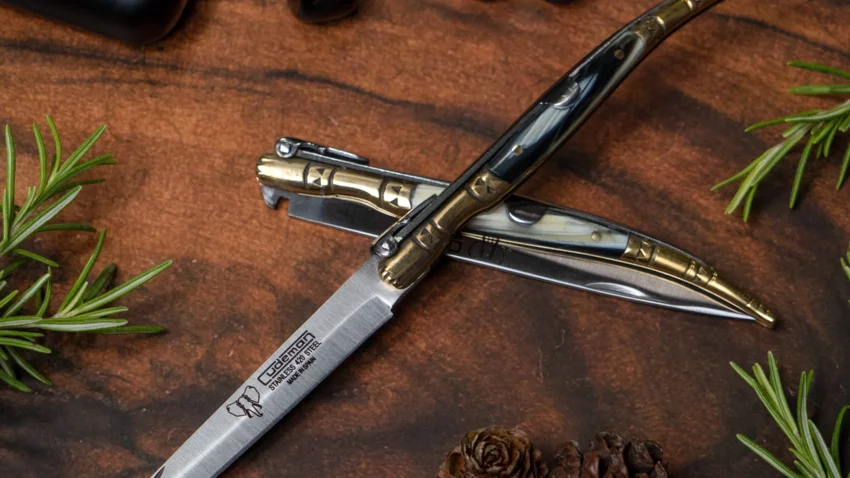
The stiletto knife has a longer and narrower blade and ends in a very sharp and rigid point. The stiletto, also known as “misericorde” (mercy), was widely used in the High Middle Ages as a secondary weapon by knights.
Its purpose was to finish off fallen or seriously wounded opponents who had heavy armor and were not expected to survive. The robust and pointed blade could easily penetrate most chain mail or find its way through a knight’s breastplates or armor joints.
A seriously wounded opponent, with little chance of survival, would then receive a merciful “coup de grâce”, hence the name misericorde. By the 16th century, its use had diversified, being employed in duels, as a means of defense, and even to intercept the enemy’s blade.
In the early 17th century, with the appearance of the Genoese knife in Italy, the stiletto began its transition from being a purely military tool to a general-purpose knife. In the late 18th and early 19th centuries, the popularization of folding knives in Italy saw several of them adopt the stiletto’s geometry, giving rise to models such as the “Piamontés”, the “Cuervo” from Ravenna, and the “Romano”, each with its own characteristics and lengths. The 20th century brought with it the mass production of automatic knives in Italy, with notable examples such as the “Prioletta” from Sardinia and the famous “Maniago”, popularized in mafia films.
In Spain, and preeminently in Albacete, the stiletto knife is an iconic symbol of artisan tradition. It is one of the twelve classic models of Albacete knives and its creation was a response to various functional, social, and cultural needs of the time. Albacete cutlery, with origins dating back to the Muslims, was historically a fundamental economic engine for the region, and its knives are recognized throughout Spain and Europe for their quality and beauty.
Features that Make it Unique: Design and Mechanism
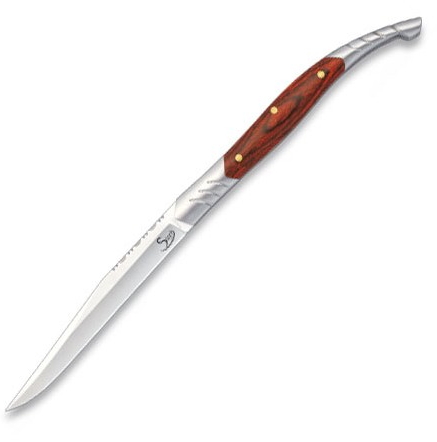
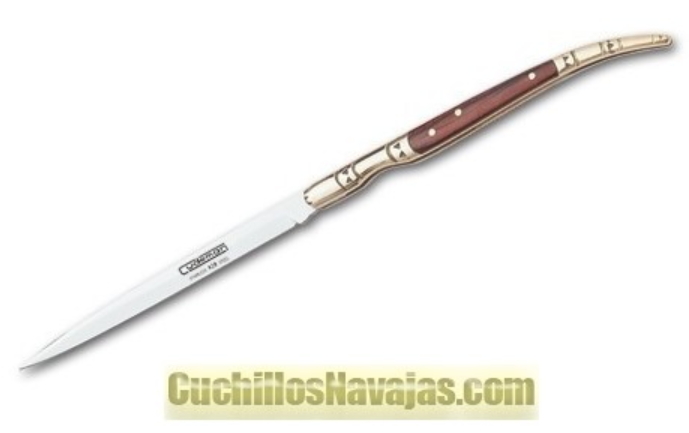
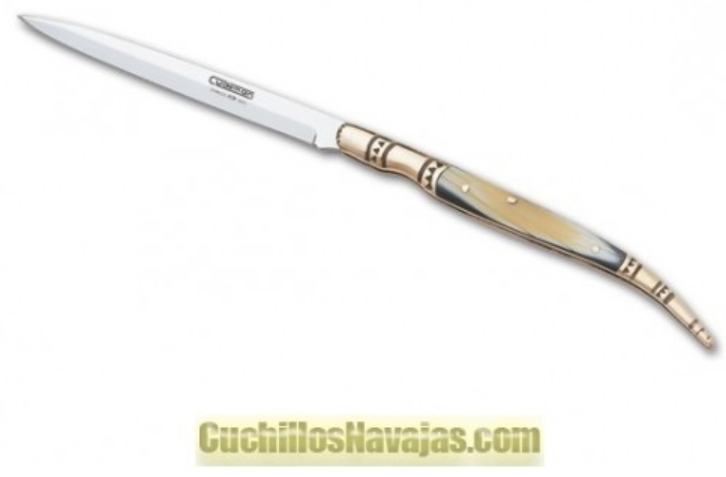
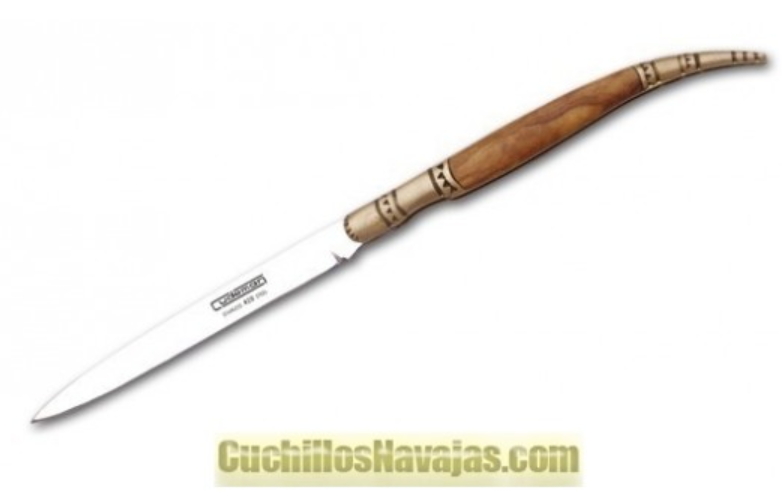
The stiletto knife is visually distinguished by its slender and stylized design, with a long, narrow blade that tapers to a point. In Albacete, it is described as very similar to the Punta de Espada knife, but much finer. Its handles are usually elegant and are made from a variety of noble materials such as wood, antler, horn, or metals, which gives each piece a singular beauty and a sense of exclusivity. The craftsmanship in the selection and working of these materials is a testament to the dedication of the master cutlers.
Regarding its mechanism, the Albacete stiletto knife often incorporates the distinctive spring or ratchet mechanism, which produces a characteristic sound when opened. This sound, far from being a mere detail, is an intrinsic part of its identity and a sign of authenticity for connoisseurs. In the Italian context, automatic stiletto knives open with push-button or lever systems, and include safety mechanisms to prevent accidental openings, reflecting an evolution towards functionality and safety in their modern use.
Sometimes the word stiletto is used to refer to spring-assisted knives and for being foldable with their particular handle style and cross-shaped guard. What is undeniable is that these stiletto knives have a beautiful “style” that makes them stand out in any collection or as a daily use tool.
Practical and Technical Differences Between Stiletto Knives
Although the term “stiletto knife” encompasses a family of knives with common characteristics, there are notable differences between the Spanish and Italian variants, and between historical and contemporary models. The Albacete stiletto knife, for example, is characterized by its ratchet mechanism and its more traditional design, focused on elegance and functionality for precision tasks. Its blade, although fine, is designed for more controlled and detailed use, which differentiates it from the more robust or military versions of yesteryear.
In contrast, Italian automatic stiletto knives, such as the famous Maniago, usually prioritize rapid opening and a more aggressive design, often associated with a specific cultural image. Their push-button or lever systems offer different functionality, and their use is more linked to personal defense or a fashion accessory, although their practicality for everyday tasks may be limited due to the rigidity of their blade and their design.
Blade length is another important technical difference. While historical stiletto knives could exceed 30 cm, modern versions, especially in Spain, are subject to regulations that limit their size, which directly influences their functionality and permitted use scenarios.
Beyond its Edge: Practical Uses and its Social Function
While its origins are in combat and dueling, the stiletto knife has evolved in its applications. The Albacete stiletto knife, with its fine and stylized point, has become an ideal companion on any office desk, perfect for precision tasks such as opening envelopes, cutting loose threads, or performing delicate manual work. Its design makes it ideal for fine and detailed cuts, which makes it a preferred tool even by artists or designers who value precision and aesthetics in their instruments.
Although the modern Italian stiletto has evolved into a peaceful accessory, its dagger or semi-dagger shape does not always make it the most versatile option for general-purpose tasks such as cutting wood or hard foods, limiting its universal popularity. Furthermore, it is a crucial factor to consider that in many countries, the carrying of automatic knives is prohibited, which restricts their portability and use in daily life. This legal limitation has led to its value being focused more on collecting and display than on practical utility.
Ideal Use Scenarios and User Profiles
The choice of a stiletto knife largely depends on the intended use and the user’s profile:
- For the collector and tradition lover: Albacete stiletto knives, with their ratchet mechanism and noble material handles, are pieces of high cultural and aesthetic value. They are ideal for display, for appreciating craftsmanship, and for understanding the history of Spanish cutlery. The collector will value the authenticity, artisanal origin, and beauty of every detail.
- For the office professional or artist: Given its fine point and ability for precise cuts, the stiletto knife is an excellent tool for opening correspondence, cutting paper, or performing detailed work in crafts and artistic projects. Its elegance makes it a distinctive accessory on any desk.
- For the history and culture enthusiast: Those interested in the evolution of weapons and tools will find the stiletto knife a fascinating object. Exploring its military origins and its transformation over the centuries offers a unique perspective on society and technology.
- For the occasional adventurer or general user: While its slender design is attractive, the stiletto knife, especially in its finer variants, is not the most robust option for camping, survival, or intensive use tasks. For these activities, knives with wider blades and more resistant locking mechanisms are recommended.
Comparison of Advantages and Disadvantages
To help make an informed decision, here is a comparison of the advantages and disadvantages of the stiletto knife:
Advantages:
- Aesthetics and Elegance: Its slender and stylized design, often with noble material handles, makes it a piece of great beauty.
- Precision in Cutting: The fine point and narrow blade are ideal for tasks requiring delicate and detailed cuts.
- Historical and Cultural Value: Especially pieces from Albacete and Italy, they possess a rich legacy that makes them collector’s items.
- Distinctive Mechanisms: The spring or ratchet of Albacete knives and the Italian automatic systems offer a unique opening experience.
- Status Symbol: In certain contexts, owning an authentic stiletto knife can be a sign of appreciation for craftsmanship and tradition.
Disadvantages:
- Limited Versatility: Its specialized design makes it less suitable for general-purpose tasks requiring force or a wider blade (e.g., cutting hard foods, field work).
- Legal Restrictions: In many places, automatic knives or those with blades of a certain length are prohibited or regulated, which limits their portability.
- Tip Fragility: The extremely fine tip, although ideal for precision, may be more susceptible to damage if used for inappropriate tasks.
- Price: Handcrafted and collectible stiletto knives can have a significantly higher cost than general-purpose knives.
Regulations and Design Adaptation
It is important to note that legislation has also shaped its design. In Spain, knives, including the stiletto, generally have a blade length that should not exceed 11 centimeters measured from the handle stop to the tip, although there are exceptions allowed by law for certain activities or collections. This regulation is a reflection of how the knife has adapted to remain functional without infringing regulations, as happened with the creation of the Punta Cortada Knife, motivated by the prohibition of sharp points in the 19th century. This adaptation demonstrates the ability of cutlery to evolve and remain relevant in a changing legal framework.
A Lasting Cultural Legacy
Beyond its functionality, the stiletto knife, especially the one from Albacete, is a collector’s item. It represents such a deep-rooted cultural legacy that it is said that “the Albacete knife is not given away, it is sold to a friend at a symbolic price, so that friendship is not cut short.” This piece is a reflection of the artisanal skill of the province of Albacete, whose heritage in cutlery has endured throughout the centuries, passed down from generation to generation and keeping alive a millenary tradition.
The history of Albacete cutlery, and therefore its stilettos, can be explored at the Albacete Cutlery Museum, located opposite the Cathedral. For those looking for an authentic stiletto knife, specialized stores and craft markets in Albacete offer the opportunity to acquire a quality piece directly from local artisans, thus ensuring authenticity and support for traditional production.
From medieval battlefields to the modern desk and the most prized collections, the stiletto knife has come a long way. It is a living proof of how craftsmanship, innovation, and culture intertwine to give life to objects that not only fulfill a function but also tell a story and are a symbol of identity and heritage. The stiletto knife, whether from Albacete or Italy, remains a testament to mastery and passion for good work, an object that transcends its utility to become a piece of art and a cultural legacy that endures over time.
If the elegance and history of these pieces have captivated you, we invite you to explore our selection of stiletto knives and discover the mastery behind each blade. For a broader view, be sure to visit our complete collection of all types of knives.