
In today’s world, the sustainability and durability of products are key priorities. We look for items that are not only efficient but also long-lasting. Within cutlery, one material has gained special prominence: titanium, both in its pure form and in coatings.
Today we are going to unravel the universe of titanium-coated knives and folding knives, a type of tool that promises to transform our experience in the kitchen and in our outdoor adventures. Although pure titanium knives are not as common, titanium coatings on steel blades are gaining ground. But what does this imply and what are its true advantages? Join us to find out!
What exactly are titanium-coated knives and folding knives?
Contents
- What exactly are titanium-coated knives and folding knives?
- Why coat a knife blade?
- The specific advantages of titanium coating
- The crucial difference: Pure titanium or coating?
- Care and maintenance of your titanium-coated knife
- Uses of titanium-coated knives and folding knives
- Who should consider buying titanium-coated knives and folding knives?
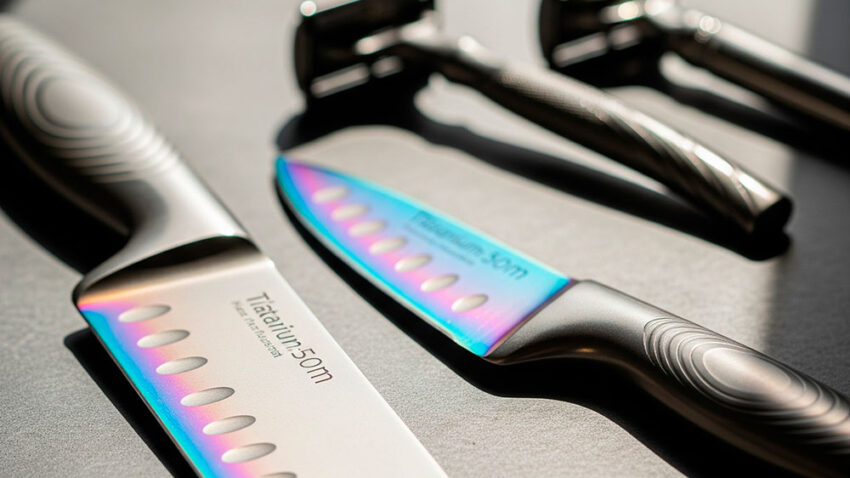
When we talk about a titanium-coated knife or folding knife, we are referring to a blade that is generally made of steel, but has been covered with a thin layer of titanium. This process, often through physical vapor deposition (PVD) or chemical vapor deposition (CVD), applies a hard ceramic powder, such as titanium nitride (TiN) or titanium carbonitride (TiCN), to improve the surface properties of the blade.
It is essential to differentiate this from a knife made 100% of pure titanium, a key distinction we will explore later. Knives and folding knives with this coating stand out for their extremely light weight, which facilitates a clean and precise cut. They are ultralight, flexible, and strong, and their edge is designed to last longer than that of a normal knife.
Why coat a knife blade?
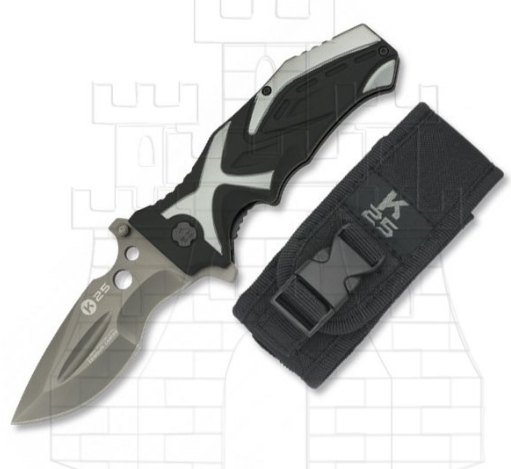
Coating a blade is not just an aesthetic matter, although a dark blade can be very attractive. Coatings serve multiple practical purposes, increasing the functionality and lifespan of the tool. Among the main reasons for applying a coating we find:
- Corrosion prevention: Rust is a constant problem for steel blades. Well-designed coatings can significantly reduce the need for maintenance.
- Greater scratch resistance: Coatings like PVD and CVD make blades more scratch-resistant, which maintains the appearance of the knife for longer.
- Reduced glare: In applications such as hunting or tactical use, light reflection on a shiny blade can be detrimental. Dark or coated surfaces are a preferred solution.
- Decreased cutting resistance: Many users report that a coated blade can minimize resistance during cutting, a practical advantage in various situations.
The specific advantages of titanium coating
Titanium coatings, especially titanium nitride (TiN), are very popular for the improvements they bring to blades. These are some of the benefits that make titanium-coated knives and folding knives stand out:
- High strength and durability: Titanium-coated blades offer remarkable resistance to corrosion and wear and are 100% stainless. It is claimed that the edge can last up to 10 times longer than that of a conventional knife.
- Antibacterial and hypoallergenic: Titanium is a less porous material than steel, which makes it more hygienic for contact with food and gives it antibacterial properties. Furthermore, it is not an allergenic material.
- Flexibility and impact resistance: Unlike ceramic knives, which can break if dropped, titanium-coated knives do not break easily.
- Easy maintenance: A great advantage is that they can be washed in the dishwasher, unlike many steel knives that require hand washing to avoid stains or damage.
The crucial difference: Pure titanium or coating?
It is vital to understand the difference between a knife made of pure titanium and one made of titanium-coated steel. Although both take advantage of titanium’s properties, their function differs. To identify them, you can bring a magnet close to the blade: if it sticks, it’s steel (coated); if not, it’s pure titanium, as this material is not magnetic.
The main difference lies in the edge. In titanium-coated steel knives, the exposed edge is still steel, meaning the cut is made with steel. However, the titanium layer does increase the overall resistance of the blade to corrosion and wear. On the other hand, a pure titanium knife will offer all the intrinsic properties of the material in its entirety, including an extremely durable edge.
Care and maintenance of your titanium-coated knife
Although the edge of titanium-coated knives has a considerable lifespan, if it needs sharpening, you should use a special diamond sharpener. For domestic users with normal use, sharpening will only be necessary after many years.
As for cleaning, these knives are very practical: they are dishwasher safe. This is a significant convenience compared to other materials. Unlike ceramic knives, they do not break if dropped on the floor.
Uses of titanium-coated knives and folding knives
Thanks to their properties, these knives are versatile tools:
- In the kitchen: They are ideal for cutting vegetables, fruits, meat, and fish, allowing for precise cuts and thin slices.
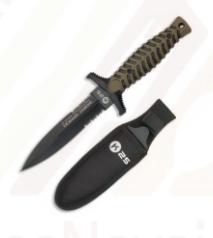
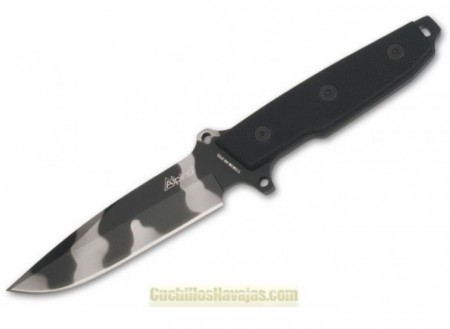
- For outdoor activities: Their high resistance to oxidation and corrosion makes them perfect for humid environments, making them the preferred choice for divers and fishermen. They are also excellent as combat or survival knives for hikers and adventurers.
Who should consider buying titanium-coated knives and folding knives?
Titanium-coated knives and folding knives are a fantastic option for those seeking durability, lightness, and high performance in their cutting tools. If you are an amateur cook who values precision and hygiene, or an adventurer who needs a tool resistant to the elements, these products are a smart choice.
The difference they make is not only noticeable in the cut but also in less maintenance, corrosion resistance, and long-term durability. In short, titanium, in any of its presentations, positions itself as an intelligent choice to enjoy superior quality tools for a long time.