A Journey to the Edge of History: Discover All the Secrets of Axes!
Contents
- A Journey to the Edge of History: Discover All the Secrets of Axes!
- 1. The Anatomy of an Axe: Get to Know Your Companion
- 2. The Fascinating Evolution of the Axe: From Stone to Steel
- 3. The Perfect Axe for Every Task! Types and Uses
- 4. Manufacturing Materials: The Essence of the Axe
- 5. Types of Edges: Cutting with Precision
- 6. The Art of Forging: From Anvil to Axe
- 7. Care and Safety: Keep Your Axe Impeccable and Safe
- 8. Which Axe to Choose According to Your Needs?
- 9. How to Distinguish a Quality Axe
Have you ever stopped to think about one of humanity’s oldest and most fascinating tools? Axes are not just a piece of metal with a handle; they are ancestral companions that have shaped our history, from prehistory to the most modern applications in survival and sport. Whether for splitting firewood, building a shelter in the wild, or even as a rescue tool, choosing the right axe is crucial.
In this article, we will guide you through the exciting world of axes: their anatomy, their evolution, the various types that exist, and how to choose the perfect one for each task. Get ready to sharpen your knowledge and immerse yourself in this universe of blade and tradition. Let’s begin!
1. The Anatomy of an Axe: Get to Know Your Companion
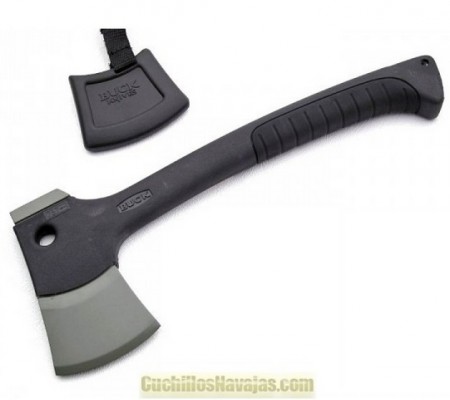
Although it may seem simple, an axe is composed of several key parts that determine its function and performance. Knowing them is not only interesting, but also much safer!
Head
This is the cutting part, generally V-shaped and made of steel. It consists of:
- Eye: The upper part of the head, where the handle is inserted and secured.
- Poll (or Butt): The back part of the head.
- Lug (or Collar): Extends the contact surface between the axe and the handle, ensuring a firm grip.
- Blade (or Edge): The cutting edge of the axe.
- Cheek: Each of the sides of the head.
- Heel (or Bit Heel): The lower part of the blade.
- Toe (or Bit Toe): The upper part of the blade. Some models have a double edge (double bit).
- Beard: The most concave part located at the bottom of the blade, near the handle, and can be shallow, intermediate, or deep.
Handle
The part where the axe is held.
- Knob (or Swell): The thickest end of the handle, which ensures a better grip and prevents the axe from slipping from the hand.
- Lanyard Hole: Often reinforced in the knob, although it is safer to use it only for hanging the axe. Tying a rope to the axe can be dangerous.
- Handle Body: The central part of the handle.
- Handle Throat: The part just above the knob.
2. The Fascinating Evolution of the Axe: From Stone to Steel
The axe is a tool that has accompanied humanity throughout almost its entire history. From its beginnings, it has been indispensable for hunting, obtaining food, building, and, of course, as a weapon.
Stone Age
The first known axe was used by Homo ergaster between 1.9 and 1.4 million years ago. These were hand axes, simple sharpened stones without a handle. Our ancestors, Homo sapiens, made the most important modification: they discovered that by attaching the head to a handle, the impact force increased significantly, making it more powerful and versatile. Its origin must be placed in prehistory, from the Neolithic period, when they were used as weapons for hunting and warfare.
Metal Age
With the advent of metallurgy, axes became stronger and lighter, could take practically any form, and be mass-produced. Forged metal axes already included the hole for the handle. They became primary close-combat weapons for various European peoples, such as the Celts.
Middle Ages
Battle axes gained great prominence in European conflicts. The Vikings, for example, developed long-handled axes with sharp blades to attack from a distance. Although formidable in attack, they had defensive limitations compared to swords. Later, the Vikings, Normans, Native Americans, English, French, etc., also used it as a weapon of war.
Present Day
With firearms, the military importance of axes diminished. From the 19th century onwards, they were used almost exclusively as tools by loggers and farmers. Today, they are essential for firefighters and rescuers, and part of the equipment for adventurers in camping, trekking, and mountaineering. Furthermore, they have become tools for leisure and sport, such as axe throwing.
3. The Perfect Axe for Every Task! Types and Uses
The key to choosing the right axe is knowing what you want to do with it: cut, split, throw, carve, or even clear a path. The size, weight, shape, and material of the head and handle are the distinguishing characteristics. Currently, the axe is still used for cutting firewood, felling trees, but it is also widely used for adventure sports and outdoor activities like big game hunting.
3.1. Felling Axes
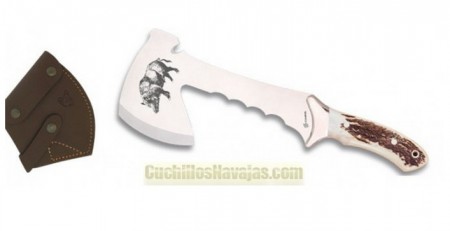
Specifically designed for felling trees and removing their roots. They require the use of both hands to take advantage of their balance and cutting power.
- Features: Sharp, thin blade for precise wood penetration. Long handle (50-65 cm or 60-80 cm), providing leverage and control. Ideal weight between 1 and 2.5 kg. The edge usually has an angle of 20-25 degrees. Some models have a surface for driving wedges.
- Materials: High-quality carbon steel or forged steel blades are preferred for power and precision. Handles are typically made of American hickory (very strong and flexible, absorbs impacts) or ash (firm, elastic, dampens impacts).
- Examples: Hultafors Åby, Fiskars X24, Gränsfors Bruk American Felling Axe.
3.2. Splitting Axes / Mauls
Expressly created for cutting wood along the grain or splitting logs, ideal for producing firewood.
- Features: Solid, wedge-shaped head. The first part of the head is thin to facilitate entry into the wood, then it thickens to split it. The edge is straight, robust, and beveled on both sides, but does not need to be extremely sharp (25-30 degree angle). They are used with two hands due to their weight.
- Weight and Length: They usually weigh between 1.25 and 3.5 kg, and the handle length varies from 40 to 90 cm.
- Splitting Maul: A particularly heavy version of the splitting axe, which may include a flat back part similar to a hammer for striking metal wedges without damaging the axe.
- Materials: Long handles made of American hickory or ash wood for their impact absorption capacity, or also fiberglass.
- Examples: Hultafors KLY, Fiskars X28, Gränsfors Bruk Large Splitting Axe.
3.3. Hand Axes / Hatchets
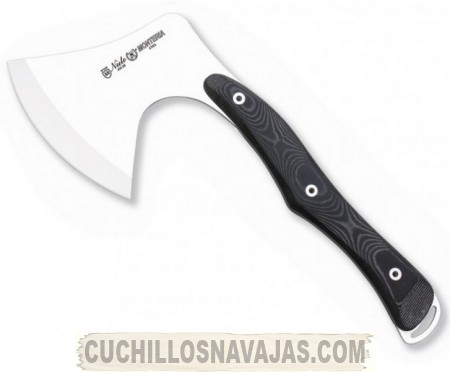
Compact, lightweight, and versatile instruments handled with one hand. They are ideal for small tasks like making kindling (splinters), cutting small branches, or for camping and hiking activities.
- Features: Portable and functional. Very sharp blade for removing a lot of material and for precise cutting tasks. Designed to be multi-purpose.
- Weight and Length: They usually weigh between 600 grams and 1.5 kg, and measure between 45 and 65 cm.
- Applications: Essential for campers, bushcraft enthusiasts, and survivalists. They serve for cutting firewood for campfires, cutting feather sticks for fire starting, or even building shelters.
- Advantages: They are a safer, quieter, easier to transport, and lower-maintenance alternative to a chainsaw for cutting small logs.
- Examples: Hultafors H 006 SV, Fiskars X13, Gränsfors Bruk Wildlife Hatchet, Njord Malin.
3.4. Carpentry Axes / Carving Axes
Smaller than felling axes and designed for carving and shaping wood.
- Features: Narrow, curved blade for extreme control and precision. A good grip is fundamental for precision. Steel quality is important for maintaining the edge and preventing rust. Some carpentry axes have a single bevel (sharpened on one side only) for cleaner cuts.
- Adze: A tool similar but not identical to an axe, used for smoothing and shaping wood, or excavating in the earth.
3.5. Double-Bit Axes
Distinctive for having two symmetrical edges, one for specific tasks and the other for general use.
- Features: One of the edges is usually sharper for felling, and the other, wedge-shaped, for splitting or striking difficult knots. Having two heads, they are heavier and may require more force to use, especially if the handle is short.
- Applications: Frequently used for felling trees, cutting, and splitting wood. Their symmetry also makes them popular in medieval fantasy and sports.
- Considerations: It is important to be clear about the purpose of each edge before using it. The head material and its design are crucial for durability.
- History: The “labrys,” a double-edged axe, was a symbol of authority in the Minoan civilization.
3.6. Throwing Axes / Tomahawks
Originally used by Native Americans and European colonialists for close-quarters combat and self-defense. Today, they are very popular in axe throwing competitions.
- Features: Lightweight and compact, designed for throwing accuracy. They often have a straight handle without a knob.
- Weight and Length: They usually weigh around 1 kg and measure between 30 and 40 cm.
- History: Some had one side sharper for work and the other duller for knots. The handle’s knob was sometimes reinforced with a lanyard hole, although tying a rope to the axe is discouraged for safety.
3.7. Tactical Axes
Modern and multifunctional design, these are very useful tools for special forces like SWAT, security forces, emergency services, and survival enthusiasts.
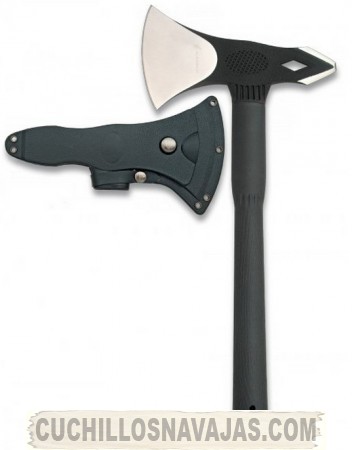
- Features: Lightweight, compact, and robust, made with highly resistant materials. They offer versatility with additional features such as indentations that serve as a wrench, ruler, or hammer. Their design is adaptable to specific tasks and urban environments.
- Functions: Ideal for cutting firewood, clearing paths, self-defense, and survival tasks. They also have tactical and military use, as security forces such as firefighters, forest rangers, and infantry have them as an excellent auxiliary work tool.
3.8. Firefighter Axes
Essential tools for firefighters and rescuers, designed to break down doors and obstacles in emergency situations.
- Features: A heavy head with a thin edge for breaching doors, and on the opposite side, a pick for clearing debris. They are often brightly colored to be easily visible. Handles are often made of Nuplaglas® fiberglass, which is very temperature resistant, lasts “forever,” and has an intertwined plastic core that makes them lightweight while maintaining steel strength.
- Crash Axe: Specific axes used on airplanes to breach doors in emergency situations.
3.9. Brush Axes
Specialized tools for clearing dense vegetation and undergrowth.
- Features: They usually have long handles and blades that can be straight or curved, with a sharp edge.
3.10. Hybrid Axes
Some manufacturers like Krumpholz offer hybrid axes that combine features of felling and splitting axes.
- Features: They have the shape of a Viking axe, with a sharper cutting angle that allows for very high sharpness, and the head thickens considerably at the back for a good splitting effect. They are ideal for both splitting firewood and felling and limbing.
4. Manufacturing Materials: The Essence of the Axe
The quality of an axe depends largely on the materials used in both its head and its handle.
4.1. Head (Blade)
- Carbon Steel: Excellent edge retention and easy to sharpen. Common in heavy-duty axes.
- Forged Steel: A type of carbon steel processed for greater strength.
- Stainless Steel: Corrosion-resistant and less brittle.
- Tool Steel (5160 or 1095): Hard and tough.
- Damascus Steel: Aesthetically unique, with welded layers, highly sought after by collectors.
4.2. Handle
Wood:
- American Hickory: The most used and preferred for axe handles due to its incredible strength, flexibility, elasticity, and ability to absorb impacts. Hickory handles rarely break completely, offering a safety advantage over ash handles.
- Ash: Firm and elastic, also absorbs impacts. More economical than American hickory.
- Beech: Another traditional wood that offers good grip and absorbs vibrations.
Other Materials:
- Plastic/Fiberglass: These are a great option nowadays, requiring less maintenance and being more forgiving of mistakes. They offer high resistance, ideal for rough use.
- Modern Composites: Lightweight, durable, and with an ergonomic feel.
5. Types of Edges: Cutting with Precision
The shape of the axe’s edge directly influences its performance and use:
- Convex Edge: Ideal for splitting wood, resists impacts well.
- Flat Grind: Precise, widely used in carpentry.
- Hollow Grind: Extremely sharp, but less resistant to impacts.
- Double Bevel: Symmetrical, for straight cuts.
- Single Bevel: Single-sided edge, offers greater control for roughing.
6. The Art of Forging: From Anvil to Axe
The manufacturing of axes, especially high-quality ones, is a traditional process that requires mastery.
Traditional Process
To forge a 2.5 kg axe, a piece of iron is started, which is thinned in the center to form the “begia” (the eye of the axe). Then, another piece of iron, the “betegarri,” is introduced and joined by welding at 1300 °C, striking quickly and strongly. For a good weld, river sand is used as a protective layer to keep the surfaces clean. Subsequently, a piece of steel (“galtzairu”) is welded to form the edge. The material is stretched and thinned to obtain the sharp shape. Finally, the eye is shaped with a piece of iron (“maneala”) and the axe is hardened by repeatedly tempering it in warm water.
Finishing
After forging, irregularities are removed in a sharpening workshop, using a rotating, wet sandstone. The sharpening of the edge is done by pressing the axe against the stone. Finally, the surfaces near the cut are polished.
Production Time
Forging an average axe could require approximately an hour and a half of work from two men, and grinding and sharpening, half an hour from a single man.
7. Care and Safety: Keep Your Axe Impeccable and Safe
A well-maintained axe is a safe and efficient axe.
- Cleaning: Remove resin, dirt, and moisture after each use.
- Regular Sharpening: Essential for optimal performance, especially for felling axes. This can be done with sharpening stones or files.
- Storage: Store your axe in a dry, cool place, ideally with a blade protector to prevent rust. Apply oil (such as linseed oil for the handle and mineral oil for the blade) to protect it.
- Loose Handle: Check the wedges and re-glue if necessary.
- Personal Safety: Always wear safety gear (cut-resistant trousers, helmet, safety footwear, goggles) to protect yourself from serious injuries. Ensure you have a stable stance when working. Never work with a wet handle or in the rain.
8. Which Axe to Choose According to Your Needs?
Choosing the perfect axe comes down to its primary purpose. Here’s a quick guide:
- Felling large diameter trees: Felling axe or double-bit axe.
- Splitting firewood or large logs: Splitting axe or splitting maul.
- Camping, bushcraft, or small splitting tasks: Hand axe (hatchet).
- Carving or shaping wood: Carpentry axe or carving axe.
- Throwing sport: Throwing axe (tomahawk).
- Survival or use by special forces: Tactical axe.
- Rescue and emergency: Firefighter axe.
- Clearing dense vegetation: Brush axe.
- Various felling and splitting tasks: Hybrid axe.
For a precise choice, consider the appropriate size and weight for you, as a heavier axe offers more power, but is harder to control.
9. How to Distinguish a Quality Axe
When investing in an axe, look for the following characteristics to ensure you acquire a durable and effective tool:
- Balance: Perfect between the blade and the handle.
- Forging: No bubbles or defects.
- Handle: Knot-free and well-fitted to the head.
- Edge: Should cut paper effortlessly.
- Marks: On handcrafted axes, look for the blacksmith’s or artisan’s marks.
Brands like Gränsfors Bruk (Sweden), Hultafors (Sweden), Council Tool (USA), and Estwing (USA) are recognized for their quality and traditional forging.
Axes are much more than simple tools; they are an extension of the human hand, witnesses to our history and, today, cult objects and inseparable companions in countless adventures. Their evolution over millions of years and their adaptation to the changing needs of humanity demonstrate their versatility and continued relevance.
We hope this comprehensive guide has provided you with a clear overview of the different types of axes and helps you choose the perfect companion for your own needs, whether for fieldwork, sports, survival, or simply to admire their craftsmanship and beauty.