
Did you know that a premium professional machete can make the difference between an efficient workday and an exhausting battle against vegetation? In expert hands, this ancient tool becomes an extension of the arm, capable of opening paths through the densest jungle or harvesting crops with the precision of a surgeon. Premium professional machetes are not just more expensive tools: they represent centuries of evolution in design, superior materials, and engineering that prioritizes ergonomics, durability, and performance under the most demanding conditions.
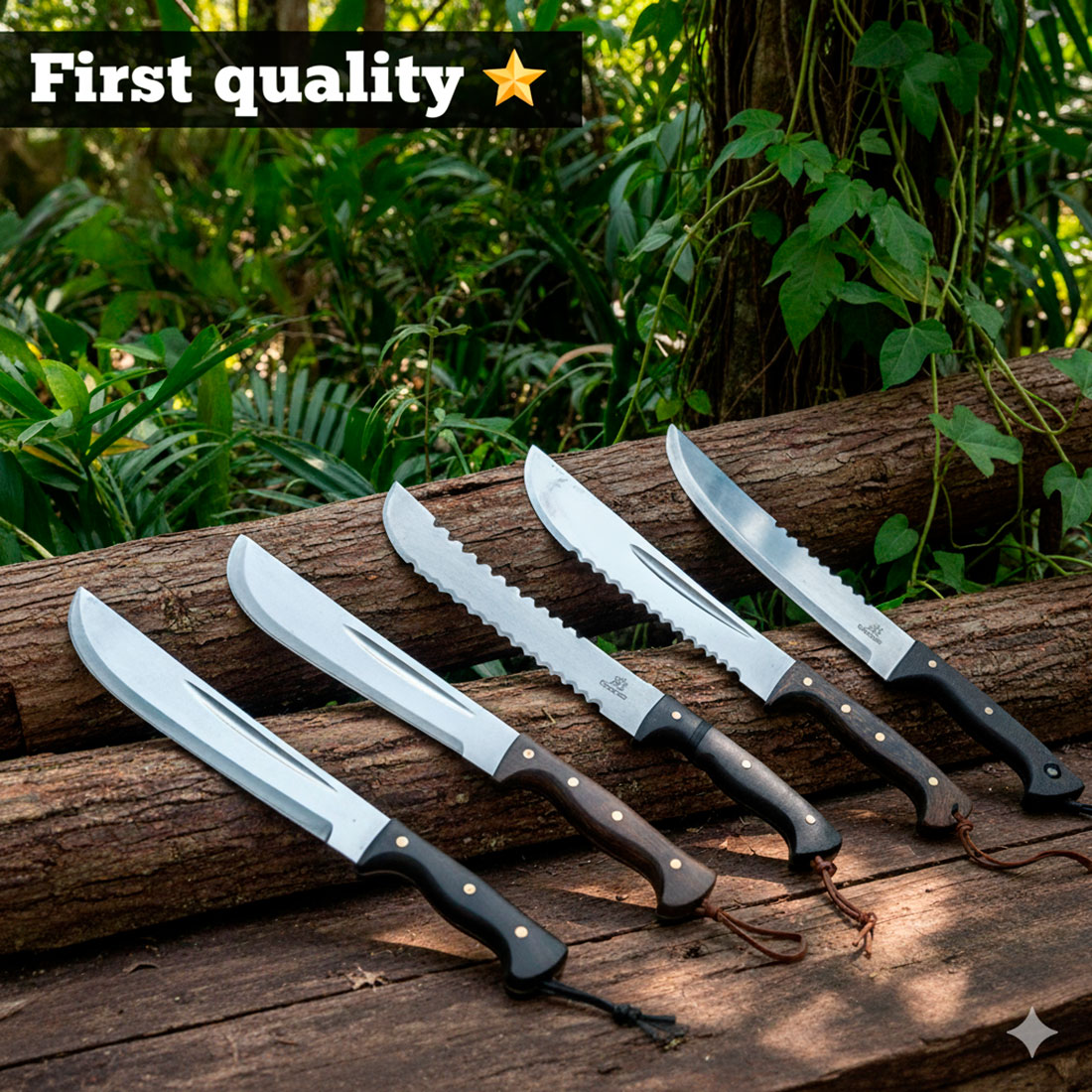
The Legacy Forged in Steel: History and Evolution of the Machete
Contents
- The Legacy Forged in Steel: History and Evolution of the Machete
- Types of Professional Machetes: Each Shape Has Its Purpose
- Features Defining Premium Quality
- Premium Professional Machetes
- Spanish Brands of International Reference
- Selecting the Ideal Professional Machete
- Professional Maintenance: Preserving Excellence
- Differences Between Steels: Carbon vs. Stainless
- Optimizing Performance According to Task
- Ergonomics for Extended Use
- Clarifying Doubts About Professional Machetes
The history of the machete dates back to the pre-colonial era, when ancient civilizations developed similar tools for agriculture and defense. During European colonization, its use expanded globally, adapting to the specific needs of each region: from the dense African forests to the sugar cane plantations in Latin America.
In Latin America, the machete transcended its agricultural function to become a symbol of resistance and autonomy during the independence struggles. In Africa, heavier and longer versions emerged to face jungle vegetation, while in Southeast Asia, lighter and more manageable designs were preferred for crop harvesting.
This constant evolution has led to modern, premium professional machetes, where centuries of practical experience combine with advanced materials such as special steels and scientifically proven ergonomic designs.
Types of Professional Machetes: Each Shape Has Its Purpose
The diversity of professional machetes reflects the specialization developed in different regions of the world, each optimized for specific working conditions.
Latin American Machetes: Masters of Clearing
Latin American machetes are characterized by their wide and curved blade, specifically designed for cutting sugar cane and clearing dense terrain. In countries like Costa Rica, they are fundamental for opening trails in tropical forests and harvesting crops like pineapple. Their curved design allows for natural movements that reduce fatigue during long workdays.
Asian Bolo and Parang: Precision in the Jungle
In terms of survival tools, the Philippine bolo and Indonesian parang represent Asian engineering at its finest. The bolo, with its heavier and pointed blade, excels in both agriculture and construction, while parangs with long, curved blades are ideal for cutting bamboo and jungle vegetation with surgical precision.
African Panga: Concentrated Force
The African panga is distinguished by its curved blade that widens towards the tip, concentrating the force of the blow to cut through thick undergrowth. Regional variations range from long and heavy models for tropical forests to shorter and lighter versions for arid zones.
| Machete Type | Origin | Typical Length | Specialization |
|---|---|---|---|
| Latin American Machete | Central/South America | 45-60 cm | Clearing and intensive agriculture |
| Filipino Bolo | Philippines | 35-45 cm | Construction and agriculture |
| Malayan Parang | Indonesia/Malaysia | 40-50 cm | Bushcraft and survival |
| African Panga | Central Africa | 40-55 cm | Dense tropical vegetation |
- Latin American Machete
-
- Origin: Central/South America
- Typical Length: 45-60 cm
- Specialization: Clearing and intensive agriculture
- Filipino Bolo
-
- Origin: Philippines
- Typical Length: 35-45 cm
- Specialization: Construction and agriculture
- Malayan Parang
-
- Origin: Indonesia/Malaysia
- Typical Length: 40-50 cm
- Specialization: Bushcraft and survival
- African Panga
-
- Origin: Central Africa
- Typical Length: 40-55 cm
- Specialization: Dense tropical vegetation
Features Defining Premium Quality
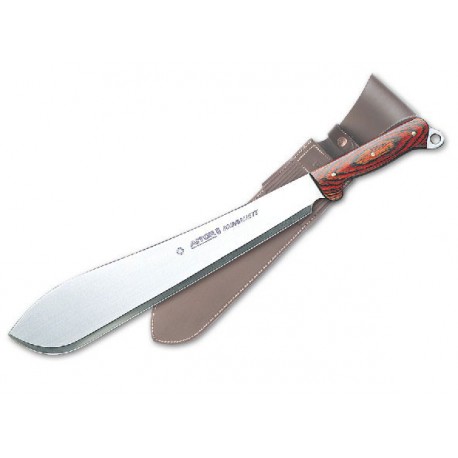 A premium professional machete is distinguished by specific criteria that guarantee its performance in extreme conditions. Superior quality is evaluated using the acronym FAR-MED: Functionality, Ergonomics, Durability, and Balance.
Blade Materials: The Heart of Performance
The blade material determines the durability, edge retention, and resistance of the professional machete.
Carbon Steel: Types such as 1055, 1095, SK-5, and C-75 offer exceptional hardness and maintain their edge for extended periods. It is the preferred choice for heavy tasks, though it requires constant maintenance against corrosion. Its superior sharpening capability makes it the standard for intensive professional use.
Stainless Steel: Varieties such as 420HC, 440C, AUS-8, and N690Co provide superior corrosion resistance, making them ideal for humid tropical environments. While they may require more frequent sharpening, their ease of maintenance makes them favored in applications where humidity is constant.
Special Alloys: High-end machetes like the Extrema Ratio Mato Grosso use Böhler N690 steel with 58 HRC hardness, combining corrosion resistance with exceptional edge retention.
Blade Design: Form Follows Function
The blade thickness in professional machetes ranges from 3.5 to 4 mm, providing the necessary robustness for tough jobs without compromising maneuverability. Finishes include MIL-C-13924 military coatings for maximum corrosion protection.
Curved vs. Straight: Curved blades excel at cutting tall grass and fibrous material like sugar cane, while straight blades offer greater versatility for wood carving and precision cuts. The choice depends on the predominant use, although many professionals keep both types.
Ergonomic Handles: Where Control Is Found
Premium quality handles use materials such as micarta, rubberized grips, or G10 compounds that provide a secure grip even in wet conditions. The ergonomic design includes finger grooves and anti-slip textures that prevent fatigue during prolonged use.
Full tang construction, where the blade extends through the entire handle, ensures maximum durability for intensive professional use. Handguards prevent accidental slipping towards the edge, significantly increasing operational safety.
Premium Professional Machetes
Premium professional machetes combine artisanal tradition with technological innovation to create tools that exceed the most demanding expectations.
Spanish Brands of International Reference
In Spain, brands like Muela, Joker, Cudeman, Albainox, K25, and Aitor have established internationally recognized quality standards. These brands stand out for their balance between artisanal tradition and modern technology, offering machetes that combine exceptional durability with competitive prices.
Condor Tool & Knife represents excellence in bushcraft and survival machetes, with models like the Viking Machete designed for extreme work using 1075 carbon steel. Their Jungolo, Golok, and Heavy Duty Kukri series are benchmarks in the professional market.
Selecting the Ideal Professional Machete
The choice of a premium professional machete requires a meticulous analysis of several critical factors that determine its effectiveness in specific applications.
Application and Environment Analysis
Will you primarily be clearing dense vegetation or do you need precision for specialized pruning? The type of vegetation, foliage density, and climatic conditions determine whether you need a curved blade for maximum cutting efficiency or a straight one for general versatility.
Length directly influences performance: long machetes (45-60 cm) maximize reach and cutting power for large areas, while short ones (20-40 cm) offer superior control for detailed work and confined spaces.
Professional Ergonomic Considerations
A professional machete must adapt to your anatomy and work style. The weight should be balanced with your strength and endurance: a machete that is too heavy causes premature fatigue, while a very light one may require more strokes to achieve the same result.
The balance between blade and handle affects maneuverability and energy efficiency. A forward balance provides more cutting force, while a neutral balance offers better control and less fatigue.
| Selection Factor | Long Machete (45-60cm) | Short Machete (20-40cm) |
|---|---|---|
| Work Area | Large extensions, agriculture | Confined spaces, bushcraft |
| Vegetation Type | Dense undergrowth, small trees | Thin branches, detailed work |
| Experience Level | Intermediate to advanced | Beginner to intermediate |
| User Fatigue | Greater with prolonged use | Less, better for long sessions |
- Long Machete (45-60cm)
-
- Work Area: Large extensions, agriculture
- Vegetation Type: Dense undergrowth, small trees
- Experience Level: Intermediate to advanced
- User Fatigue: Greater with prolonged use
- Short Machete (20-40cm)
-
- Work Area: Confined spaces, bushcraft
- Vegetation Type: Thin branches, detailed work
- Experience Level: Beginner to intermediate
- User Fatigue: Less, better for long sessions
Professional Maintenance: Preserving Excellence
 Rigorous maintenance distinguishes professionals who understand that a premium machete is an investment that must be meticulously protected.
Post-Use Cleaning Protocol
Immediately after use, remove all plant debris with a soft-bristled brush. Wash the blade with warm water and neutral soap, paying special attention to areas where sap or resins accumulate. Drying should be complete and immediate: every drop of residual moisture is an opportunity for corrosion.
Apply a thin layer of protective oil over the entire metal surface. Specialized mineral oils or camellia oils provide durable protection without attracting dirt.
Professional Precision Sharpening
Professional sharpening maintains a constant angle of 25 to 30 degrees, using progressive grit stones or specific files for machetes. The correct technique involves long, uniform strokes along the entire blade, maintaining consistent pressure.
A well-sharpened professional machete requires less force, reducing fatigue and increasing operational safety. Sharpening should be done after each intensive work session or monthly with regular use.
Professional Quality Storage
Storage in a controlled environment preserves the integrity of premium materials. Use treated leather or ballistic nylon sheaths that allow ventilation while protecting the blade. Avoid completely sealed sheaths that can trap moisture.
The storage space should maintain low relative humidity and stable temperature, away from extreme variations that can affect the steel’s temper.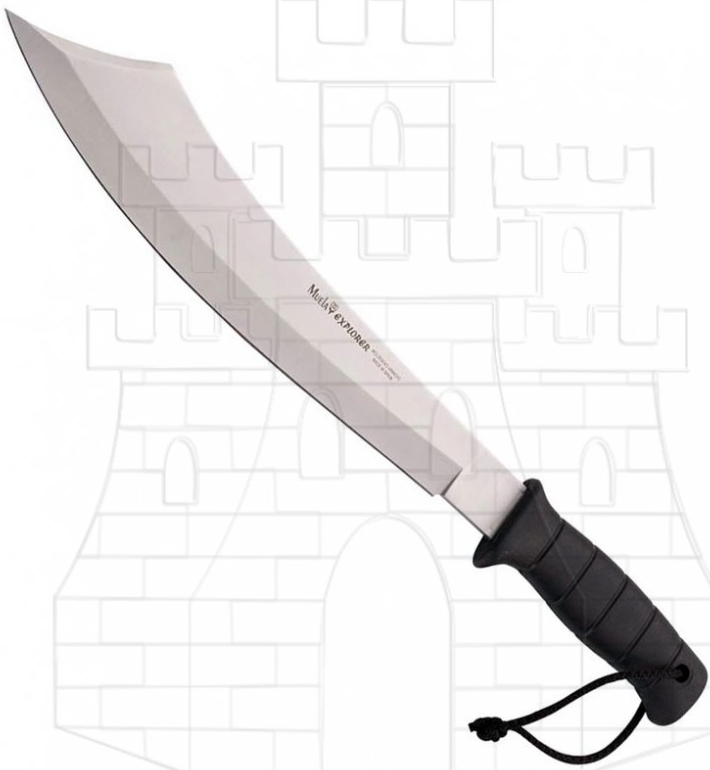
Differences Between Steels: Carbon vs. Stainless
The choice between carbon steel and stainless steel defines the character of your professional machete’s use. Stainless steel, with its chromium content exceeding 13%, offers superior corrosion resistance, making it ideal for humid conditions or corrosive environments. However, it is generally heavier, and its edge, though durable, does not achieve the fineness of carbon steel.
Carbon steel, on the other hand, provides superior hardness and a finer edge, making it easier to sharpen to an exceptionally keen cut. Its main challenge is susceptibility to oxidation, requiring constant preventative maintenance to avoid corrosion.
This fundamental difference affects not only immediate performance but also long-term durability and maintenance requirements, crucial factors in professional selection.
Optimizing Performance According to Task
The size of the machete directly impacts its operational performance. Long machetes (45-60 cm) allow for deeper cuts and cover a larger area per stroke, making them ideal for clearing or agricultural tasks in dense vegetation. However, they are heavier and more difficult to handle in confined spaces.
Short machetes (20-40 cm) offer superior control and exceptional maneuverability, preferred for activities requiring precision such as bushcraft or survival. They are easier to use for beginners and in confined environments, although they require more strokes for large-scale tasks.
Weight and balance critically influence operational fatigue: a well-balanced machete facilitates effective cuts without excessive effort, while an imbalance towards the blade or handle compromises both efficiency and safety.
Ergonomics for Extended Use
For prolonged use, the ideal handle combines moisture-resistant materials like rubberized plastic or G10 compounds, with an ergonomic design that includes grooves and a matte finish to improve grip even with sweaty hands. Seamless construction prevents bacteria accumulation and reduces pressure points that cause blisters.
The handle’s length should be proportional to the user’s height to prevent unnecessary back strain and facilitate natural cutting angles. Handles with a soft grip and anatomical contours significantly reduce fatigue during extensive work sessions.
Comfort is maximized when the handle is compatible with work gloves and certified for use in extreme conditions, maintaining a secure grip under rain, sweat, or plant debris.
| Oil Type | Main Characteristics | Recommended Use |
|---|---|---|
| Mineral Oil | High penetration, does not degrade or attract dirt | Regular protection and maintenance |
| Camellia Oil | Natural, acid-free, non-volatile | Antioxidant protection, lubrication |
| Lithium Grease | Dense, durable, does not evaporate | Prolonged storage, protection |
- Mineral Oil
-
- Main Characteristics: High penetration, does not degrade or attract dirt
- Recommended Use: Regular protection and maintenance
- Camellia Oil
-
- Main Characteristics: Natural, acid-free, non-volatile
- Recommended Use: Antioxidant protection, lubrication
- Lithium Grease
-
- Main Characteristics: Dense, durable, does not evaporate
- Recommended Use: Prolonged storage, protection
Clarifying Doubts About Professional Machetes
What is the main difference between a carbon steel machete and a stainless steel machete?
The main difference between a carbon steel machete and a stainless steel machete is that stainless steel has greater resistance to corrosion and rust due to its chromium content (more than 13%), while carbon steel, although it can maintain a sharper edge and is easier to sharpen, is more prone to rusting and requires more care to prevent corrosion.
- Stainless Steel: More resistant to oxidation and corrosion, ideal for humid conditions or corrosive environments, but generally heavier and with a less durable edge than carbon steel.
- Carbon Steel: Harder, with a finer and more durable edge, easier to sharpen, but oxidizes more easily and requires additional maintenance to prevent rust.
This difference affects the machete’s durability, maintenance, and performance depending on its use and environmental conditions.
What professional machete brands are most recommended in Spain?
The most recommended professional machete brands in Spain are Muela, Joker, Cudeman, Albainox, K25, Aitor and SOG. These brands stand out for their quality, resistance, and good ergonomic design, being preferred for both professional use and outdoor or adventure activities.
How does machete size affect its performance in different tasks?
The machete’s size affects its performance depending on the task at hand: long machetes (45-60 cm) allow for deeper cuts and cover a larger area per stroke, making them ideal for clearing or agricultural tasks in dense vegetation, but they are heavier and more difficult to handle in confined spaces or for inexperienced users. In contrast, short machetes (20-40 cm) offer superior control and exceptional maneuverability, being preferred for activities requiring precision, such as bushcraft or survival, and are easier to use for beginners or in confined environments. Furthermore, weight and ergonomics influence fatigue and effectiveness: a well-balanced machete facilitates effective cuts without excessive effort. Therefore, both length and weight must be adapted to the specific task and the user’s height and strength to maximize performance.
What type of handle is most comfortable for prolonged use?
 For prolonged use, the most comfortable handle is one that combines lightness, moisture-resistant material (such as plastic or metal), an ergonomic design with grooves and a matte finish to improve grip even with sweaty or greasy hands, and a seamless construction to prevent bacteria accumulation. Additionally, the length should be appropriate to prevent unnecessary back strain, preferably adjustable or reaching just below the user’s chin. Handles with a soft grip also significantly reduce fatigue during extended work sessions. Comfort is maximized when the handle is compatible with the tool or accessory being used and is certified for hygienic use.
Premium professional machetes represent the culmination of centuries of evolution in cutting tools, where artisanal tradition meets modern engineering. Selecting the right machete requires a deep understanding of materials, ergonomic design, and specific applications, but the most valuable investment lies in mastering maintenance practices that preserve its exceptional performance. A well-chosen and meticulously cared for professional machete becomes an indispensable companion, ready to face any challenge from the tropical jungle to the home garden, guaranteeing efficiency, safety, and durability that justify its superior quality.