Folding knives are incredibly versatile tools that accompany us in our daily lives, whether for simple tasks or outdoor adventures. Their portability and practicality are undeniable, but safety is a key factor that is often overlooked. The mechanism that secures a knife blade in its open position is fundamental, as it prevents accidental closures and ensures safe use. With such a wide variety of locking systems available, choosing the right one can seem overwhelming. But don’t worry, we’re here to simplify it for you!
Join us on this journey to understand the different types of locks that make each knife unique in terms of safety, ease of use, and durability.
Liner Lock
Contents
The liner lock, also known as Walker Lock, is one of the most widespread mechanisms in current cutlery, recognized for its simplicity and efficiency. It was popularized by knife maker Michael Walker.
How does it work?
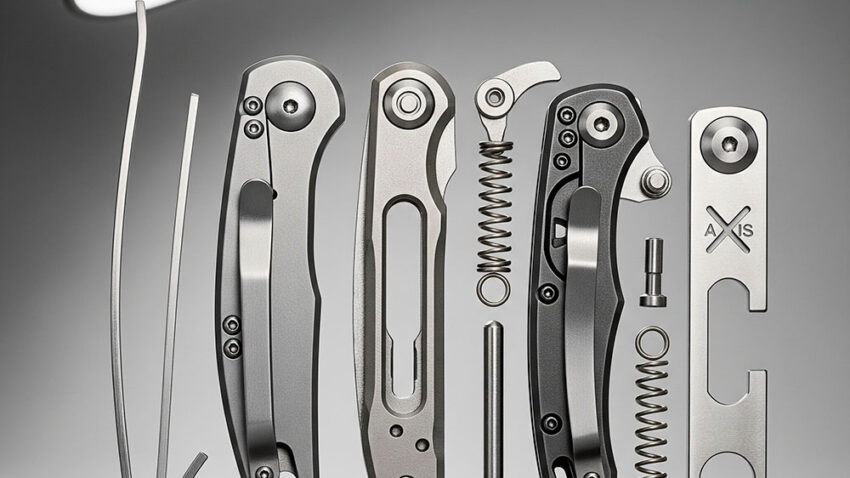
This system uses a thin metal liner, which is part of the handle’s lining, acting as a spring. When the blade is opened, this liner flexes and engages against the tang (base) of the blade, holding it firmly in position. To close the knife, simply push the liner to one side with your thumb, releasing the blade to fold it.
Key Points:
- Easy to use: Allows for simple one-handed operation, both for opening and closing.
- Slim design: Contributes to the knife being lightweight and comfortable to carry.
- Reliability: Widely adopted for its effectiveness.
Considerations:
Although it is easy to close with one hand, it is important to exercise caution to prevent fingers from crossing the blade’s path. Some users report that over time, a thin liner or poor initial adjustment can lead to slight deformation or play in the blade. However, if well-made and adjusted, it is very secure.
Frame Lock
The frame lock, also known as Reeve Integral Lock or RIL, is a robust evolution of the liner lock. It was introduced by Chris Reeve.
How does it work?
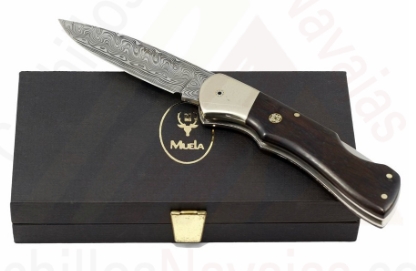
Unlike the liner lock, where an internal liner is responsible for the lock, the frame lock uses a portion of the knife’s handle frame itself to secure the blade. Generally made of strong materials such as steel or titanium, this section of the frame flexes and engages directly against the blade’s tang when opened, creating a solid lock. To unlock, this part of the frame is pressed to one side.
Key Points:
- Great strength: By using a thicker part of the frame, it is usually perceived as more robust than a liner lock.
- Integrated design: Fewer moving parts, which can contribute to greater durability.
- Ease of use: Can be easily closed with one hand, similar to the liner lock.
Considerations:
As with the liner lock, precision in manufacturing and adjustment is crucial for optimal performance. Some people prefer a more symmetrical aesthetic, which is sometimes affected by the asymmetrical design inherent in this lock.
Back Lock (or Lockback)
The back lock is one of the oldest and most reliable systems for folding knives.
How does it work?
This mechanism employs a spring-loaded bar or rocker that runs along the spine of the knife. When the blade is fully opened, a “tooth” at the end of this bar engages in a notch located at the top of the blade, securely locking it. To close the knife, the exposed part of the bar on the handle’s spine is pressed, which lifts the tooth and releases the blade.
Key Points:
- Very secure: Known for its reliability in keeping the blade fixed.
- Greater safety when closing: By pressing the handle’s spine, fingers are kept away from the blade’s path.
- Classic design: A traditional mechanism that has proven its effectiveness over time.
Considerations:
It usually requires the use of two hands to close safely. It is important to keep the mechanism clean, as dirt can affect its proper functioning and the strength of the lock. With prolonged use, small amounts of play may appear.
Crossbar Lock (AXIS Lock)
The crossbar lock, initially known by Benchmade as AXIS-Lock, is an innovative system highly valued for its fluidity and ambidextrous operation. After the original patent expired, many manufacturers have developed their own versions with different names (such as ABLE Lock, XR Lock, Clutch Lock, Pivot Lock, Dura Lock).
How does it work?
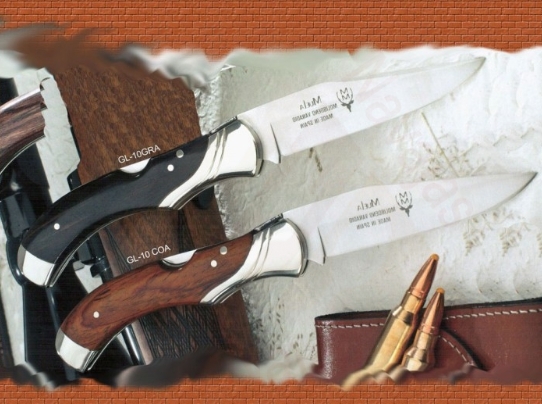
This mechanism uses a spring-loaded metal bar that extends through the knife’s handle, protruding from both sides. When the blade is open, this bar slides forward and engages in a notch at the base of the blade, firmly locking it. To release the lock, simply pull the bar back from one or both sides of the handle.
Key Points:
- Fully ambidextrous: Easy to operate with both hands, keeping fingers out of the blade’s path.
- Smooth operation: Provides very fluid and secure deployment and closing.
- Great strength: Offers a strong and reliable hold.
Button Lock (or Plunge Lock)
The button lock, also known as plunge lock, is a mechanism found in both manual and automatic knives.
How does it work?
This system uses a spring-loaded post or pin that protrudes from one side of the handle, forming the button. When the blade is opened, this post enters a notch to secure it. To release the lock, press the button, which retracts the post and allows the blade to close.
Key Points:
- Easy and quick to use: Allows for quick one-handed operation.
- Finger safety: Fingers do not cross the blade’s path when operating the lock.
- Ambidextrous: Usually easy to use for both right-handed and left-handed users.
Compression Lock®
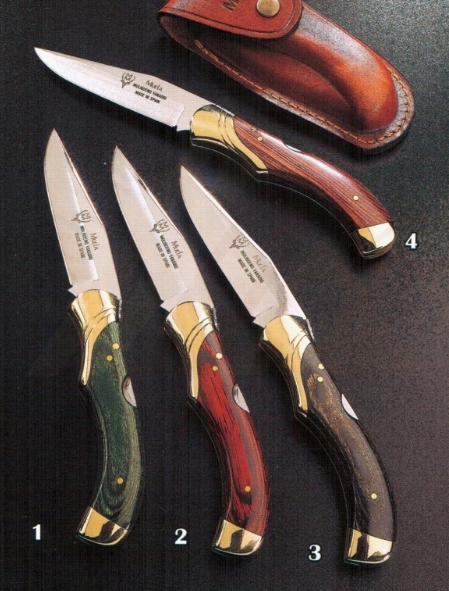
Invented and patented by Spyderco, the compression lock is similar to the liner lock, but offers superior locking strength and a safer release.
How does it work?
In this mechanism, a spring-loaded liner is positioned at the top of the handle, not inside. When the blade is opened, a small tab at the end of this liner engages in a notch in the blade, creating a locking force in multiple directions. The lock is released by a cutout on the spine of the handle or, occasionally, with a button that goes through the handle.
Key Points:
- Great locking strength: Considered a very secure mechanism and resistant to impacts and pressure.
- Safety when closing: Keeps fingers away from the blade’s path.
- Easy to use: Easily released with one hand.
Slide Lock
Slide locks are found almost exclusively on double-action Out-The-Front (OTF) automatic knives.
How does it work?
This system uses a sliding switch on the handle. A locking gate holds the blade in its open and closed positions via notches. By pushing the slider in the desired direction for the blade, a spring is compressed against the gate until a groove in the mechanism allows the gate to fold, releasing the spring tension and allowing the blade to extend or retract.
Key Points:
- Fast action: Allows for very quick and distinctive deployment and retraction.
- Security: Keeps the blade firmly in place both open and closed.
Slip Joint
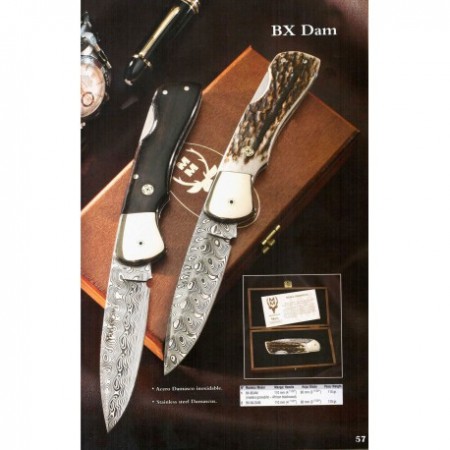
The slip joint is one of the most traditional and common mechanisms, especially in classic pocket knives. However, it is important to note that, unlike the previous ones, it is not a rigid lock in the strict sense, but rather uses friction to hold the blade in place.
How does it work?
Similar to a back lock, but without a positive lock, this system exerts pressure on the blade via a spring at the back of the handle. This tension provides resistance when closing the blade, acting as an obstacle to prevent accidental closure, but it does not immovably lock it.
Key Points:
- Great simplicity: Very easy to open and close.
- Greater legality: Often allowed in more places where knives with firm locks are restricted.
- Classic design: Popular for their traditional aesthetic.
Considerations:
Lower security: It does not offer the same level of security as rigid locking mechanisms, as the blade can close if enough pressure is applied. Therefore, it is not recommended for demanding tasks. It requires caution and proper handling techniques to reduce the risk of injury.
Other Notable Locking Systems
In addition to the most popular mechanisms, there are other innovations and variants worth knowing:
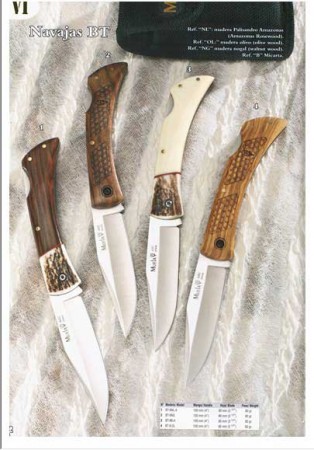
- Tri-Ad Lock: An improved and more robust version of the back lock, developed by Cold Steel. It incorporates a solid support over the blade that distributes the load and a larger, stronger spring that engages deeper into the blade’s notch, increasing its reliability.
- Virobloc (or Ringlock): Common in traditional knives, such as Opinel. A ring rotates around the blade’s pivot, securing its movement in both open and closed positions.
- Ball Bearing Lock: Similar in operation to the AXIS-lock, but uses ball bearings instead of a horizontal bar.
- Lever Lock: A system that uses a small lever on the handle to lock the blade. It allows for quick opening and is compact, ideal for space-saving designs.
- Mid Lock: Similar to the Back Lock, but the locking system is located in the middle of the handle, which allows it to withstand greater pressure.
- Notch Joint (or Notch Lock): A simple mechanism that uses a notch in the blade’s tang that engages with a tab or bar in the handle, creating friction and tension. It is not a positive lock and may be less secure.
- Stop Lock: Located at the back of the handle, it uses a stop pin that engages in a notch in the blade, acting as a stop and preventing accidental closure.
Choosing the Perfect Lock for You
As you have seen, each type of knife lock has its own characteristics and advantages. The “best” option does not exist universally; it depends entirely on your personal needs and the use you will give your knife. If you are looking for a knife for light tasks where legality is key, a slip joint might be ideal. For more demanding jobs that require robust security, a frame lock, a back lock, or a compression lock could be excellent options.
If you still don’t know which knife to choose, you can visit our section on knives with locks and find the one that best suits your needs. Additionally, if you are looking for a safe, reliable, and stylish tool, we invite you to explore our selection of knives at Cuchillos Navajas. Find the perfect lock for your adventures!