
You press down on the freshly baked loaf, and instead of an airy slice, you end up with a squashed mess and crumbs all over the countertop. If this scene sounds familiar, it’s likely your bread knife isn’t cutting like it used to. Many home cooks resignedly accept that wear and tear is normal, believing that serrated blades have a limited lifespan and there’s no real solution beyond buying a new one. This belief is a common misconception that we’re going to definitively debunk today.
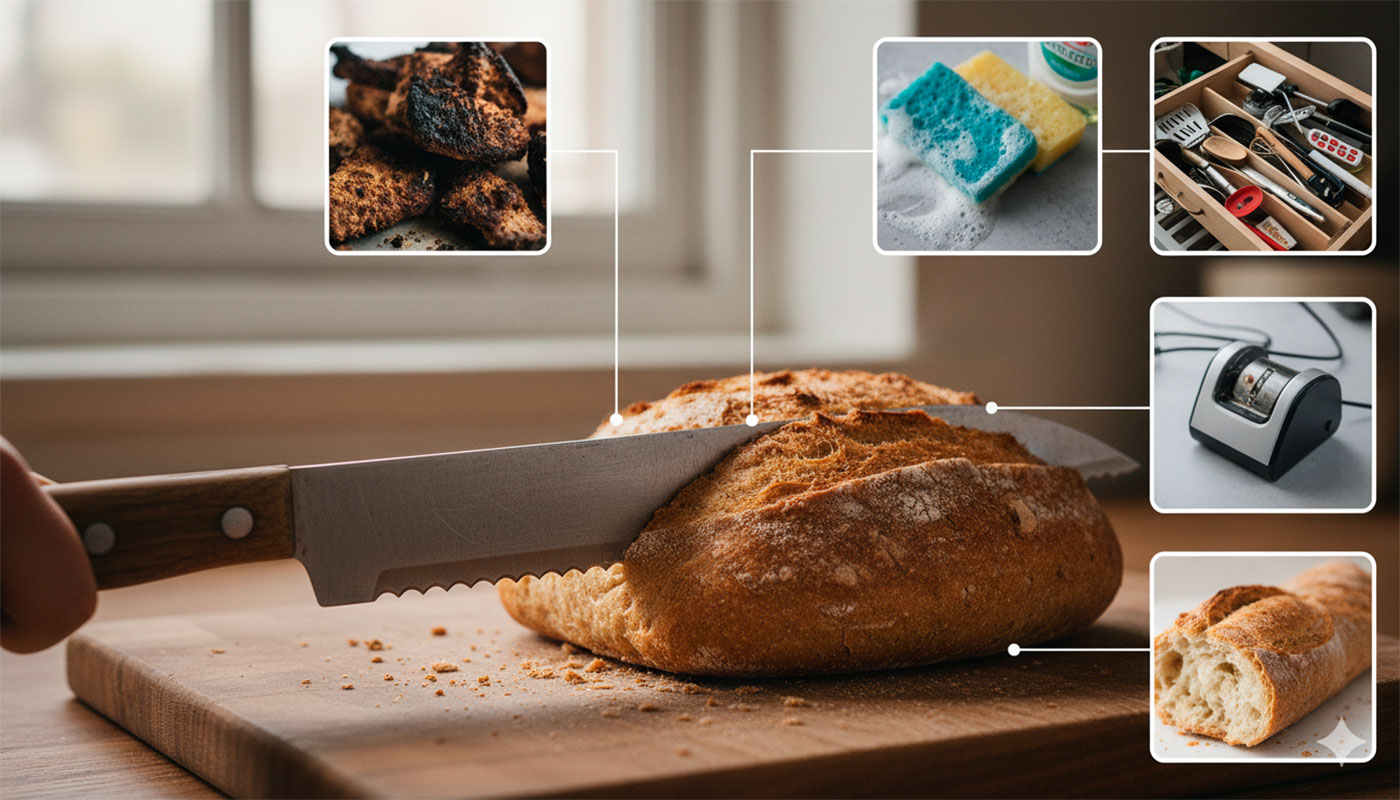
Contents
- Why isn’t your bread knife cutting anymore? The problem of frustrated users and the promise of quick solutions
- Reason 1: Wear from contact with cutting boards + Solution with ceramic honing steel
- Reasons 2 and 3: Incorrect use on hard surfaces and dishwasher washing + Immediate prevention
- Reasons 4 and 5: Lack of drying/maintenance and inadequate sharpening + Expert guide, errors, and next steps
- Cut cleanly: The essential knives for your kitchen
Why isn’t your bread knife cutting anymore? The problem of frustrated users and the promise of quick solutions
Frustration when facing a crispy crust with an inefficient tool ruins the culinary experience. There are five main technical reasons explaining this decline, from using unsuitable cutting boards to thermal shock in dishwashers. Bread knife maintenance is often omitted because people fear damaging the serration, but allowing it to remain dull only increases the danger of accidental slips.
Identifying why a dull bread knife behaves this way is the first step to regaining control. Throughout this guide, we will explore practical solutions that will allow you to regain the perfect edge. You will learn that you don’t need to be an expert to apply quick techniques that ensure clean cuts effortlessly. We are going to transform that forgotten tool into the most precise ally in your kitchen, demystifying the care of serrated blades so that every slice is impeccable and safe.
Reason 1: Wear from contact with cutting boards + Solution with ceramic honing steel
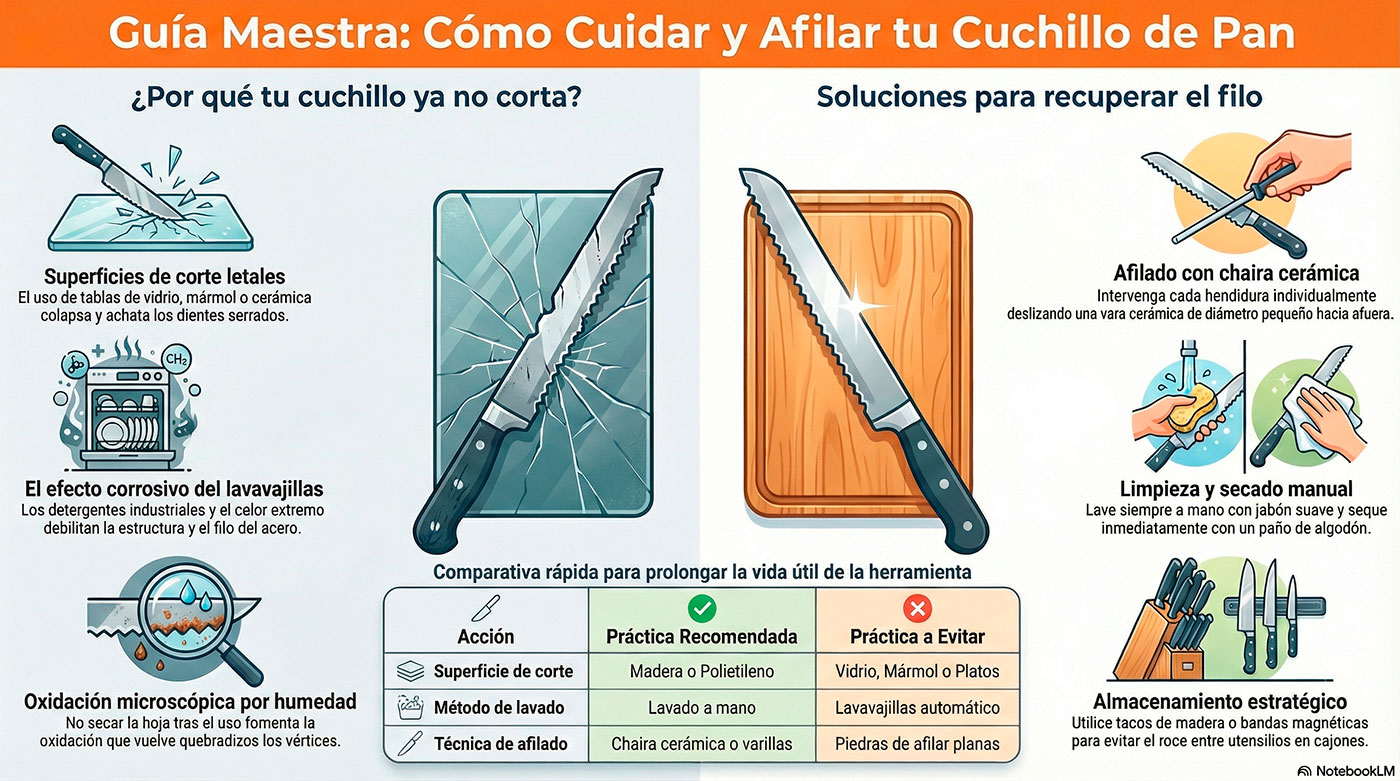
The most common reason a bread knife doesn’t cut is due to daily contact with the work surface. Every time the edge goes through the crust and hits the cutting board, the micro-teeth of the serrated blade undergo a dulling process. Although wooden or plastic boards are gentler than glass, repeated friction eventually rounds the tips of the teeth, preventing them from biting into the bread with the necessary aggressiveness.
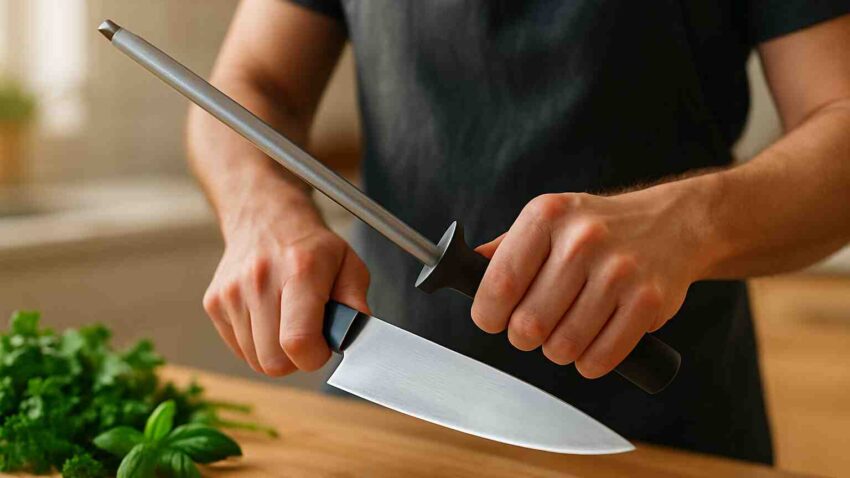 To reverse this situation, the most effective solution is the use of a small-diameter ceramic honing steel. Unlike smooth-bladed knives, sharpening a bread knife requires intervening in each individual indentation. The process is simple: position the honing steel against the bevel of one of the inner teeth and slide it outwards with light, steady pressure. It is crucial that the thickness of the tool matches the size of the waves on your knife to avoid deforming its original geometry.
Repeat this motion tooth by tooth along the entire blade. You don’t need to spend more than a few seconds on each section to notice an immediate improvement. When finished, gently pass the flat side of the blade over a stone or leather to remove any burr that may have remained on the opposite side. With this basic maintenance, you will achieve a professional result in a few minutes, restoring clean cutting ability without the need to invest in expensive tools or external technical services.
Reasons 2 and 3: Incorrect use on hard surfaces and dishwasher washing + Immediate prevention
Another critical reason your bread knife isn’t cutting is the use of excessively hard cutting surfaces. Using marble countertops, ceramic plates, or glass boards acts as a lethal abrasive for the blade’s teeth. Being stiffer materials than steel, they collapse the serrated edge upon first impact, flattening the tips that should tear through the crust. To avoid this, replace these surfaces with wooden or high-density polyethylene boards, which absorb impact and preserve the integrity of the metal for much longer.
In parallel, washing in a dishwasher constitutes a devastating maintenance error. Industrial detergents contain corrosive agents that attack stainless steel, while extreme heat cycles expand and contract the metal, weakening its structure. Furthermore, the movement of water causes the knife to collide with other metal utensils, nicking the delicate teeth of the serration. The inevitable result is a dull bread knife much sooner than expected from normal use.
Immediate prevention is the best strategy to keep your tools operational. Adopt the habit of washing your knives by hand using warm water, a mild soap, and a non-abrasive sponge. It is essential to meticulously dry them with a cotton cloth immediately after rinsing to prevent microscopic oxidation. By implementing these simple changes in your daily routine, you will stop premature deterioration and ensure that every cut into your loaves is fluid, precise, and completely frustration-free.
Reasons 4 and 5: Lack of drying/maintenance and inadequate sharpening + Expert guide, errors, and next steps
 Moisture accumulation is the fourth silent reason a bread knife stops cutting. Even in stainless steels, leaving the blade wet after use promotes microscopic oxidation, weakening the peaks of the serration. This oversight in bread knife maintenance compromises the metal’s stability, causing the teeth to become brittle. Drying the tool immediately with a dry cloth is vital to preserve its ability to penetrate hard crusts without the steel losing its essential mechanical properties.
Finally, inadequate sharpening constitutes the fifth cause of failure. Many users try to use conventional flat stones as if it were a chef’s knife, filing down the tips and destroying the serrated profile. To fix a dull bread knife, it is recommended to use specific sharpening systems, such as ceramic triangular rods or special profiling stones (Spyderco method). This allows you to work the concave angle of each tooth without altering the original shape of the blade.
If, after sharpening, you notice that the knife still doesn’t glide, verify that you have removed the burr on the flat side of the blade. A common mistake is not cleaning the excess metal accumulated after friction. To ensure a durable edge, store your knives in wooden blocks or magnetic strips, avoiding rubbing in messy drawers. By following these expert steps and avoiding careless storage, you will guarantee that your cutting equipment is always ready to face any type of loaf with professional precision.
Cut cleanly: The essential knives for your kitchen
You don’t need an arsenal of tools to cook like a professional, but rather the exact pieces. We analyze the essential knives that combine balance, durability, and impeccable cutting to transform your technique in the kitchen.


A good knife is an extension of a chef’s hand. Discover which models are truly worth the investment and how to identify that steel that will maintain its edge intact after years of intensive use.
Do you want to know the best bread knives? | More kitchen knives