
There are stories that can only be told on the cutting edge of experience, where every word cuts as deep as tempered steel. Tales forged in the embers of adventure, sharpened by years in the mountains and jungle, polished by the wisdom of those who have made nature their home. Manufacturas Muela, the legendary Spanish cutlery firm, has decided to give voice to these stories with its first official podcast: Will of Steel, a platform where knifemaking culture finds its most human, technical, and passionate narrative.
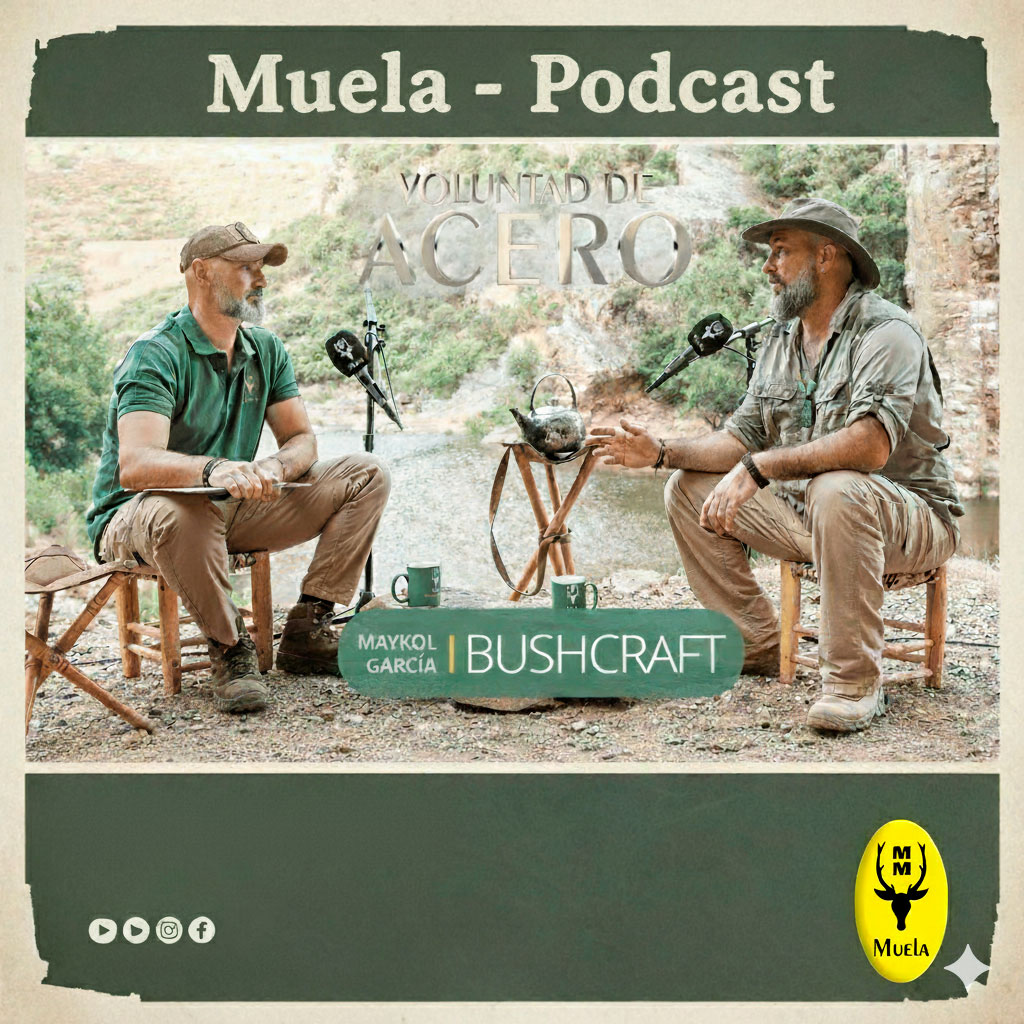
This project is not just another podcast about survival or bushcraft. It is the meeting point between the centuries-old craft of forging and the experiences of those who have made the knife an extension of their will. Each episode is a sonic expedition that transports you from the Amazon jungles to the Mediterranean mountains, from the blacksmith’s workshop to an improvised shelter in the middle of a storm. If you have ever wondered what stories each blade that comes out of Muela holds, this podcast is your answer.
The Birth of a Sonic Adventure: What is Will of Steel?
Contents
- The Birth of a Sonic Adventure: What is Will of Steel?
- Maykol García: The Legend Who Paves the Way
- María Moreno: Hunting Passion and Personal Strength
- Knives Forged in Experience: Maykol García’s Designs
- Philosophy of the Edge: What Makes a Good Bushcraft Knife
- Survival and Bushcraft Techniques in Will of Steel
- The Manatee Totem and the Spiritual Connection
- Rescues, Dangers, and Close Calls
- The Future of Will of Steel: More Stories, More Edge
- Knifemaking Culture as a Living Heritage
- Clarifying doubts about the Will of Steel podcast
Will of Steel is the official podcast of Manufacturas Muela, launched in September 2025 with a clear mission: to disseminate knifemaking culture and connect with the passion of its community. It is not a cold technical space nor a sonic product catalog. It is, in essence, a tribute to the people who live, breathe, and embody the values that Muela has defended for generations: resistance, precision, functionality, and respect for nature.
The podcast format is structured around in-depth interviews with influential people in the world of bushcraft, survival, hunting, and the knifemaking trade. Each episode is an adventure told by its true protagonists, without filters or prefabricated scripts. There is no room here for television falsehoods or impossible survival tricks. Only real stories, narrated in the first person, that show the genuine connection between human beings, tools, and the natural environment.
The podcast is presented by Pedro Romero, known on social media as petersniper_romero, who guides each conversation with the curiosity of an explorer and the respect of someone who knows the value of the trade. The audiovisual production is handled by professionals such as Alberto Sánchez and Daniel Catalina, guaranteeing technical quality that does justice to the depth of the shared stories.
Maykol García: The Legend Who Paves the Way
The first episode of Will of Steel could not have a more emblematic guest. Maykol García, considered a living legend of bushcraft and survival, is the protagonist who sets the tone of the podcast. With more than 25 years exploring mountains, sierras, deserts, and jungles, Maykol is not just a technical expert: he is an outdoor philosopher, a knife designer, and a natural communicator who has dedicated his life to understanding nature from its deepest roots.
Maykol’s relationship with Muela transcends the commercial. He has been collaborating closely for more than 12 years with the Muela family (Don Eladio, Eladio, and José María), whom he considers his own family. His first Muela knife was an olive wood Rino, acquired in Tenerife, a piece that marked the beginning of a connection that would lead to joint projects, events, and revolutionary designs.
From Agronomist to Jungle Dweller
Maykol studied Agronomic Engineering in animal production, but shortly before graduating, he discovered the world of survival, which would change his life forever. After obtaining his degree, he made the most radical decision of his career: to live for three years with aboriginal communities of the upper Orinoco River, deep in the Amazon jungles. He lived with tribes such as the Pemones, Hajibos, Amorúas, and especially with the Piaroa community, an experience he defines as his “master’s degree in survival”.
There he learned much more than fire-starting, shelter-building, or hunting techniques. He discovered the values of camaraderie, team trust, and the feeling of tribe. “Survival in natural environments depends on inner fire and social fabric,” says Maykol. He also experienced very difficult moments, such as funerals for children who died from diseases that in modern life would be cured with 4 or 5 euro pills. These experiences shaped his philosophy: nature is generous, but also relentless; the right tool and knowledge can make the difference between life and death.
The Valley of Alcudia and the Baltic Call
After his years in America, Maykol settled for more than 12 years in the Alcudia Valley, in Spain, which he considers the largest protected natural area in the country. This territory brings together three natural parks: Cardeña and Montoro, Serranía de Andújar, and Valle Alcudia and Sierra Madrona. A space that embodies his favorite environment: the Mediterranean mountain, with its mix of aridity, resilient vegetation, and adapted fauna.
However, love took him even further. He is currently based in Lithuania, on the border with Russia, with his “Baltic warrior.” This move has not stopped his passion or his message: to continue communicating, teaching, and enjoying outdoor life, regardless of latitude.
María Moreno: Hunting Passion and Personal Strength
The podcast Will of Steel has also opened its microphones to other inspiring voices, such as that of María Moreno, a woman passionate about hunting since childhood. Her story is a testament to overcoming challenges and personal strength, reflecting the deep emotional bond that many people have with nature and hunting activities.
María represents the growing female presence in the world of hunting and bushcraft, a traditionally masculine field that is increasingly enriched with diverse perspectives. Her participation in the podcast underscores Muela’s commitment to humanizing the brand, showing that behind every knife there are real people with stories of effort, resilience, and passion.
Knives Forged in Experience: Maykol García’s Designs
Maykol García is not just a Muela knife user: he is a designer who has brought technical and functional innovations to the brand’s range. His creations are born from real need, from extreme use in adverse conditions, and from a deep understanding of what it means to work with a blade in the wild.
The Aborigen Knife: Extreme Functionality
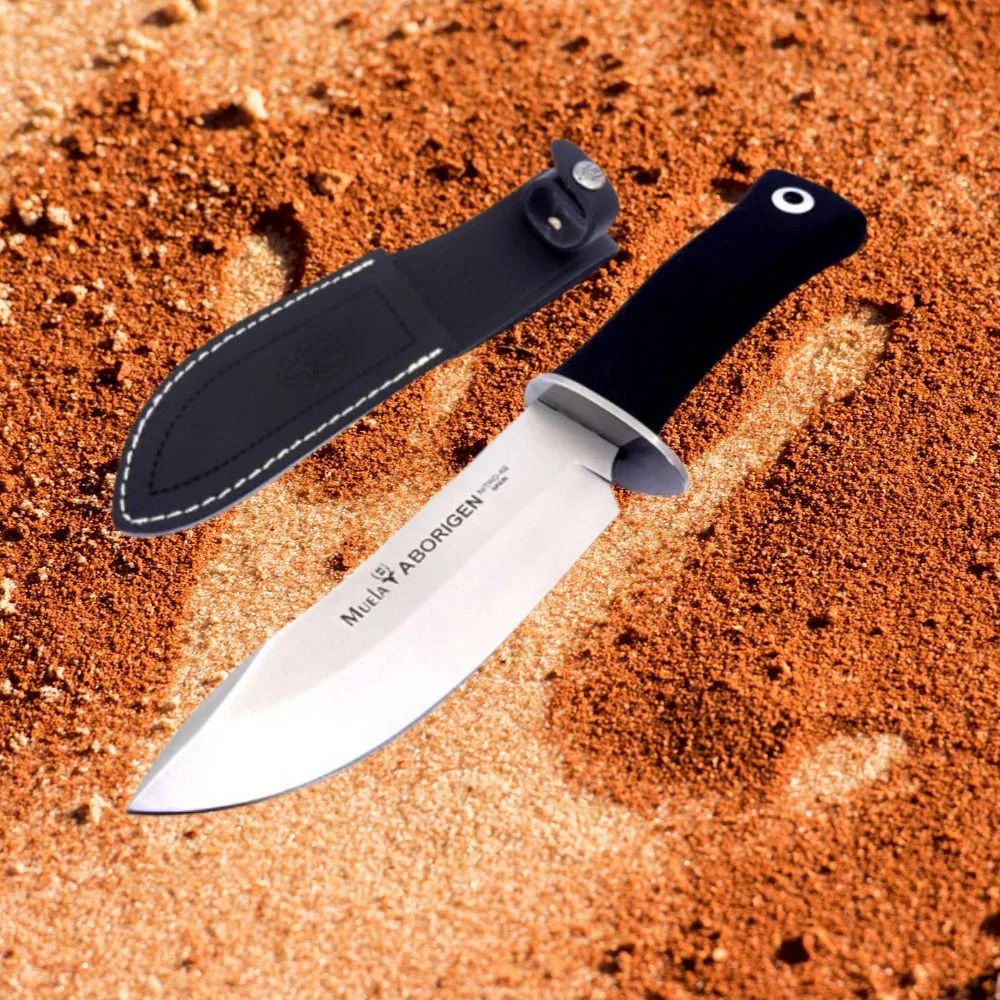 His most emblematic design is the Muela Aborigen, a knife currently sold in almost 50 countries that originated from modifications he himself requested on a rough prototype created by blacksmith Juan David. Subsequently, it was technified at the Muela plant until it met the quality standards that define it today.
The Aborigen is the synthesis of Maykol’s philosophy on what a bushcraft knife should be. Its essential characteristics are:
- Full tang construction: Made from a single piece of metal, ensuring maximum structural strength.
- Finger choil: Allows the index finger to be inserted for fine work or wood carving with surgical precision.
- Forward weight: Facilitates controlled striking and batoning (a technique for splitting wood by striking the spine of the knife).
- Wide blade: Provides versatility for multiple tasks.
- Multiple grip points: Allows working with different muscle groups (shoulder blades, triceps) depending on the task.
The Aborigen is inspired by other classic Muela models that Maykol admired: the Gavilán, the Rino (his personal favorite), and the Codiac, from which he took the geometry of the edge. The result is a tool that is not a weapon, but an extension of the bushcrafter’s body, designed to last generations.
The Viking Line and the Pecarí
In addition to the Aborigen, Maykol designed the Viking line (M and J models), more oriented towards woodcraft (woodworking). He also participated in the creation of the Pecarí, a reframing of the popular Colibrí model. Each of these designs responds to specific needs of the advanced user, incorporating technical details that only someone who has spent thousands of hours in the wilderness can identify.
Philosophy of the Edge: What Makes a Good Bushcraft Knife
According to Maykol García, the worst knife is one that doesn’t cut. Losing an edge forces excessive and disordered effort, which inevitably causes accidents. A good knife must maintain its edge, allow for easy field sharpening, and be robust enough to withstand batoning, carving, and food processing tasks.
But beyond technical specifications, Maykol advocates for prior training before acquiring an expensive knife. “The best knife is not the most expensive, but the one you have on hand when you need it most,” he asserts. This philosophy demystifies premium steel fetishism and returns the spotlight to the user’s skill, knowledge, and preparation.
Dangerous Designs: Fantasy that Kills
Maykol also warns about “fantasy” knives that try to be both a weapon and a utilitarian tool, ultimately detracting from both roles. He clearly recalls an accident he suffered with a knife that had a saw and an edge on the spine: while batoning, he cut himself due to that inadequate geometry. Effective designs are simple, functional, and respond to ergonomic principles proven over centuries of use.
Survival and Bushcraft Techniques in Will of Steel
Throughout the episodes of Will of Steel, a range of techniques, strategies, and philosophies about life in nature are unfolded. From friction fire-starting to navigation without a compass, through the selection of wild foods and shelter building. But the difference between survivalism, bushcraft, and preparedness is also addressed, three currents that are often confused but have distinct approaches.
Bushcraft vs. Survival: A Fundamental Distinction
Bushcraft is the art of living comfortably in nature through traditional knowledge and skills. It involves woodworking, plant knowledge, fire mastery, and building durable shelters. The emphasis is on long-term self-sufficiency and enjoying the environment.
Survival, on the other hand, is reactive: it’s activated when something goes wrong and the goal is to get out of the critical situation as quickly as possible. Here, speed, improvisation, and stress management are paramount.
Preparedness focuses on anticipating crisis scenarios (natural disasters, social collapses) and accumulating resources and knowledge to deal with them.
Maykol García moves between these three worlds, but his heart belongs to bushcraft: the deep, respectful, and lasting connection with nature.
Food in the Mountains: From Turtle to Tapir
Regarding wild foraging, Maykol has clear preferences. His favorite meat is venison (deer), while the most unpleasant he has tasted is tapir, whose flavor resembles liver. In pure survival situations, his first objective would be to catch a turtle (galápago): easy to catch, high protein content, and abundant meat.
He also shares anecdotes about unexpected help: while in Venezuela with critical thirst, he came to drink water from a deep bovine footprint in the mud. It’s not glamorous, but it kept him alive until he found a source. These real experiences brutally contrast with televised survival tips, which often distort elements to gain spectacularity.
Hardship and Resilience: The School of the Wild
Maykol has spent more time not speaking (due to solo expeditions) than not showering. In Africa, he went at least a week without showering; in El Hierro, during a 30-day expedition, he wore the same clothes all month (he could only wash them after 12 days) and only showered when it rained. These deprivations are not a boast, but a demonstration of adaptability and that modern hygiene, while desirable, is not essential for survival.
The most useless item he has seen in an expedition backpack was a bottle of perfume (specifically Nenuco). His rule is clear: every item in the backpack must have two or more uses. Dead weight has no place when every gram counts.
The Manatee Totem and the Spiritual Connection
During his stay with the Piaroa community, a shaman assigned Maykol an animal totem: the manatee. This aquatic mammal, which lives at the boundary between land and water, enjoys two worlds, has no natural enemies, and is colonized by algae that integrate it into the ecosystem. The shaman saw in Maykol that same duality: a man who traverses between civilization and wild nature, who adapts to multiple environments, and who lives in harmony with his surroundings.
This spiritual connection with the natural world is one of the pillars of authentic bushcraft. It is not just about mastering techniques, but about understanding your place in the ecosystem, respecting balance, and moving with humility and gratitude.
Rescues, Dangers, and Close Calls
Maykol has saved lives and has also been saved. He rescued a young man from hypothermia (caused by improper alcohol use) in the Gerte Valley. He also revived a girl in the Hoces del Cabriel who was trapped under a tree while trying to save her dog. But he has also needed help: his friend Ángel saved his life in the Cabriel River after a backwash sucked him in while kayaking, emerging from the water almost unconscious.
These episodes reinforce a fundamental truth: in nature, your expedition partner can make the difference between life and death. That’s why Maykol is inflexible about the characteristics of the worst companion: distrust, low resilience, and constant complaining (“How much longer?”, “my feet hurt”). A companion must trust the decisions made at the moment, even if they are discussed later, when the adrenaline subsides and reason regains control.
Fear of Animals? No: Fear of Christmas Dinners
With his characteristic sense of humor, Maykol confesses that he fears a Christmas dinner more than a wild animal. The animal that inspires him the most respect is not the jaguar or the snake, but the mosquito, a vector of malaria and hemorrhagic dengue. This realistic perspective unmasks media sensationalism: in nature, the true dangers are not always the most obvious.
He also recounts that he once had to draw his knife (without completely removing it from his belt) to show it to a threatening person, demonstrating that he could defend himself. This happened outside of Spain, in a context where the tool temporarily became a deterrent. But he insists: a knife is a great tool, not a weapon. Its primary function is work, not combat.
The Future of Will of Steel: More Stories, More Edge
The Will of Steel podcast is growing rapidly. Following the initial episodes with Maykol García and María Moreno, new installments are expected with hunters, artisans, mountain guides, blacksmiths, and adventurers who embody the values of the Muela brand. Each episode is an opportunity to delve into a different aspect of knifemaking culture: from the chemistry of steels to regional knife traditions, from sustainable hunting to polar expeditions.
Maykol, for example, has invited Pedro Romero and the entire Muela team to circumnavigate Lake Alqueva, the largest in Western Europe. This would involve covering 1700 km in winter (January), sleeping in good conditions (sleeping bag, mat, well-pitched tarp), in an expedition estimated to last about 30 days. Projects like this demonstrate that Will of Steel is not just a studio podcast: it is a platform that can go out into the field, document real adventures, and transmit the emotion of the outdoors in real time.
Knifemaking Culture as a Living Heritage
 Through Will of Steel, Manufacturas Muela not only sells knives: it transmits a legacy. Each episode is a reminder that behind every blade there are centuries of metallurgical knowledge, ergonomic design, and field testing. That a knife is not a disposable object, but a tool that can accompany you throughout your life if you care for and respect it.
The podcast also highlights the figure of the artisan, the blacksmith, the designer who listens to the end-user and adjusts millimeter by millimeter until the perfect piece is achieved. In a world dominated by mass production and planned obsolescence, Muela champions durability, repairability, and timeless functionality.
Message for New Generations
Maykol García has a clear message for new generations: reconnection with nature and passion for what you do. “Feel happy when Monday starts,” he says. It’s not about rejecting modernity, but about recovering ancestral skills, understanding that technology is a tool, not a substitute for knowledge.
If he had to leave a message engraved on a knife to be discovered in 50 years, it would be: “Subsistence, the art of life in nature”. A statement that summarizes his philosophy and encapsulates the spirit of Will of Steel: live with less, enjoy more, and leave a mark only on people, not on the ecosystem.
Clarifying doubts about the Will of Steel podcast
What specific topics does the Will of Steel podcast address?
The “Will of Steel” podcast addresses topics related to inspiring stories that highlight the value of steel, but primarily focuses on interviews with people who have overcome significant challenges in their lives. These stories explore how individuals have demonstrated an iron will and formidable strength to overcome obstacles, which may include aspects of inspiration, motivation, and commitment to achieving goals despite adversity. It also delves into bushcraft techniques, survival, hunting, and the intimate relationship between humans and their tools.
How has the reception of the Will of Steel podcast been so far?
The reception of the Will of Steel podcast has been positive, standing out for offering inspiring interviews and conversations that highlight steel and the human stories behind cutlery, according to the official launch reported. However, there is no specific data or public audience metrics in the current results that quantify its success or popularity in concrete numbers or rankings so far. This suggests that it is a project in development or with still-growing dissemination, without a prominent presence in massive lists of the most listened-to podcasts in the region.
What guests have participated in the Will of Steel podcast?
The Will of Steel podcast has featured prominent guests from the world of bushcraft, survival, and hunting, such as Maykol García, considered a living legend of bushcraft with over 25 years of experience and designer of several Muela knife models, and María Moreno, a passionate hunter who represents the growing female presence in these fields. More guests related to knifemaking culture, nature, and outdoor adventures are expected in upcoming episodes.
What survival and bushcraft techniques are mentioned in the podcast?
The survival and bushcraft techniques mentioned in the podcast episodes include:
| Technique/Area | Description | Practical application |
|---|---|---|
| Batoning | Splitting wood by striking the spine of the knife | Obtaining dry firewood, preparing kindling for fire |
| Shelter building | Using tarps, branches, and natural elements | Protection against weather during long expeditions |
| Wild foraging | Identifying and catching edible fauna | Subsistence in emergency or expedition situations |
| Water management | Location, purification, and conservation | Safe hydration in remote environments |
| Natural navigation | Orientation without compass or GPS | Safe travel in unknown territory |
- Batoning
-
- Description: Splitting wood by striking the spine of the knife
- Practical application: Obtaining dry firewood, preparing kindling for fire
- Shelter building
-
- Description: Using tarps, branches, and natural elements
- Practical application: Protection against weather during long expeditions
- Wild foraging
-
- Description: Identifying and catching edible fauna
- Practical application: Subsistence in emergency or expedition situations
- Water management
-
- Description: Location, purification, and conservation
- Practical application: Safe hydration in remote environments
- Natural navigation
-
- Description: Orientation without compass or GPS
- Practical application: Safe travel in unknown territory
In addition, defense strategies, the difference between survivalism, bushcraft, and preparedness are discussed, highlighting training in self-sufficiency techniques, the importance of the human team, and mental resilience in adverse situations.
How is the Will of Steel podcast related to knifemaking culture?
The Will of Steel podcast is directly related to knifemaking culture because it is produced by Manufacturas Muela, a recognized company in the field of cutlery and hunting tools. Through interviews and stories, the podcast explores the lives of people closely involved in the world of hunting, survival, and their relationship with nature, areas where the knife is a fundamental tool and, in many cases, a cultural symbol. Their guests often share personal experiences, knowledge, and challenges linked to these activities, highlighting skill, strength, and respect for the natural environment, aspects that characterize and define knifemaking culture.
Each episode of the podcast is an invitation to look beyond the steel and discover the hands that forge it, the stories that accompany it, and the adventures that put it to the test. Will of Steel is not just a communication project: it is a manifesto about what it means to live with purpose, equip yourself with wisdom, and face every challenge with the same determination that a blacksmith shapes red-hot metal. If you have ever felt the call of the wild, if you have held a knife and understood that it is much more than a tool, this podcast speaks your language. Because there are stories that can only be told on the cutting edge of experience, and Muela has decided it’s time for the world to hear them.